Loading...
Augustus II the Strong vs John III of Sweden
Augustus II the Strong leads by 3.4 pts · 2 figures compared
…
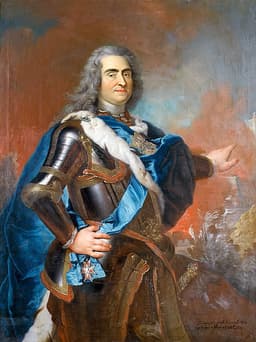
Augustus II the Strong
Emperor · Modern
54.8Total
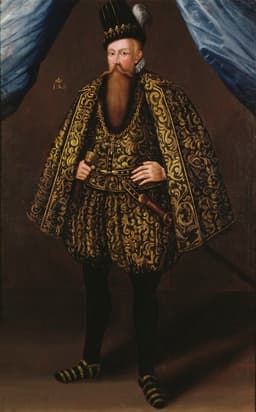
John III of Sweden
Emperor · Modern
51.4Total
Basic Information
Born
1670
1537
Died
1733
1592
Era
Modern
Modern
Nationality
Poland
Sweden
Occupation
Emperor
Emperor
Civilization
Western
Western
Score Comparison
Military (10%)
25.0
50.0
Political (20%)
72.0
68.0
Influence (20%)
58.0
53.3
Legacy (20%)
46.7
44.2
Leadership (15%)
62.0
53.2
Strategy (15%)
60.0
38.3
TOTAL
54.8
51.4
Augustus II the Strong — Complete Timeline
1697 AD
Election as King of PolandPolitical Action◆ Major
Augustus II was elected King of Poland and Grand Duke of Lithuania after converting to Catholicism. His election was supported by Russia and Austria, marking the beginning of his reign over the Polish-Lithuanian Commonwealth.
ElectionPolish-Lithuanian CommonwealthConversion
Impact: regional
Establishment of the Saxon-Polish UnionPolitical Action◆ Major
Augustus II created a personal union between Saxony and Poland, ruling both territories. This union lasted intermittently until 1763, linking the German electorate with the Polish-Lithuanian Commonwealth.
Personal UnionSaxonyPoland
Impact: regional
1700 AD
Alliance with Russia in the Great Northern WarWar◆ Major
Augustus II allied with Peter the Great of Russia and Frederick IV of Denmark against Sweden. This alliance initiated the Great Northern War, aiming to reduce Swedish dominance in the Baltic region.
Great Northern WarAllianceSweden
Impact: regional
1706 AD
Deposition from the Polish ThronePolitical Action◆ Major
Following Swedish King Charles XII's invasion of Poland, Augustus II was deposed by the Swedish-backed Stanis
DepositionTreaty of AltranstädtSwedish Invasion
Impact: regionaltragic
1709 AD
Restoration to the Polish ThronePolitical Action◆ Major
After the Swedish defeat at the Battle of Poltava, Augustus II was restored as King of Poland with Russian support. He returned to power but with diminished authority, effectively becoming a Russian client.
RestorationRussian InfluencePoltava
Impact: regional
John III of Sweden — Complete Timeline
1569 AD
Coronation of John IIIPolitical Action◆ Major
John III was crowned King of Sweden after deposing his half-brother Eric XIV. His reign focused on religious reconciliation and cultural patronage, including the introduction of the Red Book liturgy.
CoronationSuccession
Impact: national
Imprisonment of Eric XIVPolitical Action
John III ordered the continued imprisonment of his deposed half-brother Eric XIV, who was held at various castles until his death in 1577. This secured John's throne but created a lasting stain on his reign.
ImprisonmentDynastic Conflict
Impact: nationaldestructive
1570 AD
War against Russia (Livonian War)War◆ Major
John III continued Sweden's involvement in the Livonian War against Russia, seeking control over Estonia and Livonia. The war ended inconclusively in 1583 with the Treaty of Plussa, ceding some territories to Sweden.
Livonian WarRussiaTerritorial Conflict
Impact: regional
1574 AD
Establishment of the Swedish Jesuit MissionPolitical Action
John III invited Jesuit priests to Sweden to promote Catholic-Lutheran dialogue and secretly negotiated with the Papacy about a possible reunion. The mission failed due to Protestant opposition and the Jesuits' expulsion in 1580.
JesuitsCatholicismReligious Diplomacy
Impact: national
1576 AD
Promulgation of the Red BookCultural◆ Major
John III issued the Red Book (Liturgy of 1576), a new church liturgy that incorporated Catholic elements into Lutheran worship. This attempt to reconcile Catholicism and Lutheranism caused conflict with the Swedish clergy and nobility.
LiturgyReligious ReformCatholic-Lutheran
Impact: national
Expert Analysis
Origins
Augustus II the Strong (1670–1733) was born in Dresden as Friedrich August I, Elector of Saxony. He inherited a prosperous German state and was known for his physical strength—he could bend horseshoes with his bare hands. His father, John George III, was a capable ruler, and Augustus received a thorough education in politics and military affairs. In 1694, he became Elector of Saxony and soon set his sights on the Polish throne, which required conversion to Catholicism from Lutheranism.
John III of Sweden (1537–1592) was born in Stockholm as the second son of King Gustav Vasa. His mother was Margaret Leijonhufvud, a Swedish noblewoman. John was educated in theology and languages, and he developed a keen interest in religious matters. He served as Duke of Finland from 1556, where he gained administrative experience and built a power base. Unlike Augustus, John's path to kingship was marked by family conflict, as he deposed his mentally unstable half-brother Eric XIV in 1568.
Rise to Power
Augustus II secured the Polish throne in 1697 after converting to Catholicism, a move that alienated his Lutheran Saxon subjects but won him support from the Polish nobility and the Habsburgs. His election was backed by Russia and Austria, who saw him as a counterbalance to Swedish influence. In 1700, he formed the anti-Swedish coalition with Peter the Great of Russia and Frederick IV of Denmark, initiating the Great Northern War. However, his early military campaigns were disastrous; he scored only 25.0 in military aptitude, reflecting his poor generalship.
John III rose to power by deposing his brother Eric XIV in 1568, after Eric had imprisoned John for suspected treason. John's coronation in 1569 was the result of a noble rebellion against Eric's erratic rule. John promised to uphold the Lutheran faith but also pursued religious reconciliation with Catholicism, a stance that defined his reign. He scored 68.0 in political acumen, slightly lower than Augustus's 72.0, but he was more cautious in foreign policy.
Leadership & Governance
Augustus II ruled Saxony and Poland in a personal union, but he prioritized Saxon interests over Polish ones, leading to resentment. He attempted to centralize power in Poland but faced opposition from the nobility and the Sejm (parliament). His lavish court and patronage of the arts drained state finances. In contrast, John III focused on religious reform: in 1576, he issued the Red Book, a new liturgy that reintroduced Catholic elements into Swedish Lutheranism. This sparked conflict with the clergy and nobility, who saw it as a betrayal of the Reformation. John also invited Jesuits to Sweden and secretly negotiated with the Papacy, but his efforts failed to achieve reunion. John's score of 53.2 in leadership reflects his divisive approach.
Triumph & Tragedy
Augustus II's greatest triumph was the establishment of the Saxon-Polish union, which lasted intermittently until 1763. He also oversaw a cultural flourishing in Dresden, building the Zwinger palace and amassing art collections. However, his military failures in the Great Northern War led to his deposition in 1706 by Charles XII of Sweden. He was restored in 1709 after the Swedish defeat at Poltava, but his power was severely diminished, and Poland became a Russian satellite. His score of 58.0 in influence reflects his mixed success.
John III's triumph was his cultural patronage, including the construction of Uppsala Castle and the development of the Swedish navy. He also secured a peace with Russia in 1583, ending the Livonian War with modest gains. His tragedy was the failure of his religious policy: the Red Book was abolished after his death, and his attempts at Catholic-Lutheran reconciliation were rejected. He died isolated, with his son Sigismund III Vasa inheriting both Sweden and Poland but losing the Swedish throne due to his Catholicism. John's legacy score of 44.2 is the lowest among the two.
Character & Destiny
Augustus II was extravagant, ambitious, and physically powerful, but politically reckless. His obsession with the Polish crown led him to make costly alliances and conversions. He fathered an estimated 300 children, but only one legitimate heir, which weakened the dynasty. His character earned him the nickname "the Strong," but his governance was often weak.
John III was scholarly, stubborn, and idealistic. His religious vision was ahead of its time, but he lacked the political skill to implement it. He alienated both Lutherans and Catholics, and his imprisonment of Eric XIV (who died in 1577) cast a shadow over his reign. Historians view him as a transitional figure who failed to bridge the Reformation divide.
Legacy
Augustus II left a mixed legacy: he strengthened Saxony's cultural prestige but weakened Poland, contributing to its eventual partitions. The Saxon-Polish union is remembered as a period of decadence and foreign domination. His total score of 54.8 reflects his moderate overall impact.
John III's legacy is tied to his religious experiments, which are studied as an early ecumenical attempt. He also strengthened the Swedish monarchy's independence from the church, though his son's reign led to a Catholic backlash. His total score of 51.4 ranks him slightly below Augustus.
Conclusion
While both rulers had significant flaws, Augustus II the Strong had a greater impact due to his role in the Great Northern War and the Saxon-Polish union, which shaped Eastern European politics for decades. His political score (72.0) and influence score (58.0) exceed John's (68.0 and 53.3), and his total score of 54.8 is 3.4 points higher. John III's religious ambitions were admirable but ultimately ineffective. Augustus's legacy, though tarnished, altered the balance of power in the region, whereas John's reforms were quickly reversed. Therefore, Augustus II the Strong stands as the more consequential monarch.
Rankings
🥇
Augustus II the StrongLeader
Mil: 25.0Pol: 72.0Inf: 58.0
54.8
🥈
John III of Sweden
Mil: 50.0Pol: 68.0Inf: 53.3
51.4
+3.4 behind
How This Comparison Works
Algorithm
Each figure is scored on 6 dimensions (0—100 scale) based on structured historical data: Military (10%), Political (20%), Influence (20%), Legacy (20%), Leadership (15%), Strategy (15%). The weighted total produces the final ranking.
Data Sources
Scores are computed from structured sub-indicators in the database. Scale factors adjust for era (Ancient ×0.85, Modern ×1.0) and civilization size (Eastern ×1.05, Other ×0.80) to account for differences in population and military scale.
Maximum 3 Figures
Comparisons are limited to 2—3 figures to ensure readability and statistical meaningfulness.
Error Margins
±5 points per dimension — Sub-scores are derived from historical records with inherent uncertainty. Two figures within 5 points on a dimension should be considered roughly equivalent in that area.
Total Score Accuracy
±3 points overall — The weighted combination of 6 dimensions produces a total score with approximately ±3 points of uncertainty. Differences of less than 3 points are not statistically significant— the figures are effectively tied.
Known Limitations
- Historical records are incomplete and uneven across civilizations
- Figures from oral-tradition societies may be underrepresented
- Occupation labels can misclassify multi-role figures
- Scores measure capability and impact, not moral character
- Quantitative scoring is a comparison tool, not absolute truth
Capability Radar
Military (10%) — Battles & Warfare
Battles
40
20
Win Rate
30
25
Expansion
35
15
Political (20%) — Governance & Reform
Reform
50
55
Diplomacy
55
50
Economy
50
45
Influence (20%) — Cultural & Global Reach
Cultural
55
40
Global
45
20
Legacy (20%) — Historical Impact
Historical
50
45
Longevity
40
30
Leadership (15%) — Power & Stability
Tenure
60
60
Stability
30
40
Strategy (15%) — Tactics & Innovation
Strategy
40
20
Tactics
35
15
Reform
45
30
Similar Comparisons
Comments & Discussion
No comments yet. Be the first to share your thoughts!