Loading...
This comparison has not been analyzed yet.
One-time AI generation (~1 minute). Scores and timeline are already available below.
Atahualpa vs El Kulug Shad
Atahualpa leads by 6.4 pts · 2 figures compared
…
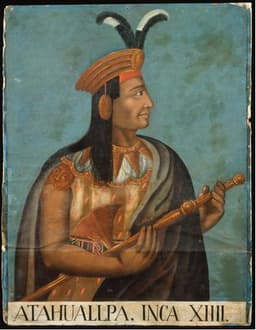
Atahualpa
Emperor · Medieval
44.5Total
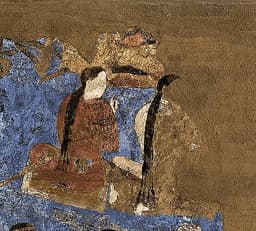
El Kulug Shad
Emperor · Medieval
38.1Total
Basic Information
Born
1502
620
Died
1533
645
Era
Medieval
Medieval
Nationality
Inca Empire
Western Turkic Khaganate
Occupation
Emperor
Emperor
Civilization
Other
Eastern
Score Comparison
Military (10%)
46.7
22.6
Political (20%)
27.9
33.6
Influence (20%)
57.2
45.5
Legacy (20%)
46.7
35.8
Leadership (15%)
39.0
49.9
Strategy (15%)
38.3
30.3
TOTAL
44.5
38.1
Atahualpa — Complete Timeline
1532 AD
Victory in the Inca Civil WarWar◆ Major
Atahualpa defeated his brother Hu
Civil WarSuccessionInca Empire
Impact: regionaldestructive
Capture at CajamarcaWar
Francisco Pizarro ambushed Atahualpa at Cajamarca, capturing the Inca emperor after a surprise attack. Spanish forces killed thousands of unarmed Inca attendants while Atahualpa was taken prisoner, marking the beginning of Spanish conquest.
Spanish ConquestAmbushPizarro
Impact: globaltragic
1533 AD
Ransom Room PaymentPolitical Action◆ Major
Atahualpa offered to fill a room with gold and silver in exchange for his release. Over several months, the Inca delivered approximately 6 tons of gold and 12 tons of silver, the largest ransom in history, but Pizarro executed him anyway.
RansomGoldSpanish Greed
Impact: regionaltragic
Execution by GarrotePolitical Action
Pizarro ordered Atahualpa's execution by garrote after a mock trial accused him of treason, idolatry, and ordering Hu
ExecutionSpanish ConquestEnd of Empire
Impact: globaltragic
El Kulug Shad — Complete Timeline
640 AD
Rebellion against Tang ChinaWar◆ Major
El Kulug Shad, a Western Turkic prince, led a rebellion against Tang Chinese control over the Western Turkic Khaganate. He allied with the Xueyantuo and other tribes to resist Tang expansion into the Tarim Basin.
RebellionTang DynastyWestern Turkic Khaganate
Impact: regionaldestructive
644 AD
Battle of KarasahrWar◆ Major
El Kulug Shad fought against Tang forces at the Battle of Karasahr in the Tarim Basin. He was defeated by the Tang general Guo Xiaoke, leading to the loss of the city and weakening his position.
BattleTang DynastyTarim Basin
Impact: regionaldestructive
645 AD
Death in battleWar◆ Major
El Kulug Shad was killed in battle against Tang forces. His death ended the major Turkic resistance in the Western Regions, allowing Tang China to consolidate control over the Silk Road and the Tarim Basin.
DeathBattleTang Dynasty
Impact: regionaltragic
This comparison has not been analyzed yet.
One-time AI generation (~1 minute). Scores and timeline are already available below.
Rankings
🥇
AtahualpaLeader
Mil: 46.7Pol: 27.9Inf: 57.2
44.5
🥈
El Kulug Shad
Mil: 22.6Pol: 33.6Inf: 45.5
38.1
+6.4 behind
How This Comparison Works
Algorithm
Each figure is scored on 6 dimensions (0—100 scale) based on structured historical data: Military (10%), Political (20%), Influence (20%), Legacy (20%), Leadership (15%), Strategy (15%). The weighted total produces the final ranking.
Data Sources
Scores are computed from structured sub-indicators in the database. Scale factors adjust for era (Ancient ×0.85, Modern ×1.0) and civilization size (Eastern ×1.05, Other ×0.80) to account for differences in population and military scale.
Maximum 3 Figures
Comparisons are limited to 2—3 figures to ensure readability and statistical meaningfulness.
Error Margins
±5 points per dimension — Sub-scores are derived from historical records with inherent uncertainty. Two figures within 5 points on a dimension should be considered roughly equivalent in that area.
Total Score Accuracy
±3 points overall — The weighted combination of 6 dimensions produces a total score with approximately ±3 points of uncertainty. Differences of less than 3 points are not statistically significant— the figures are effectively tied.
Known Limitations
- Historical records are incomplete and uneven across civilizations
- Figures from oral-tradition societies may be underrepresented
- Occupation labels can misclassify multi-role figures
- Scores measure capability and impact, not moral character
- Quantitative scoring is a comparison tool, not absolute truth
Capability Radar
Military (10%) — Battles & Warfare
Battles
40
15
Win Rate
35
10
Expansion
20
10
Political (20%) — Governance & Reform
Reform
10
5
Diplomacy
20
15
Economy
15
5
Influence (20%) — Cultural & Global Reach
Cultural
40
5
Global
35
5
Legacy (20%) — Historical Impact
Historical
50
10
Longevity
30
5
Leadership (15%) — Power & Stability
Tenure
15
10
Stability
10
5
Strategy (15%) — Tactics & Innovation
Strategy
25
15
Tactics
30
20
Reform
10
5
Similar Comparisons
Comments & Discussion
No comments yet. Be the first to share your thoughts!