Loading...
Atahualpa vs Napoleon Bonaparte
Napoleon Bonaparte leads by 26.4 pts · 2 figures compared
…
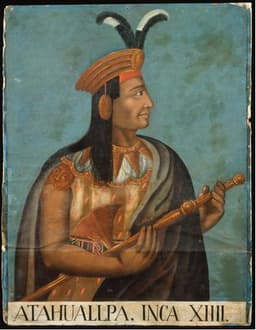
Atahualpa
Emperor · Medieval
44.5Total

Napoleon Bonaparte
General · Modern
70.9Total
Basic Information
Born
1502
1769
Died
1533
1821
Era
Medieval
Modern
Nationality
Inca Empire
France
Occupation
Emperor
General
Civilization
Other
Western
Score Comparison
Military (10%)
46.7
94.0
Political (20%)
27.9
72.0
Influence (20%)
57.2
40.0
Legacy (20%)
46.7
80.0
Leadership (15%)
39.0
78.0
Strategy (15%)
38.3
90.0
TOTAL
44.5
70.9
Atahualpa — Complete Timeline
1532 AD
Victory in the Inca Civil WarWar◆ Major
Atahualpa defeated his brother Hu
Civil WarSuccessionInca Empire
Impact: regionaldestructive
Capture at CajamarcaWar
Francisco Pizarro ambushed Atahualpa at Cajamarca, capturing the Inca emperor after a surprise attack. Spanish forces killed thousands of unarmed Inca attendants while Atahualpa was taken prisoner, marking the beginning of Spanish conquest.
Spanish ConquestAmbushPizarro
Impact: globaltragic
1533 AD
Ransom Room PaymentPolitical Action◆ Major
Atahualpa offered to fill a room with gold and silver in exchange for his release. Over several months, the Inca delivered approximately 6 tons of gold and 12 tons of silver, the largest ransom in history, but Pizarro executed him anyway.
RansomGoldSpanish Greed
Impact: regionaltragic
Execution by GarrotePolitical Action
Pizarro ordered Atahualpa's execution by garrote after a mock trial accused him of treason, idolatry, and ordering Hu
ExecutionSpanish ConquestEnd of Empire
Impact: globaltragic
Napoleon Bonaparte — Complete Timeline
1799 AD
Coup of 18 BrumaireOther◆ Major
Napoleon Bonaparte, with support from his brother Lucien and key political figures, overthrew the Directory in a bloodless coup. He established the Consulate with himself as First Consul, effectively becoming the ruler of France. This event ended the French Revolution's most unstable period.
French RevolutionCoupRise to Power
Impact: regional
1804 AD
Promulgation of the Napoleonic CodeOther◆ Major
Napoleon enacted the Civil Code of the French, known as the Napoleonic Code, a comprehensive set of laws that replaced the fragmented feudal legal systems. The code established legal equality, protected property rights, and secularized law. It became the basis for legal systems in many European and world countries.
Legal ReformNapoleonic CodeCivil Law
Impact: globalconstructive
1805 AD
Battle of AusterlitzWar◆ Major
Napoleon's Grande Arm
Napoleonic WarsBattleDecisive Victory
Impact: global
1812 AD
Invasion of RussiaWar◆ Major
Napoleon led the Grande Arm
Napoleonic WarsInvasionDisaster
Impact: globaldestructive
1815 AD
Battle of WaterlooWar◆ Major
Napoleon's French army was defeated by the combined forces of the Duke of Wellington's Anglo-Allied army and Gebhard Leberecht von Bl
Napoleonic WarsBattleFinal Defeat
Impact: globaldestructive
Expert Analysis
Origins
Atahualpa was born around 1500 in Quito, the son of Inca Emperor Huayna Capac. He was raised in the northern part of the empire, likely groomed for leadership. His mother was a Quitan noblewoman, and his father's death in 1527 triggered a succession crisis. Atahualpa's early years were marked by the Inca practice of split inheritance, where power passed to a chosen son but wealth remained with the previous ruler's other descendants. He received military training and governed the northern region during his father's later years.
Napoleon Bonaparte was born on August 15, 1769, in Ajaccio, Corsica, to a minor noble family. His father, Carlo Buonaparte, was a lawyer who secured a scholarship for Napoleon to attend military school in France. Napoleon entered the Brienne military academy in 1779, graduating in 1784, and then the École Militaire in Paris. He was commissioned as a second lieutenant in the artillery in 1785. His Corsican background and modest nobility shaped his early identity, and he initially supported Corsican independence before fully aligning with France during the Revolution.
Rise to Power
Atahualpa's rise came through the Inca Civil War (1529-1532) against his half-brother Huáscar. After Huayna Capac's death, the empire was split between Huáscar (south) and Atahualpa (north). Atahualpa, with experienced generals like Quisquis and Rumiñawi, won decisive battles, culminating in the Battle of Quipaipan in April 1532. Huáscar was captured, and Atahualpa consolidated control over the empire. He was en route to Cusco to claim the throne when Francisco Pizarro arrived in 1532.
Napoleon rose through the ranks of the French Revolutionary Army. He gained fame for his victory at the Siege of Toulon in 1793, where he was promoted to brigadier general. After a brief fall from favor during the Thermidorian Reaction, he commanded the Army of Italy in 1796, winning a series of battles against the Austrians and Piedmontese. His success in Italy and later in Egypt (1798-1799) built his reputation. On 9 November 1799 (18 Brumaire), he led a coup d'état that overthrew the Directory, establishing the Consulate with himself as First Consul.
Leadership & Governance
Atahualpa's leadership was typical of Inca emperors: absolute, theocratic, and centralized. He ruled as a divine figure, the Sapa Inca, with authority over all aspects of life. His governance relied on a complex system of administration, with quipu (knotted cords) for record-keeping and a network of roads for communication. However, his reign was cut short before he could implement any reforms. His capture at Cajamarca revealed a critical failure: he underestimated the Spanish threat, viewing them as potential allies against his rivals.
Napoleon's leadership was transformative. As First Consul and later Emperor (1804), he centralized the French state, reformed the legal system with the Napoleonic Code (1804), and established the Bank of France (1800). He promoted meritocracy, expanded education, and signed concordats with the Catholic Church. His governance style was authoritarian but efficient, using prefects to enforce policies. Militarily, he commanded armies personally, employing speed and decisive battle. His strategic score of 93.0 reflects his ability to outmaneuver opponents at Austerlitz (1805) and Jena (1806).
Triumph & Tragedy
Atahualpa's greatest triumph was winning the Inca Civil War, unifying the empire under his rule. He demonstrated strategic skill, scoring 55.9 in strategy, by defeating Huáscar's larger forces. His tragedy was his capture and execution. After the Spanish ambush at Cajamarca on 16 November 1532, he offered a ransom of a room filled with gold and silver—approximately 6 tons of gold and 12 tons of silver—but was executed by garrote on 26 July 1533 anyway. His death triggered the collapse of Inca resistance, leading to Spanish conquest.
Napoleon's triumphs include the Battle of Austerlitz (2 December 1805), where he crushed the Russo-Austrian army, and the Napoleonic Code, which influenced legal systems worldwide. His military score of 94.0 reflects these successes. His tragedies include the disastrous Invasion of Russia in 1812, where his Grande Armée of over 600,000 men was reduced to fewer than 100,000 survivors due to cold, disease, and scorched-earth tactics. He was exiled to Elba in 1814, returned for the Hundred Days, and was finally defeated at Waterloo on 18 June 1815, leading to his exile on Saint Helena.
Character & Destiny
Atahualpa was confident and calculating but ultimately naive about European intentions. He believed that by paying the ransom, he would be freed, and he underestimated Pizarro's ruthlessness. His decision to meet the Spanish at Cajamarca without a large army was a fatal miscalculation. His character, shaped by the Inca tradition of divine kingship, made him unable to conceive of betrayal.
Napoleon was ambitious, brilliant, and relentless. His personality drove him to conquer Europe, but also led to overreach. His decision to invade Russia, despite warnings, stemmed from his need to enforce the Continental System against Britain. His character combined military genius with political acumen, but his hubris and refusal to compromise led to his downfall. Historians note that his leadership score of 80.0 reflects his ability to inspire loyalty, but also his dictatorial tendencies.
Legacy
Atahualpa's legacy is as a symbol of Inca resistance and the tragic end of an empire. His capture and death marked the beginning of Spanish domination in South America. The Inca Empire's administrative systems, roads, and agricultural terraces survived in part, but his lineage was extinguished. His influence score of 72.6 reflects the enduring memory of the Inca civilization, though his personal impact was limited by his short reign.
Napoleon's legacy is vast. The Napoleonic Code remains the foundation of civil law in many countries. He reshaped Europe's borders, abolished the Holy Roman Empire, and introduced ideas of nationalism and meritocracy. His military tactics are studied worldwide, and his political reforms influenced modern states. His influence score of 82.0 and legacy score of 78.0 underscore his lasting impact. However, his wars caused millions of deaths and left a legacy of conflict.
Conclusion
Napoleon Bonaparte clearly had greater impact than Atahualpa. With a total score of 82.4 versus Atahualpa's 50.6, Napoleon's achievements in military, political, and legal spheres reshaped Europe and the world. Atahualpa's brief reign ended in tragedy, and his empire was destroyed, while Napoleon's reforms endure. Though Atahualpa's story is poignant, Napoleon's influence on modern governance, law, and warfare is unparalleled. The data supports this: Napoleon scored 94.0 in military to Atahualpa's 39.0, and 93.0 in strategy to 55.9. Atahualpa was a victim of circumstance; Napoleon was an agent of change.
Rankings
🥇
Napoleon BonaparteLeader
Mil: 94.0Pol: 72.0Inf: 40.0
70.9
🥈
Atahualpa
Mil: 46.7Pol: 27.9Inf: 57.2
44.5
+26.4 behind
How This Comparison Works
Algorithm
Each figure is scored on 6 dimensions (0—100 scale) based on structured historical data: Military (10%), Political (20%), Influence (20%), Legacy (20%), Leadership (15%), Strategy (15%). The weighted total produces the final ranking.
Data Sources
Scores are computed from structured sub-indicators in the database. Scale factors adjust for era (Ancient ×0.85, Modern ×1.0) and civilization size (Eastern ×1.05, Other ×0.80) to account for differences in population and military scale.
Maximum 3 Figures
Comparisons are limited to 2—3 figures to ensure readability and statistical meaningfulness.
Error Margins
±5 points per dimension — Sub-scores are derived from historical records with inherent uncertainty. Two figures within 5 points on a dimension should be considered roughly equivalent in that area.
Total Score Accuracy
±3 points overall — The weighted combination of 6 dimensions produces a total score with approximately ±3 points of uncertainty. Differences of less than 3 points are not statistically significant— the figures are effectively tied.
Known Limitations
- Historical records are incomplete and uneven across civilizations
- Figures from oral-tradition societies may be underrepresented
- Occupation labels can misclassify multi-role figures
- Scores measure capability and impact, not moral character
- Quantitative scoring is a comparison tool, not absolute truth
Capability Radar
Military (10%) — Battles & Warfare
Battles
40
95
Win Rate
35
90
Expansion
20
95
Political (20%) — Governance & Reform
Reform
10
95
Diplomacy
20
80
Economy
15
85
Influence (20%) — Cultural & Global Reach
Cultural
40
85
Global
35
90
Legacy (20%) — Historical Impact
Historical
50
95
Longevity
30
90
Leadership (15%) — Power & Stability
Tenure
15
85
Stability
10
70
Strategy (15%) — Tactics & Innovation
Strategy
25
95
Tactics
30
98
Reform
10
92
Similar Comparisons
Comments & Discussion
No comments yet. Be the first to share your thoughts!