Loading...
Askia Muhammad vs Richard of Cornwall
Askia Muhammad leads by 25.8 pts · 2 figures compared
…
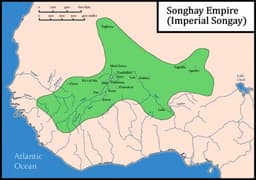
Askia Muhammad
Emperor · Medieval
71.2Total

Richard of Cornwall
Emperor · Medieval
45.4Total
Basic Information
Born
1443
1209
Died
1538
1272
Era
Medieval
Medieval
Nationality
Songhai Empire
Holy Roman Empire
Occupation
Emperor
Emperor
Civilization
Other
Western
Score Comparison
Military (10%)
78.0
50.0
Political (20%)
70.3
40.8
Influence (20%)
82.0
51.8
Legacy (20%)
55.0
40.0
Leadership (15%)
78.0
55.3
Strategy (15%)
69.1
30.3
TOTAL
71.2
45.4
Askia Muhammad — Complete Timeline
1493 AD
Coup against Sonni BaruPolitical Action
Askia Muhammad overthrew Sonni Baru, the son of Sonni Ali, in a coup. Muhammad, a general under Sonni Ali, seized power after Baru refused to embrace Islam more fully, establishing the Askia dynasty.
CoupAskia DynastyIslam
Impact: regional
1496 AD
Pilgrimage to MeccaCultural◆ Major
Askia Muhammad made a pilgrimage to Mecca, traveling with a large retinue and distributing gold. He was appointed Caliph of the Sudan by the Abbasid caliph, enhancing his religious and political legitimacy.
PilgrimageMeccaCaliph
Impact: regionalconstructive
1498 AD
Administrative ReformsReform◆ Major
Askia Muhammad reorganized the Songhai Empire into provinces governed by appointed officials. He standardized weights, measures, and currency, and established a professional bureaucracy, improving tax collection and governance.
AdministrationBureaucracyTaxation
Impact: regionalconstructive
1500 AD
Promotion of Islamic ScholarshipCultural◆ Major
Askia Muhammad patronized Islamic scholars and built mosques and schools in Timbuktu, Gao, and Djenn
ScholarshipTimbuktuIslam
Impact: regionalconstructive
1512 AD
Conquest of the Hausa StatesWar◆ Major
Askia Muhammad led a military campaign against the Hausa city-states, including Kano and Katsina. He conquered them and imposed tribute, extending Songhai control over the Hausa region and securing trade routes.
ConquestHausa StatesTrade Routes
Impact: regional
Richard of Cornwall — Complete Timeline
1257 AD
Elected King of GermanyPolitical Action◆ Major
Richard of Cornwall was elected King of Germany by a faction of prince-electors, opposing Alfonso X of Castile. This election was part of the Great Interregnum, with Richard receiving support from the English crown and the Papacy.
ElectionGreat InterregnumEnglish Influence
Impact: regional
Crowned King of GermanyPolitical Action◆ Major
Richard of Cornwall was crowned King of Germany in Aachen by the Archbishop of Cologne. His coronation was contested by Alfonso X, and Richard's authority was largely confined to the Rhineland and parts of southern Germany.
CoronationGreat InterregnumRival Claimant
Impact: regional
1262 AD
Returned to EnglandPolitical Action
Richard of Cornwall returned to England after spending several years in Germany. His departure weakened his influence in the Holy Roman Empire, and he never returned, leaving the German throne contested until the end of the Great Interregnum.
ReturnEnglandGreat Interregnum
Impact: regional
1272 AD
Died in EnglandOther◆ Major
Richard of Cornwall died at Berkhamsted Castle in England. His death ended his claim to the German throne, and he was succeeded by Rudolf of Habsburg, who ended the Great Interregnum.
DeathGreat InterregnumEnd of Claim
Impact: regional
Expert Analysis
Origins
Askia Muhammad was born as Muhammad Toure around 1443 in the Songhai Empire, likely in the region of Gao. His father was a Soninke general, and his mother was a local woman. He rose through the military ranks under Sonni Ali, the founder of the Songhai Empire. Richard of Cornwall was born on 5 January 1209 at Winchester Castle, the second son of King John of England and Isabella of Angoulême. He was a member of the Plantagenet dynasty and grew up in the English court, receiving a strong education in governance and finance. His wealth came from the Cornish tin mines and his role as Earl of Cornwall.
Rise to Power
Askia Muhammad came to power in 1493 after a coup against Sonni Baru, the son of Sonni Ali. Muhammad, a general under Sonni Ali, seized control when Baru refused to embrace Islam. His coup was supported by Muslim factions in the empire. He consolidated power by establishing a centralized administration and legitimizing his rule through a pilgrimage to Mecca in 1496–1497. During this pilgrimage, he was appointed Caliph of the Sudan by the Abbasid caliph in Cairo, enhancing his religious authority. Richard of Cornwall was elected King of Germany on 13 January 1257 by a faction of prince-electors during the Great Interregnum. His election was opposed by Alfonso X of Castile, who was elected by another faction. Richard spent significant sums to secure support and was crowned in Aachen on 17 May 1257 by the Archbishop of Cologne. However, his authority remained limited to the Rhineland and parts of southern Germany.
Leadership & Governance
Askia Muhammad reorganized the Songhai Empire into provinces governed by appointed officials, replacing hereditary chiefs. He standardized weights, measures, and currency, and established a professional bureaucracy. He promoted Islamic scholarship, building mosques and schools in Timbuktu, Gao, and Djenné, and invited scholars from North Africa. His governance was centralized and efficient, with a focus on trade and agriculture. Richard of Cornwall, as King of Germany, had little actual power. He rarely visited Germany after his coronation, preferring to stay in England. His governance was minimal, as he relied on local nobles to maintain order. He focused on his English estates and financial interests, leaving Germany to the rival king Alfonso X and local princes. Richard's leadership score of 55.3 reflects his limited engagement, while Askia Muhammad's 78.0 indicates more effective rule.
Triumph & Tragedy
Askia Muhammad's greatest success was the expansion of the Songhai Empire to its largest extent, conquering the Hausa states (Kano and Katsina) and the salt mines of Taghaza. He also made Songhai a center of Islamic learning. However, his later years were marked by tragedy: in 1528, at age 85, he was deposed by his son Musa and died in exile on a small island in the Niger River. His empire declined after his death. Richard of Cornwall's triumph was his election as King of Germany, a prestigious title that recognized his wealth and status. He also successfully managed his English estates and became one of the wealthiest men in England. His tragedy was his failure to establish effective rule in Germany; his authority was never recognized by most German princes, and after his death in 1272, his claim ended without lasting impact. Richard scored 40.0 in legacy, while Askia scored 55.0.
Character & Destiny
Askia Muhammad was a devout Muslim, strategic administrator, and ambitious conqueror. His character combined military prowess with religious piety, which he used to legitimize his rule. His destiny was shaped by his successful coup and expansion, but also by his advanced age leading to a loss of power. Richard of Cornwall was a pragmatic financier and diplomat, but lacked the ambition to press his German claims. His character was cautious and focused on personal wealth rather than imperial glory. His destiny was to be a footnote in German history, overshadowed by the eventual rise of Rudolf of Habsburg. Askia's military score of 78.0 and strategy of 69.1 reflect his decisive actions, while Richard's military 50.0 and strategy 30.3 show his passivity.
Legacy
Askia Muhammad's legacy is enduring: he transformed Songhai into a centralized, Islamic state that became a model for West African empires. The University of Sankore in Timbuktu flourished under his patronage, and his administrative reforms influenced later rulers. However, his empire collapsed within decades of his death. Richard of Cornwall's legacy is minimal: he is remembered as a wealthy English prince who briefly held the German throne. His reign did not change the course of German history, and the Great Interregnum continued until 1273. Askia's influence score of 82.0 dwarfs Richard's 51.8, reflecting his greater impact on culture and governance.
Conclusion
Askia Muhammad had a significantly greater impact on history than Richard of Cornwall. With a total score of 71.2 compared to Richard's 45.4, Askia's achievements in empire-building, administration, and cultural patronage shaped West Africa for generations. Richard's election as King of Germany was a personal honor with no lasting consequences. Askia's military, political, and strategic scores all surpass Richard's, and his legacy in Islamic scholarship remains. While Richard's financial acumen was notable, his failure to govern effectively leaves him a minor figure. Therefore, Askia Muhammad is the more consequential historical figure.
Rankings
🥇
Askia MuhammadLeader
Mil: 78.0Pol: 70.3Inf: 82.0
71.2
🥈
Richard of Cornwall
Mil: 50.0Pol: 40.8Inf: 51.8
45.4
+25.8 behind
How This Comparison Works
Algorithm
Each figure is scored on 6 dimensions (0—100 scale) based on structured historical data: Military (10%), Political (20%), Influence (20%), Legacy (20%), Leadership (15%), Strategy (15%). The weighted total produces the final ranking.
Data Sources
Scores are computed from structured sub-indicators in the database. Scale factors adjust for era (Ancient ×0.85, Modern ×1.0) and civilization size (Eastern ×1.05, Other ×0.80) to account for differences in population and military scale.
Maximum 3 Figures
Comparisons are limited to 2—3 figures to ensure readability and statistical meaningfulness.
Error Margins
±5 points per dimension — Sub-scores are derived from historical records with inherent uncertainty. Two figures within 5 points on a dimension should be considered roughly equivalent in that area.
Total Score Accuracy
±3 points overall — The weighted combination of 6 dimensions produces a total score with approximately ±3 points of uncertainty. Differences of less than 3 points are not statistically significant— the figures are effectively tied.
Known Limitations
- Historical records are incomplete and uneven across civilizations
- Figures from oral-tradition societies may be underrepresented
- Occupation labels can misclassify multi-role figures
- Scores measure capability and impact, not moral character
- Quantitative scoring is a comparison tool, not absolute truth
Capability Radar
Military (10%) — Battles & Warfare
Battles
75
20
Win Rate
80
25
Expansion
80
10
Political (20%) — Governance & Reform
Reform
90
15
Diplomacy
80
45
Economy
85
50
Influence (20%) — Cultural & Global Reach
Cultural
70
20
Global
60
20
Legacy (20%) — Historical Impact
Historical
75
25
Longevity
65
15
Leadership (15%) — Power & Stability
Tenure
85
40
Stability
80
30
Strategy (15%) — Tactics & Innovation
Strategy
75
20
Tactics
70
15
Reform
85
5
Similar Comparisons
Comments & Discussion
No comments yet. Be the first to share your thoughts!