Loading...
Aristotle vs Laozi
Aristotle leads by 4.8 pts · 2 figures compared
…
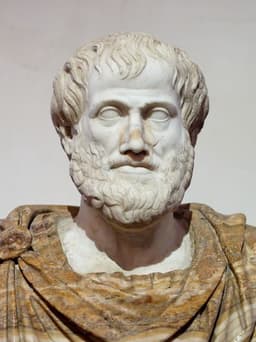
Aristotle
Philosopher · Ancient
59.3Total

Laozi
Philosopher · Ancient
54.5Total
Basic Information
Born
-384
-604
Died
-322
-531
Era
Ancient
Ancient
Nationality
Greece
China
Occupation
Philosopher
Philosopher
Civilization
Western
Eastern
Score Comparison
Military (10%)
8.8
9.0
Political (20%)
35.0
27.5
Influence (20%)
92.0
80.0
Legacy (20%)
87.0
87.0
Leadership (15%)
27.2
21.7
Strategy (15%)
43.6
44.4
TOTAL
59.3
54.5
Aristotle — Complete Timeline
350 BC
Development of Formal LogicInvention
Aristotle developed the first formal system of logic, including syllogistic logic, in his work 'Organon'. He identified the rules of valid reasoning, such as the syllogism, which became the foundation of Western logic for over two millennia.
LogicPhilosophyScience
Impact: globalprogressive
343 BC
Tutoring Alexander the GreatCultural◆ Major
Philip II of Macedon invited Aristotle to tutor his son Alexander. Aristotle taught Alexander for several years, instilling in him an interest in Greek culture, science, and philosophy. This relationship influenced Alexander's later policies of Hellenization in his conquered territories.
EducationMentorshipHellenization
Impact: globalconstructive
340 BC
Publication of 'Nicomachean Ethics'Cultural◆ Major
Aristotle wrote the 'Nicomachean Ethics', a treatise on virtue ethics. He argued that the highest good is eudaimonia (flourishing) achieved through virtuous activity and practical wisdom. This work became a cornerstone of Western moral philosophy.
EthicsPhilosophyVirtue
Impact: globalconstructive
335 BC
Founding of the LyceumCultural◆ Major
Aristotle founded the Lyceum, a school in Athens dedicated to philosophical and scientific research. He established a library and organized systematic studies across disciplines. The Lyceum became a major center of learning, rivaling Plato's Academy.
SchoolPhilosophyResearch
Impact: globalconstructive
323 BC
Departure from AthensPolitical Action
After Alexander's death, anti-Macedonian sentiment rose in Athens. Aristotle, associated with Macedon, left the city to avoid persecution, saying he would not allow Athens to 'sin twice against philosophy' (referring to Socrates' execution). He died in exile in Chalcis.
ExilePoliticsPhilosophy
Expert Analysis
Origins
Aristotle was born in 384 BCE in Stagira, a Greek city in Chalcidice. His father, Nicomachus, was court physician to King Amyntas III of Macedon, giving Aristotle early exposure to biology and medicine. Orphaned young, he was raised by a guardian. At 17, he joined Plato's Academy in Athens, where he studied for 20 years until Plato's death. His empirical bent contrasted with Plato's idealism, setting the stage for his own system.
Laozi (also Lao Tzu) is traditionally dated to the 6th century BCE, though some scholars place him later. He was born in the state of Chu (modern-day Henan) and served as a record keeper or archivist at the Zhou court. Little is known of his early life; the primary source is Sima Qian's Records of the Grand Historian, written centuries later. His role as an archivist gave him access to ancient texts, influencing his deep reflection on the Dao (the Way).
Rise to Power
Aristotle's rise began at the Academy, where he was known as the 'mind of the school.' After Plato's death in 347 BCE, he left Athens, traveling to Assos and Lesbos, conducting biological research. In 343 BCE, Philip II of Macedon invited him to tutor his son Alexander, then 13. Aristotle spent three years teaching Alexander, instilling an appreciation for Greek culture and science. After Alexander became king, Aristotle returned to Athens in 335 BCE and founded the Lyceum, a school that rivaled Plato's Academy. He established a library and organized systematic research across disciplines, attracting students and scholars. His rise was intellectual rather than political; he never held high office but became the leading philosopher of his time.
Laozi's rise is shrouded in legend. According to tradition, he served as an archivist in the Zhou court, where he gained wisdom. Disillusioned with the court's decline, he resigned and departed westward. At the Han Gu Pass, a guard named Yinxi asked him to record his teachings, resulting in the Tao Te Ching. This text became the foundational scripture of Daoism, influencing Chinese thought for millennia. Unlike Aristotle, Laozi did not found a formal school or mentor a powerful ruler; his influence came solely from his writing.
Leadership & Governance
Aristotle's leadership was institutional and systematic. At the Lyceum, he organized research teams, collected specimens, and developed a curriculum covering logic, ethics, politics, physics, and biology. He wrote extensively on governance in Politics, analyzing constitutions of 158 Greek city-states. He advocated for a mixed constitution balancing monarchy, aristocracy, and democracy. His political theory scored 35.0, reflecting moderate impact. He also tutored Alexander, shaping his approach to empire, though Alexander's later actions diverged from Aristotle's ideals.
Laozi's leadership was anti-institutional. The Tao Te Ching advocates wu wei (non-action) and ruling by example, not force. He criticized Confucian activism and legalist coercion. His political score is 27.5, lower than Aristotle's, but his ideas influenced Chinese governance through Daoist-inspired laissez-faire policies in some dynasties. The Tao Te Ching was used by rulers as a guide to minimalist government.
Triumph & Tragedy
Aristotle's greatest triumph was his comprehensive system of knowledge. He invented formal logic (scoring 43.6 in strategy), which dominated Western thought for 2,000 years. His works on ethics (Nicomachean Ethics) and politics remain foundational. His biology, though flawed, was the first systematic study. His tragedy: his association with Alexander made him a target after Alexander's death. He fled Athens in 322 BCE, saying he would not let Athens 'sin twice against philosophy' (referring to Socrates). He died soon after. Also, his scientific errors, like geocentrism, were accepted for centuries.
Laozi's triumph is the Tao Te Ching, a text of profound influence on Chinese culture, religion, and philosophy. It is one of the most translated works in world literature. His tragedy is that his historical existence is uncertain; many scholars doubt whether he was a single person. The Tao Te Ching may be a compilation of multiple authors. His teachings were also co-opted by later religious Daoism, which incorporated alchemy and superstition he might not have endorsed.
Character & Destiny
Aristotle was methodical, empirical, and systematic. He wrote in a dry, analytical style. His character shaped his fate: his pursuit of knowledge led him to found the Lyceum, but his political naivety (scoring 27.2 in leadership) left him vulnerable. He died in exile, but his works survived through the Arab world and were rediscovered in medieval Europe, securing his legacy. Laozi was enigmatic, mystical, and anti-authoritarian. His character, as depicted in the Tao Te Ching, values simplicity and humility. His 'destiny' was to become a legendary figure, with little known of his actual life.
Legacy
Aristotle's legacy is immense. His logic (Organon) was the standard for 2,000 years. His ethics and politics shaped Western philosophy. His influence score is 92.0, the highest among ancient philosophers. He influenced Aquinas, the scientific revolution, and modern education. His works were preserved and studied in the Islamic Golden Age, then translated into Latin, fueling scholasticism. The Lyceum model inspired universities.
Laozi's legacy is equally profound in East Asia. The Tao Te Ching is central to Daoism, influencing Chinese art, poetry, and medicine. It also spread to Buddhism and Confucianism. His legacy score is 87.0, tied with Aristotle. However, his influence is more cultural than institutional. The Tao Te Ching has been read by millions, but it did not create a formal educational system like Aristotle's.
Conclusion
Aristotle had a greater impact on the development of systematic knowledge and institutions. His total score of 59.3 exceeds Laozi's 54.5. Aristotle's logic, ethics, and political theory provided the framework for Western thought, while his founding of the Lyceum set a precedent for academic research. Laozi's wisdom, though profound, is more diffuse and less actionable in terms of governance and science. Therefore, Aristotle is more influential in shaping the intellectual structure of the world.
Rankings
🥇
AristotleLeader
Mil: 8.8Pol: 35.0Inf: 92.0
59.3
🥈
Laozi
Mil: 9.0Pol: 27.5Inf: 80.0
54.5
+4.8 behind
How This Comparison Works
Algorithm
Each figure is scored on 6 dimensions (0—100 scale) based on structured historical data: Military (10%), Political (20%), Influence (20%), Legacy (20%), Leadership (15%), Strategy (15%). The weighted total produces the final ranking.
Data Sources
Scores are computed from structured sub-indicators in the database. Scale factors adjust for era (Ancient ×0.85, Modern ×1.0) and civilization size (Eastern ×1.05, Other ×0.80) to account for differences in population and military scale.
Maximum 3 Figures
Comparisons are limited to 2—3 figures to ensure readability and statistical meaningfulness.
Error Margins
±5 points per dimension — Sub-scores are derived from historical records with inherent uncertainty. Two figures within 5 points on a dimension should be considered roughly equivalent in that area.
Total Score Accuracy
±3 points overall — The weighted combination of 6 dimensions produces a total score with approximately ±3 points of uncertainty. Differences of less than 3 points are not statistically significant— the figures are effectively tied.
Known Limitations
- Historical records are incomplete and uneven across civilizations
- Figures from oral-tradition societies may be underrepresented
- Occupation labels can misclassify multi-role figures
- Scores measure capability and impact, not moral character
- Quantitative scoring is a comparison tool, not absolute truth
Capability Radar
Military (10%) — Battles & Warfare
Battles
17
17
Win Rate
16
16
Expansion
18
21
Political (20%) — Governance & Reform
Reform
30
10
Diplomacy
20
10
Economy
20
10
Influence (20%) — Cultural & Global Reach
Cultural
95
95
Global
95
85
Legacy (20%) — Historical Impact
Historical
95
95
Longevity
95
95
Leadership (15%) — Power & Stability
Tenure
10
10
Stability
10
10
Strategy (15%) — Tactics & Innovation
Strategy
21
23
Tactics
28
29
Reform
30
29
Similar Comparisons
Comments & Discussion
No comments yet. Be the first to share your thoughts!