Loading...
Apolinario Mabini vs Francois Duvalier
Apolinario Mabini leads by 7.9 pts · 2 figures compared
…
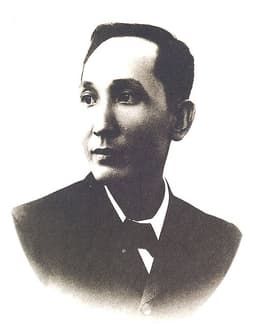
Apolinario Mabini
Politician · Modern
53.6Total

Francois Duvalier
Politician · Modern
45.7Total
Basic Information
Born
1864
1907
Died
1903
1971
Era
Modern
Modern
Nationality
Philippines
Haiti
Occupation
Politician
Politician
Civilization
Eastern
Western
Score Comparison
Military (10%)
18.4
49.3
Political (20%)
68.0
27.9
Influence (20%)
58.3
50.2
Legacy (20%)
58.0
40.0
Leadership (15%)
62.2
65.7
Strategy (15%)
31.3
41.7
TOTAL
53.6
45.7
Apolinario Mabini — Complete Timeline
1898 AD
Authored the Constitutional Program of the Philippine RepublicPolitical Action◆ Major
Mabini wrote the 'Constitutional Program of the Philippine Republic' in 1898, outlining the principles of the revolutionary government. His writings influenced the Malolos Constitution and the establishment of the First Philippine Republic.
Philippine HistoryConstitutionRevolution
Impact: nationalconstructive
1899 AD
Appointed as Prime Minister of the First Philippine RepublicPolitical Action◆ Major
Apolinario Mabini was appointed as the first Prime Minister of the First Philippine Republic on January 2, 1899, by President Emilio Aguinaldo. He served as the de facto head of government during the Philippine-American War.
Philippine HistoryFirst RepublicGovernment
Impact: nationalconstructive
1901 AD
Captured by American Forces and ExiledPolitical Action◆ Major
Mabini was captured by American forces on December 10, 1901, and exiled to Guam. He refused to swear allegiance to the United States, remaining a symbol of resistance. He was allowed to return to the Philippines in 1903.
Philippine HistoryExileResistance
Impact: nationaltragic
1903 AD
Died of Cholera Shortly After ReturnOther◆ Major
Apolinario Mabini died of cholera on May 13, 1903, shortly after returning from exile in Guam. His death at age 38 cut short his political career, but he is remembered as the 'Sublime Paralytic' and a key intellectual of the Philippine Revolution.
Philippine HistoryDeathRevolutionary
Impact: nationaltragic
Francois Duvalier — Complete Timeline
1957 AD
1957 Haitian general electionPolitical Action◆ Major
Duvalier won the presidential election amid widespread fraud and violence. He was supported by the military and used the election to legitimize his rule, beginning a 14-year dictatorship.
ElectionFraudDictatorship
Impact: nationaldestructive
1959 AD
Establishment of the Tonton MacoutePolitical Action◆ Major
Duvalier created the Tonton Macoute, a paramilitary force that served as his personal security and terror apparatus. The group operated outside the law, suppressing dissent through murder, torture, and intimidation.
ParamilitaryTerrorHuman Rights Abuses
Impact: nationaldestructive
1961 AD
Excommunication from the Catholic ChurchCultural
Duvalier expelled the Archbishop of Port-au-Prince and other foreign clergy, leading to his excommunication by the Vatican. He then promoted a cult of personality blending voodoo and Catholicism to legitimize his rule.
ReligionCult of PersonalityChurch-State Conflict
Impact: nationaldestructive
1964 AD
Declaration of Duvalier as President for LifePolitical Action◆ Major
Duvalier amended the Haitian constitution to declare himself President for Life. This move eliminated any possibility of democratic succession and solidified his absolute control over the country.
Constitutional ChangeDictatorshipPower Consolidation
Impact: nationaldestructive
Expert Analysis
Origins
Apolinario Mabini was born on July 23, 1864, in Talaga, Tanauan, Philippines, into a poor peasant family. His father, Inocencio Mabini, and mother, Dionisia Maranan, were of modest means. Despite his physical limitations—he contracted polio at age 35, which paralyzed his legs—Mabini excelled academically. He studied at the Colegio de San Juan de Letran and later at the University of Santo Tomas, earning a law degree in 1894. His early experiences with poverty and injustice shaped his revolutionary ideas.
François Duvalier was born on April 14, 1907, in Port-au-Prince, Haiti, to a middle-class family. His father, Duval Duvalier, was a judge, and his mother, Ulyssia Abraham, was a teacher. Duvalier studied medicine at the University of Haiti and became a physician, specializing in public health. His work in rural areas exposed him to the plight of the poor and the influence of Vodou, which he later exploited for political control.
Rise to Power
Mabini rose to prominence as a key intellectual of the Philippine Revolution. He joined the Katipunan in 1896 and became a close adviser to General Emilio Aguinaldo. His writings, including the "Constitutional Program of the Philippine Republic" (1898), provided the ideological foundation for the revolutionary government. In January 1899, he was appointed Prime Minister and Secretary of Foreign Affairs of the First Philippine Republic. His rise was driven by his intellect and unwavering commitment to independence.
Duvalier's rise began with his appointment as Minister of Health under President Dumarsais Estimé in 1949. He gained popularity through his anti-communist stance and promotion of noirisme, a movement celebrating black identity. In the 1957 election, Duvalier won amid widespread fraud, supported by the military. He consolidated power by purging opponents and creating the Tonton Macoute in 1959. His political score of 27.9 reflects his low democratic legitimacy.
Leadership & Governance
Mabini's leadership was marked by principled governance and legal reform. He drafted decrees establishing civil liberties, land reform, and education. His leadership score of 62.2 reflects his ability to guide a nascent republic despite physical disability. He refused to compromise on Philippine sovereignty, even when captured by Americans in 1901. He was exiled to Guam for refusing to swear allegiance to the United States.
Duvalier's governance was authoritarian and brutal. He declared himself President for Life in 1964, eliminating term limits. The Tonton Macoute, a paramilitary force, suppressed dissent through torture and murder. Duvalier promoted a cult of personality, portraying himself as a Vodou priest and invoking supernatural powers. His political score of 27.9 indicates his failure in democratic governance.
Triumph & Tragedy
Mabini's greatest success was his role in articulating the ideals of the Philippine Revolution. His writings influenced subsequent generations. His tragedy was his early death at age 38 from cholera in 1903, shortly after returning from exile. He never saw Philippine independence, which came in 1946.
Duvalier's success was in maintaining power for 14 years until his death in 1971. He created a stable, though oppressive, regime. His tragedy was the devastation of Haiti's economy and society; thousands were killed, and the country remains impoverished. His legacy score of 40.0 reflects the negative impact.
Character & Destiny
Mabini's character was defined by resilience and principle. Despite paralysis, he remained intellectually active and politically engaged. His destiny was to be a martyr for Philippine independence, remembered as the "Sublime Paralytic." Duvalier's character was shrewd and ruthless. He used fear and superstition to control Haiti. His destiny was to leave a legacy of tyranny.
Legacy
Mabini's legacy is enduring in the Philippines. He is revered as a national hero, and his writings on governance and revolution are studied. His influence score of 58.3 reflects his impact on Philippine nationalism. Duvalier's legacy is largely negative; his son Jean-Claude succeeded him, but the regime collapsed in 1986. Haiti still struggles with the consequences of his rule.
Conclusion
Apolinario Mabini, with a total score of 53.6, had a greater historical impact than François Duvalier's 45.7. Mabini's contributions to Philippine independence and democratic ideals outweigh Duvalier's repressive regime. While Duvalier's influence was destructive, Mabini's ideas continue to inspire. The score gap of 7.9 points reflects the difference between a visionary leader and a brutal dictator.
Rankings
🥇
Apolinario MabiniLeader
Mil: 18.4Pol: 68.0Inf: 58.3
53.6
🥈
Francois Duvalier
Mil: 49.3Pol: 27.9Inf: 50.2
45.7
+7.9 behind
How This Comparison Works
Algorithm
Each figure is scored on 6 dimensions (0—100 scale) based on structured historical data: Military (10%), Political (20%), Influence (20%), Legacy (20%), Leadership (15%), Strategy (15%). The weighted total produces the final ranking.
Data Sources
Scores are computed from structured sub-indicators in the database. Scale factors adjust for era (Ancient ×0.85, Modern ×1.0) and civilization size (Eastern ×1.05, Other ×0.80) to account for differences in population and military scale.
Maximum 3 Figures
Comparisons are limited to 2—3 figures to ensure readability and statistical meaningfulness.
Error Margins
±5 points per dimension — Sub-scores are derived from historical records with inherent uncertainty. Two figures within 5 points on a dimension should be considered roughly equivalent in that area.
Total Score Accuracy
±3 points overall — The weighted combination of 6 dimensions produces a total score with approximately ±3 points of uncertainty. Differences of less than 3 points are not statistically significant— the figures are effectively tied.
Known Limitations
- Historical records are incomplete and uneven across civilizations
- Figures from oral-tradition societies may be underrepresented
- Occupation labels can misclassify multi-role figures
- Scores measure capability and impact, not moral character
- Quantitative scoring is a comparison tool, not absolute truth
Capability Radar
Military (10%) — Battles & Warfare
Battles
12
28
Win Rate
16
32
Expansion
19
36
Political (20%) — Governance & Reform
Reform
60
10
Diplomacy
55
15
Economy
30
5
Influence (20%) — Cultural & Global Reach
Cultural
65
20
Global
45
20
Legacy (20%) — Historical Impact
Historical
70
25
Longevity
55
15
Leadership (15%) — Power & Stability
Tenure
40
60
Stability
20
5
Strategy (15%) — Tactics & Innovation
Strategy
22
38
Tactics
27
41
Reform
30
42
Similar Comparisons
Comments & Discussion
No comments yet. Be the first to share your thoughts!