Loading...
Andres Manuel Lopez Obrador vs Julius Caesar
Julius Caesar leads by 27.2 pts · 2 figures compared
…
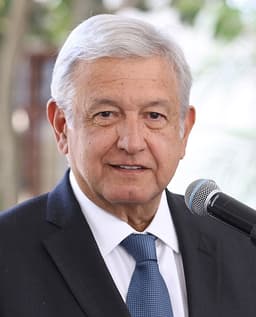
Andres Manuel Lopez Obrador
Politician · Modern
55.6Total

Julius Caesar
General · Ancient
82.8Total
Basic Information
Born
1953
-100
Died
—
-44
Era
Modern
Ancient
Nationality
Mexico
Roman Republic
Occupation
Politician
General
Civilization
Western
Western
Score Comparison
Military (10%)
49.8
88.0
Political (20%)
68.0
78.0
Influence (20%)
56.4
85.0
Legacy (20%)
45.8
82.0
Leadership (15%)
72.0
80.0
Strategy (15%)
40.8
85.0
TOTAL
55.6
82.8
Andres Manuel Lopez Obrador — Complete Timeline
2018 AD
Elected President of MexicoPolitical Action◆ Major
López Obrador won the 2018 Mexican general election with 53% of the vote, representing the MORENA party. His victory ended decades of dominance by the PRI and PAN parties, marking a shift to leftist governance in Mexico.
ElectionPolitical Change
Impact: nationalconstructive
Cancelled the Mexico City Texcoco AirportPolitical Action◆ Major
After a public consultation, AMLO cancelled the partially built $13 billion Mexico City Texcoco airport project, citing corruption and cost overruns. He replaced it with the expansion of the Santa Luc
InfrastructureCorruption
Impact: nationaldestructive
2019 AD
Launched the 'Fourth Transformation' reformsReform◆ Major
AMLO initiated a series of constitutional and policy changes under the 'Fourth Transformation' agenda, including anti-corruption measures, austerity for high-level officials, and increased social spending. These reforms aimed to reduce inequality and state corruption.
ReformSocial Policy
Impact: nationalconstructive
Implemented the 'Sembrando Vida' reforestation programReform
AMLO launched Sembrando Vida, a large-scale reforestation and rural employment program providing payments to farmers for planting trees. The program aimed to combat deforestation and poverty in rural Mexico, covering over 1 million hectares.
EnvironmentSocial Program
Impact: nationalconstructive
2020 AD
Faced the COVID-19 pandemic responsePolitical Action◆ Major
AMLO's government implemented a limited lockdown and promoted the 'Healthy Distance' campaign. His administration faced criticism for downplaying the pandemic and for a high death toll, but also expanded hospital capacity and vaccination rollout.
PandemicPublic Health
Impact: national
2022 AD
Nationalized lithium reservesReform
AMLO signed a decree nationalizing lithium reserves in Mexico, declaring the mineral a strategic resource for the state. This move aimed to control the supply chain for electric vehicle batteries, but raised concerns among foreign investors about property rights.
NationalizationEnergy
Impact: nationalconstructive
Julius Caesar — Complete Timeline
58 BC
Gallic WarsWar◆ Major
Caesar, as proconsul of Gaul, launched a series of campaigns that conquered all of Gaul (modern France, Belgium, and parts of Switzerland). He fought numerous battles, including against the Helvetii, the Belgae, and the Gallic chieftain Vercingetorix. The wars brought immense wealth and a loyal army to Caesar.
Gallic WarsConquestRoman Expansion
Impact: regional
49 BC
Crossing the RubiconPolitical Action◆ Major
Caesar led Legio XIII across the Rubicon River into Italy, defying the Roman Senate's order to disband his army. This act triggered a civil war against Pompey and the Optimates, ultimately leading to Caesar's dictatorship and the end of the Roman Republic.
Roman Civil WarEnd of RepublicPower Struggle
Impact: global
48 BC
Battle of PharsalusWar◆ Major
Caesar's outnumbered army defeated the larger forces of Pompey the Great at Pharsalus in Greece. Caesar's tactical use of a reserve line to counter Pompey's cavalry charge proved decisive. Pompey fled to Egypt, where he was assassinated, leaving Caesar as the undisputed master of the Roman world.
Roman Civil WarBattleDecisive Victory
Impact: regional
44 BC
Appointment as Dictator for LifePolitical Action◆ Major
The Roman Senate appointed Caesar dictator perpetuo (dictator for life), granting him unprecedented personal power. This move concentrated military, legislative, and judicial authority in one person, effectively ending the Roman Republic's traditional system of checks and balances and alarming many senators.
DictatorshipEnd of RepublicPower Consolidation
Impact: regionaldestructive
Assassination on the Ides of MarchPolitical Action◆ Major
A group of Roman senators, led by Marcus Junius Brutus and Gaius Cassius Longinus, stabbed Caesar to death at a meeting of the Senate in the Theatre of Pompey. The assassination was intended to restore the Republic, but instead triggered another civil war that led to the rise of the Roman Empire.
AssassinationRoman PoliticsEnd of Republic
Impact: globaldestructive
Expert Analysis
andres-manuel-lopez-obrador-vs-julius-caesar
# The Ides of March and the Fourth Transformation
On a winter morning in 44 BCE, Julius Caesar walked into the Senate chamber of Rome, a man who had conquered Gaul, crossed the Rubicon, and made himself master of the Mediterranean world. Within minutes, he lay bleeding on the marble floor, stabbed twenty-three times by men he had once called friends. Two thousand years later, on a December afternoon in 2018, Andrés Manuel López Obrador stood before a crowd in Mexico City, a man who had run for president three times, founded his own party, and finally won with the largest mandate in modern Mexican history. He raised his hand and swore to transform his country. One died at the height of his power; the other lived to see his revolution unfold. What separates these two figures, both reformers, both disruptors, both men who bent their nations to their will?
Origins
Caesar was born into the Roman patrician class, a family that traced its lineage to the goddess Venus but had fallen on hard times. His father died when he was sixteen, leaving him to navigate the brutal politics of the late Republic. He grew up in a world where the old senatorial aristocracy was crumbling, where generals commanded personal armies, and where the city of Rome teetered between oligarchy and chaos. He was a product of a civilization that valued glory above all else—glory won on battlefields, in Senate debates, and through the adoration of the mob.
López Obrador was born in 1953 in the small town of Tepetitán, in the southern state of Tabasco, Mexico. His father was a shopkeeper, his mother a homemaker. He grew up in a Mexico dominated by the Institutional Revolutionary Party (PRI), a one-party state that had ruled for decades through a mix of patronage, corruption, and occasional repression. His world was one of poverty, inequality, and a deep sense that the system was rigged. Where Caesar inherited a name and a claim to divine ancestry, López Obrador inherited a memory of his grandmother selling bread to make ends meet. One was born to rule; the other had to claw his way upward.
Rise to Power
Caesar’s path to power was paved with debt, military command, and political cunning. He borrowed enormous sums to fund games and bribes, winning the office of pontifex maximus and later a governorship in Spain. But his true ascent began when he formed the First Triumvirate with Pompey and Crassus in 60 BCE, a backroom deal that gave him command of Gaul. Over the next eight years, he conquered a territory larger than Italy itself, amassed a fortune, and built an army that was loyal to him alone, not to the Republic. When the Senate ordered him to disband his legions, he crossed the Rubicon River in 49 BCE, a act of war that began a civil war. He won, became dictator, and never looked back.
López Obrador’s rise was slower, more patient, and entirely political. He entered politics in the 1970s as a member of the PRI, but broke away in the 1980s to join the leftist Party of the Democratic Revolution (PRD). He served as mayor of Mexico City from 2000 to 2005, where he implemented popular social programs and built a reputation as a man of the people. He ran for president in 2006 and lost by a razor-thin margin, alleging fraud and leading massive protests. He ran again in 2012 and lost again. Only in 2018, at age sixty-four, did he win, with 53 percent of the vote—a landslide in a fractured democracy. Caesar seized power in a single, violent stroke; López Obrador earned it through persistence, organization, and the slow erosion of a ruling party’s legitimacy.
Leadership & Governance
Caesar ruled as a military dictator who never forgot that he was a politician. He reformed the calendar, granted citizenship to provincials, launched public works projects, and redistributed land to his veterans. He centralized power in his own hands, packed the Senate with his supporters, and began building the machinery of empire. But he also governed through a delicate balance of terror and generosity. He pardoned many of his enemies, including Brutus and Cassius—a clemency that would prove fatal. His reforms were sweeping, but they were imposed from above, by the sword.
López Obrador governed as a democratic populist who never held a sword. He called his presidency the "Fourth Transformation" of Mexico, after independence, the Reform War, and the Mexican Revolution. He launched social programs like "Sembrando Vida," which paid farmers to plant trees, and "Jóvenes Construyendo el Futuro," which gave apprenticeships to young people. He canceled the partially built $13 billion Mexico City airport after a public consultation, a move that thrilled his supporters and horrified business leaders. He nationalized lithium reserves and pursued a policy of "hugs, not bullets" to address crime. His style was personal, even paternalistic—he held daily morning press conferences, drove himself around in a modest car, and refused to live in the presidential palace. Where Caesar built an empire, López Obrador tried to rebuild a nation’s soul.
Triumph & Tragedy
Caesar’s greatest triumph was his conquest of Gaul, a campaign so brilliant that it is still studied in military academies. He defeated hundreds of tribes, crossed the Rhine into Germany, and invaded Britain—all while writing a commentary that remains a masterpiece of Latin prose. His greatest tragedy was his assassination, a moment that has echoed through history as the ultimate warning against unchecked power. He died not on a battlefield, but in a Senate chamber, surrounded by the men he had spared.
López Obrador’s greatest triumph was his election itself—a victory that broke the stranglehold of the PRI and gave hope to millions of Mexicans who felt invisible. His greatest tragedy was his handling of the COVID-19 pandemic. He downplayed the virus, refused to wear a mask, and promoted a "Healthy Distance" campaign that did little to slow the spread. Mexico suffered one of the highest death tolls in the world. His supporters saw him as a man who refused to panic; his critics saw him as a leader who failed his people in their hour of need.
Character & Destiny
Caesar was audacious, calculating, and utterly convinced of his own greatness. He took risks that would have destroyed lesser men—crossing the Rubicon, fighting in Britain, pardoning his enemies. His confidence was his strength and his undoing. He believed that his presence alone could bind the Republic together, and he ignored the warnings of his wife, his friends, and the soothsayers who told him to beware the Ides of March. He was a man who shaped his own destiny, but destiny, in the end, shaped him.
López Obrador is stubborn, ascetic, and deeply convinced of his own moral mission. He has been called "the messiah of the poor" and "the caudillo of the left." He refuses to compromise, even when it costs him allies. He believes that Mexico’s problems are the result of a corrupt elite, and he has spent his life fighting them. His character is a weapon and a shield—it endears him to his followers and infuriates his opponents. He is not a man who bends; he is a man who breaks.
Legacy
Caesar’s legacy is the Roman Empire. His assassination did not restore the Republic; it unleashed a civil war that ended with his adopted son, Octavian, becoming the first emperor. Every Roman emperor who followed called himself "Caesar." His name became synonymous with power itself—the German "Kaiser," the Russian "Tsar." He transformed the world, and the world has never stopped arguing about whether that transformation was good or evil.
López Obrador’s legacy is still being written. He left office in 2024, having served a single six-year term, as Mexico’s constitution requires. His supporters say he restored dignity to the poor, fought corruption, and reclaimed Mexico’s sovereignty. His critics say he weakened institutions, empowered the military, and left the economy stagnant. The truth, as always, lies somewhere in between. He did not conquer Gaul or cross a Rubicon. He did something perhaps more difficult in the modern world: he won a democratic mandate and tried to use it to change his country from within.
Conclusion
Caesar and López Obrador share a common thread: both men believed that the systems they inherited were broken, and both believed that they alone could fix them. Caesar broke the Republic to save it, and in breaking it, created an empire. López Obrador broke the PRI’s grip on power, and in breaking it, opened a door to something new. One died by the sword; the other lived to see his term end. One changed the course of Western civilization; the other changed the course of a single nation. But both understood a truth that transcends time and place: that history is not made by committees or by chance, but by men who are willing to act, to risk, and to bear the consequences of their ambition. The Ides of March and the Fourth Transformation are different echoes of the same human impulse—the desire to leave a mark on the world before the world leaves us behind.
Rankings
🥇
Julius CaesarLeader
Mil: 88.0Pol: 78.0Inf: 85.0
82.8
🥈
Andres Manuel Lopez Obrador
Mil: 49.8Pol: 68.0Inf: 56.4
55.6
+27.2 behind
How This Comparison Works
Algorithm
Each figure is scored on 6 dimensions (0—100 scale) based on structured historical data: Military (10%), Political (20%), Influence (20%), Legacy (20%), Leadership (15%), Strategy (15%). The weighted total produces the final ranking.
Data Sources
Scores are computed from structured sub-indicators in the database. Scale factors adjust for era (Ancient ×0.85, Modern ×1.0) and civilization size (Eastern ×1.05, Other ×0.80) to account for differences in population and military scale.
Maximum 3 Figures
Comparisons are limited to 2—3 figures to ensure readability and statistical meaningfulness.
Error Margins
±5 points per dimension — Sub-scores are derived from historical records with inherent uncertainty. Two figures within 5 points on a dimension should be considered roughly equivalent in that area.
Total Score Accuracy
±3 points overall — The weighted combination of 6 dimensions produces a total score with approximately ±3 points of uncertainty. Differences of less than 3 points are not statistically significant— the figures are effectively tied.
Known Limitations
- Historical records are incomplete and uneven across civilizations
- Figures from oral-tradition societies may be underrepresented
- Occupation labels can misclassify multi-role figures
- Scores measure capability and impact, not moral character
- Quantitative scoring is a comparison tool, not absolute truth
Capability Radar
Military (10%) — Battles & Warfare
Battles
28
95
Win Rate
34
92
Expansion
33
97
Political (20%) — Governance & Reform
Reform
60
90
Diplomacy
55
85
Economy
50
82
Influence (20%) — Cultural & Global Reach
Cultural
40
88
Global
40
94
Legacy (20%) — Historical Impact
Historical
45
95
Longevity
30
96
Leadership (15%) — Power & Stability
Tenure
65
75
Stability
45
60
Strategy (15%) — Tactics & Innovation
Strategy
36
94
Tactics
38
96
Reform
43
88
Similar Comparisons
Comments & Discussion
TogaTabasco6/17/2026
Caesar conquered Gaul with legions and political genius; AMLO won with a landslide and political theater. One crossed the Rubicon, the other crossed out corruption. But here's the thing—Caesar's reforms died with him on the Senate floor, while AMLO's Fourth Transformation has already outlasted his first term. Glory is fleeting, but a social welfare program? That's eternal. Give me the man who builds hospitals over the man who built a bridge across the Rhine any day.
RubiconRat6/17/2026
Data check: Caesar's assassination didn't stop his reforms—Augustus implemented them. AMLO's reforms? Mexico's GDP growth averaged 0.8% under him versus 2.1% under Peña Nieto. Numbers don't lie. One man built an empire that lasted centuries; the other is building a legacy of stagnation. I'll take the man who crossed a river over the man who can't cross a 1% growth rate.
SPQR20246/17/2026
Classicist take: Caesar's reforms were revolutionary in context—land redistribution, calendar reform, citizenship extension. AMLO's are... a train that doesn't work and oil refinery that's losing money. Caesar understood that power requires infrastructure of both steel and soul. The Ides of March happened because he moved too fast. AMLO's tragedy is he moves too slow. One died for his vision; the other is just... there.