Loading...
This comparison has not been analyzed yet.
One-time AI generation (~1 minute). Scores and timeline are already available below.
Andreas Papandreou vs Hailemariam Desalegn
Andreas Papandreou leads by 20.1 pts · 2 figures compared
…
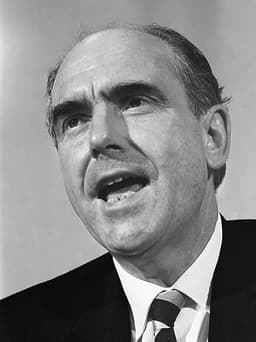
Andreas Papandreou
Politician · Modern
63.9Total

Hailemariam Desalegn
Politician · Modern
43.8Total
Basic Information
Born
1919
1965
Died
1996
—
Era
Modern
Modern
Nationality
Greece
Ethiopia
Occupation
Politician
Politician
Civilization
Western
Other
Score Comparison
Military (10%)
50.0
50.0
Political (20%)
65.0
32.2
Influence (20%)
82.0
49.4
Legacy (20%)
56.0
37.5
Leadership (15%)
68.0
51.9
Strategy (15%)
44.0
44.1
TOTAL
63.9
43.8
Andreas Papandreou — Complete Timeline
1974 AD
Founded the Panhellenic Socialist Movement (PASOK)Political Action◆ Major
Andreas Papandreou founded PASOK, a socialist political party that advocated for national independence, social justice, and democratic reforms. The party quickly became a major force in Greek politics, challenging the conservative establishment.
Political PartySocialismThird Way
Impact: nationalconstructive
1981 AD
Elected Prime Minister of GreecePolitical Action◆ Major
Papandreou led PASOK to a landslide victory in the 1981 elections, becoming the first socialist Prime Minister of Greece. His government implemented sweeping reforms, including the establishment of the National Health System and the legalization of civil marriage.
ElectionSocial ReformWelfare State
Impact: nationalconstructive
1982 AD
Legalized Civil MarriageReform◆ Major
Papandreou's government passed Law 1250/1982, which legalized civil marriage in Greece, ending the monopoly of the Orthodox Church over marriage. The reform was part of a broader secularization agenda that also included divorce reform.
SecularizationSocial ReformChurch-State Relations
Impact: nationalconstructive
1983 AD
Introduced the National Health System (ESY)Reform◆ Major
Papandreou's government established the National Health System (ESY), providing universal healthcare to all Greek citizens. The reform was a cornerstone of PASOK's social policy, significantly improving access to medical services.
HealthcareSocial PolicyReform
Impact: nationalconstructive
1985 AD
Economic Crisis and Austerity MeasuresPolitical Action◆ Major
Facing economic crisis, Papandreou's government implemented austerity measures, including wage freezes and currency devaluation. The policies caused internal party dissent and led to a decline in PASOK's popularity, though they stabilized the economy temporarily.
Economic PolicyAusterityCrisis
Impact: nationaldestructive
1989 AD
Imprisonment and Acquittal in Koskotas ScandalPolitical Action◆ Major
Papandreou was implicated in the Koskotas financial scandal, involving embezzlement and bribery. He was tried and acquitted in 1992, but the scandal damaged his reputation and contributed to PASOK's electoral defeat in 1989.
ScandalCorruptionTrial
Impact: nationaldestructive
Hailemariam Desalegn — Complete Timeline
2010 AD
Appointed Deputy Prime Minister of EthiopiaPolitical Action◆ Major
Hailemariam Desalegn was appointed Deputy Prime Minister and Minister of Foreign Affairs under Prime Minister Meles Zenawi. As a southerner and engineer, his appointment signaled the Ethiopian People's Revolutionary Democratic Front's effort to broaden regional representation.
Ethiopian PoliticsAppointmentEPRDF
Impact: nationalconstructive
2012 AD
Became Prime Minister of Ethiopia after Meles Zenawi's deathPolitical Action◆ Major
Following the death of long-serving Prime Minister Meles Zenawi, Hailemariam Desalegn succeeded him as Prime Minister. He became the first Ethiopian leader from the southern region, but faced challenges in consolidating power within the EPRDF coalition.
SuccessionPrime MinisterEthiopia
Impact: national
2018 AD
Resigned as Prime Minister amid political crisisPolitical Action◆ Major
Hailemariam resigned as Prime Minister in February 2018 after widespread anti-government protests and a state of emergency. His resignation was seen as an attempt to pave the way for political reforms, leading to the appointment of Abiy Ahmed as his successor.
ResignationPolitical CrisisProtests
Impact: nationaltragic
This comparison has not been analyzed yet.
One-time AI generation (~1 minute). Scores and timeline are already available below.
Rankings
🥇
Andreas PapandreouLeader
Mil: 50.0Pol: 65.0Inf: 82.0
63.9
🥈
Hailemariam Desalegn
Mil: 50.0Pol: 32.2Inf: 49.4
43.8
+20.1 behind
How This Comparison Works
Algorithm
Each figure is scored on 6 dimensions (0—100 scale) based on structured historical data: Military (10%), Political (20%), Influence (20%), Legacy (20%), Leadership (15%), Strategy (15%). The weighted total produces the final ranking.
Data Sources
Scores are computed from structured sub-indicators in the database. Scale factors adjust for era (Ancient ×0.85, Modern ×1.0) and civilization size (Eastern ×1.05, Other ×0.80) to account for differences in population and military scale.
Maximum 3 Figures
Comparisons are limited to 2—3 figures to ensure readability and statistical meaningfulness.
Error Margins
±5 points per dimension — Sub-scores are derived from historical records with inherent uncertainty. Two figures within 5 points on a dimension should be considered roughly equivalent in that area.
Total Score Accuracy
±3 points overall — The weighted combination of 6 dimensions produces a total score with approximately ±3 points of uncertainty. Differences of less than 3 points are not statistically significant— the figures are effectively tied.
Known Limitations
- Historical records are incomplete and uneven across civilizations
- Figures from oral-tradition societies may be underrepresented
- Occupation labels can misclassify multi-role figures
- Scores measure capability and impact, not moral character
- Quantitative scoring is a comparison tool, not absolute truth
Capability Radar
Military (10%) — Battles & Warfare
Battles
26
23
Win Rate
32
23
Expansion
32
30
Political (20%) — Governance & Reform
Reform
75
20
Diplomacy
70
30
Economy
60
15
Influence (20%) — Cultural & Global Reach
Cultural
55
10
Global
55
15
Legacy (20%) — Historical Impact
Historical
60
15
Longevity
50
10
Leadership (15%) — Power & Stability
Tenure
65
35
Stability
40
10
Strategy (15%) — Tactics & Innovation
Strategy
41
29
Tactics
40
34
Reform
47
34
Similar Comparisons
Comments & Discussion
No comments yet. Be the first to share your thoughts!