Loading...
This comparison has not been analyzed yet.
One-time AI generation (~1 minute). Scores and timeline are already available below.
Alp Arslan vs Tarmashirin
Alp Arslan leads by 25.8 pts · 2 figures compared
…
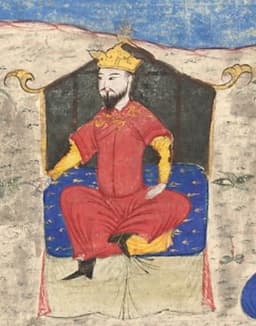
Alp Arslan
Emperor · Medieval
74.2Total
Tarmashirin
Emperor · Medieval
48.4Total
Basic Information
Born
1029
1280
Died
1072
1334
Era
Medieval
Medieval
Nationality
Seljuk Empire
Chagatai Khanate
Occupation
Emperor
Emperor
Civilization
Middle Eastern
Eastern
Score Comparison
Military (10%)
82.0
55.0
Political (20%)
65.0
40.8
Influence (20%)
82.0
54.9
Legacy (20%)
72.0
41.7
Leadership (15%)
72.0
55.3
Strategy (15%)
70.0
43.3
TOTAL
74.2
48.4
Alp Arslan — Complete Timeline
1070 AD
Conquest of Aleppo and SyriaWar◆ Major
Alp Arslan led campaigns into Syria, capturing Aleppo and extending Seljuk control to the Mediterranean coast. He defeated the Fatimid Caliphate's forces and established Seljuk dominance over the Levant.
ConquestSyriaFatimid
Impact: regional
1071 AD
Battle of ManzikertWar
Alp Arslan defeated the Byzantine Emperor Romanos IV Diogenes at the Battle of Manzikert in eastern Anatolia. The Byzantine army was destroyed and Romanos captured, leading to the Seljuk conquest of Anatolia and the beginning of Turkic settlement in the region.
BattleByzantineAnatolia
Impact: global
1072 AD
AssassinationOther◆ Major
Alp Arslan was assassinated by a captured fortress commander while on campaign in Transoxiana. His death at the height of his power led to a succession struggle and the eventual fragmentation of the Seljuk Empire under his son Malik Shah I.
AssassinationDeathSuccession
Impact: regionaltragic
Tarmashirin — Complete Timeline
1326 AD
Conversion to IslamCultural◆ Major
Tarmashirin converted to Islam, becoming the first Chagatai khan to adopt the religion. This conversion influenced the religious orientation of the Chagatai Khanate and led to tensions with traditionalist Mongol factions who opposed Islamic influence.
Religious ConversionIslamizationChagatai Khanate
Impact: regional
1334 AD
Deposition and DeathPolitical Action◆ Major
Tarmashirin was deposed and killed by a rebellion led by traditionalist Mongol nobles who opposed his Islamic policies and perceived abandonment of Mongol customs. His death ended his reign and marked a period of instability in the Chagatai Khanate.
DepositionRebellionChagatai Khanate
Impact: regionaltragic
This comparison has not been analyzed yet.
One-time AI generation (~1 minute). Scores and timeline are already available below.
Rankings
🥇
Alp ArslanLeader
Mil: 82.0Pol: 65.0Inf: 82.0
74.2
🥈
Tarmashirin
Mil: 55.0Pol: 40.8Inf: 54.9
48.4
+25.8 behind
How This Comparison Works
Algorithm
Each figure is scored on 6 dimensions (0—100 scale) based on structured historical data: Military (10%), Political (20%), Influence (20%), Legacy (20%), Leadership (15%), Strategy (15%). The weighted total produces the final ranking.
Data Sources
Scores are computed from structured sub-indicators in the database. Scale factors adjust for era (Ancient ×0.85, Modern ×1.0) and civilization size (Eastern ×1.05, Other ×0.80) to account for differences in population and military scale.
Maximum 3 Figures
Comparisons are limited to 2—3 figures to ensure readability and statistical meaningfulness.
Error Margins
±5 points per dimension — Sub-scores are derived from historical records with inherent uncertainty. Two figures within 5 points on a dimension should be considered roughly equivalent in that area.
Total Score Accuracy
±3 points overall — The weighted combination of 6 dimensions produces a total score with approximately ±3 points of uncertainty. Differences of less than 3 points are not statistically significant— the figures are effectively tied.
Known Limitations
- Historical records are incomplete and uneven across civilizations
- Figures from oral-tradition societies may be underrepresented
- Occupation labels can misclassify multi-role figures
- Scores measure capability and impact, not moral character
- Quantitative scoring is a comparison tool, not absolute truth
Capability Radar
Military (10%) — Battles & Warfare
Battles
85
30
Win Rate
90
30
Expansion
85
30
Political (20%) — Governance & Reform
Reform
70
40
Diplomacy
80
40
Economy
70
30
Influence (20%) — Cultural & Global Reach
Cultural
65
40
Global
75
20
Legacy (20%) — Historical Impact
Historical
80
30
Longevity
70
20
Leadership (15%) — Power & Stability
Tenure
75
40
Stability
70
30
Strategy (15%) — Tactics & Innovation
Strategy
85
30
Tactics
80
30
Reform
70
20
Similar Comparisons
Comments & Discussion
No comments yet. Be the first to share your thoughts!