Loading...
Alp Arslan vs Julius Caesar
Julius Caesar leads by 8.6 pts · 2 figures compared
…
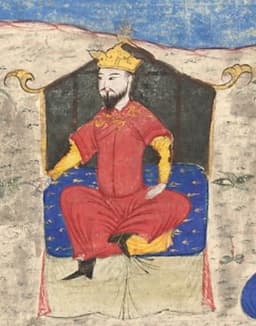
Alp Arslan
Emperor · Medieval
74.2Total

Julius Caesar
General · Ancient
82.8Total
Basic Information
Born
1029
-100
Died
1072
-44
Era
Medieval
Ancient
Nationality
Seljuk Empire
Roman Republic
Occupation
Emperor
General
Civilization
Middle Eastern
Western
Score Comparison
Military (10%)
82.0
88.0
Political (20%)
65.0
78.0
Influence (20%)
82.0
85.0
Legacy (20%)
72.0
82.0
Leadership (15%)
72.0
80.0
Strategy (15%)
70.0
85.0
TOTAL
74.2
82.8
Alp Arslan — Complete Timeline
1070 AD
Conquest of Aleppo and SyriaWar◆ Major
Alp Arslan led campaigns into Syria, capturing Aleppo and extending Seljuk control to the Mediterranean coast. He defeated the Fatimid Caliphate's forces and established Seljuk dominance over the Levant.
ConquestSyriaFatimid
Impact: regional
1071 AD
Battle of ManzikertWar
Alp Arslan defeated the Byzantine Emperor Romanos IV Diogenes at the Battle of Manzikert in eastern Anatolia. The Byzantine army was destroyed and Romanos captured, leading to the Seljuk conquest of Anatolia and the beginning of Turkic settlement in the region.
BattleByzantineAnatolia
Impact: global
1072 AD
AssassinationOther◆ Major
Alp Arslan was assassinated by a captured fortress commander while on campaign in Transoxiana. His death at the height of his power led to a succession struggle and the eventual fragmentation of the Seljuk Empire under his son Malik Shah I.
AssassinationDeathSuccession
Impact: regionaltragic
Julius Caesar — Complete Timeline
58 BC
Gallic WarsWar◆ Major
Caesar, as proconsul of Gaul, launched a series of campaigns that conquered all of Gaul (modern France, Belgium, and parts of Switzerland). He fought numerous battles, including against the Helvetii, the Belgae, and the Gallic chieftain Vercingetorix. The wars brought immense wealth and a loyal army to Caesar.
Gallic WarsConquestRoman Expansion
Impact: regional
49 BC
Crossing the RubiconPolitical Action◆ Major
Caesar led Legio XIII across the Rubicon River into Italy, defying the Roman Senate's order to disband his army. This act triggered a civil war against Pompey and the Optimates, ultimately leading to Caesar's dictatorship and the end of the Roman Republic.
Roman Civil WarEnd of RepublicPower Struggle
Impact: global
48 BC
Battle of PharsalusWar◆ Major
Caesar's outnumbered army defeated the larger forces of Pompey the Great at Pharsalus in Greece. Caesar's tactical use of a reserve line to counter Pompey's cavalry charge proved decisive. Pompey fled to Egypt, where he was assassinated, leaving Caesar as the undisputed master of the Roman world.
Roman Civil WarBattleDecisive Victory
Impact: regional
44 BC
Appointment as Dictator for LifePolitical Action◆ Major
The Roman Senate appointed Caesar dictator perpetuo (dictator for life), granting him unprecedented personal power. This move concentrated military, legislative, and judicial authority in one person, effectively ending the Roman Republic's traditional system of checks and balances and alarming many senators.
DictatorshipEnd of RepublicPower Consolidation
Impact: regionaldestructive
Assassination on the Ides of MarchPolitical Action◆ Major
A group of Roman senators, led by Marcus Junius Brutus and Gaius Cassius Longinus, stabbed Caesar to death at a meeting of the Senate in the Theatre of Pompey. The assassination was intended to restore the Republic, but instead triggered another civil war that led to the rise of the Roman Empire.
AssassinationRoman PoliticsEnd of Republic
Impact: globaldestructive
Expert Analysis
alp-arslan-vs-julius-caesar
# The Dictator and the Sultan
On the Ides of March, 44 BCE, a Roman dictator fell beneath twenty-three dagger blows in the Senate chamber. A thousand years later, in 1072, a Seljuk sultan died not in battle but at the hands of a prisoner he had captured. Julius Caesar and Alp Arslan—two men who reshaped their worlds through conquest—met opposite ends, yet both left empires trembling in their wake. What drove these two figures, so distant in time and culture, to achieve such different fates? The answer lies not merely in their deeds but in the currents of history that carried them.
Origins
Caesar was born into the patrician Julian clan, a family of ancient prestige but diminished wealth in the late Roman Republic. His uncle Marius had been a populist general, and Caesar grew up amid the violent factionalism that tore Rome apart—the Social War, the civil wars of Sulla and Marius. He was a child of chaos, and chaos became his forge. Alp Arslan, by contrast, was born in 1029 to the Turkic Seljuk dynasty, a nomadic people who had converted to Islam and swept out of Central Asia. His grandfather had founded the empire; his father, Chaghri Beg, ruled Khorasan. Alp Arslan inherited a state already in motion—a war machine honed on the steppes, hungry for Anatolia.
The difference in their eras is stark. Caesar lived in a world of city-states, senatorial debates, and written law—a civilization that valued rhetoric as much as the sword. Alp Arslan emerged from a world of tribal loyalty, swift horses, and the Quran—a civilization where power flowed from the saddle and the spear. One was a product of republican decay; the other, of imperial expansion.
Rise to Power
Caesar’s ascent was a masterclass in political patience. He climbed the Roman *cursus honorum*—quaestor, aedile, praetor—borrowing fortunes to stage games and win popularity. In 59 BCE, he forged the First Triumvirate with Pompey and Crassus, a backroom deal that secured him the governorship of Gaul. There, over eight years, he conquered a vast territory, built a loyal army, and wrote his own propaganda—the *Commentaries*—to sway Roman opinion. When the Senate ordered him to disband his legions, he crossed the Rubicon River in 49 BCE, igniting a civil war that made him master of Rome.
Alp Arslan’s rise was swifter and simpler. He succeeded his father in 1063, inheriting an empire that stretched from Iran to the Caspian. His name meant “Heroic Lion,” and he lived up to it. He crushed rivals in the east, then turned west. In 1070, he conquered Aleppo and pushed Seljuk control to the Mediterranean coast. His path was one of conquest, not political maneuvering—a sultan’s power relied on military success, not senatorial votes.
Leadership & Governance
Caesar governed as a reformer and a dictator. He centralized authority, reformed the calendar, granted citizenship to provincials, and launched public works. He was a military genius—his siege of Alesia and his victories at Pharsalus and Thapsus are studied to this day—but his political wisdom was flawed. He pardoned enemies, yet failed to secure his own safety. He accepted the title “dictator for life,” a move that alienated the senatorial class. His leadership score of 82.0 reflects a man who could command legions but not loyalty among peers.
Alp Arslan ruled as a sultan, a military monarch whose authority rested on the sword and the *ulama*—Islamic scholars. His greatest achievement was the Battle of Manzikert in 1071, where he defeated the Byzantine Emperor Romanos IV Diogenes. The victory opened Anatolia to Turkic settlement, altering the course of medieval history. Yet his political score of 60.6 suggests a ruler who relied on force, not statecraft. He did not reform or build institutions; he conquered and moved on. His strategy score of 59.9 is surprisingly low for a victor, perhaps because Manzikert was as much a Byzantine collapse as a Seljuk triumph.
Triumph & Tragedy
Caesar’s triumph was his conquest of Gaul and his victory in the civil war—he became the undisputed master of the Roman world. His tragedy was his assassination: the Ides of March, 44 BCE, when senators he had pardoned stabbed him to death. He died at fifty-five, his work unfinished, his legacy debated.
Alp Arslan’s triumph was Manzikert, a battle that reshaped the Middle East. His tragedy came a year later, in 1072, when he was assassinated by a captured fortress commander while campaigning in Transoxiana. He was forty-three, at the height of his power. Both men fell to betrayal—Caesar by allies, Alp Arslan by a prisoner. But Caesar’s death sparked another civil war; Alp Arslan’s merely passed the scepter to his son, Malik-Shah.
Character & Destiny
Caesar was ambitious, calculated, and charismatic. He gambled on his own genius, crossing the Rubicon with a single legion. He wrote his own history, literally. His personality drove him to seek absolute power, and that same personality made him enemies. Alp Arslan was a warrior-sultan, less introspective, more direct. He did not write memoirs; he led cavalry charges. His destiny was shaped by the nomadic tradition—rule or be ruled, conquer or be conquered.
Legacy
Caesar’s legacy is immense. His name became a title—*Kaiser*, *Tsar*, *Caesar*. His reforms outlived him; the Roman Empire that followed was his creation. His score of 82.0 for legacy reflects his enduring influence on Western civilization. Alp Arslan’s legacy is narrower but profound: Manzikert opened Anatolia to Turkic peoples, leading eventually to the Ottoman Empire. His legacy score of 66.1 is lower, perhaps because his empire fragmented soon after his death.
Conclusion
Caesar and Alp Arslan both conquered, both died by violence, both changed history. But Caesar’s world was one of institutions and ideas; Alp Arslan’s, of tribes and faith. One built an empire that lasted centuries; the other opened a door that led to another. In the end, their differences are not just personal—they are the differences between Rome and the steppe, between the republic and the sultanate. And yet, both remind us that history’s greatest shapers are often those who fall before their work is done.
Rankings
🥇
Julius CaesarLeader
Mil: 88.0Pol: 78.0Inf: 85.0
82.8
🥈
Alp Arslan
Mil: 82.0Pol: 65.0Inf: 82.0
74.2
+8.6 behind
How This Comparison Works
Algorithm
Each figure is scored on 6 dimensions (0—100 scale) based on structured historical data: Military (10%), Political (20%), Influence (20%), Legacy (20%), Leadership (15%), Strategy (15%). The weighted total produces the final ranking.
Data Sources
Scores are computed from structured sub-indicators in the database. Scale factors adjust for era (Ancient ×0.85, Modern ×1.0) and civilization size (Eastern ×1.05, Other ×0.80) to account for differences in population and military scale.
Maximum 3 Figures
Comparisons are limited to 2—3 figures to ensure readability and statistical meaningfulness.
Error Margins
±5 points per dimension — Sub-scores are derived from historical records with inherent uncertainty. Two figures within 5 points on a dimension should be considered roughly equivalent in that area.
Total Score Accuracy
±3 points overall — The weighted combination of 6 dimensions produces a total score with approximately ±3 points of uncertainty. Differences of less than 3 points are not statistically significant— the figures are effectively tied.
Known Limitations
- Historical records are incomplete and uneven across civilizations
- Figures from oral-tradition societies may be underrepresented
- Occupation labels can misclassify multi-role figures
- Scores measure capability and impact, not moral character
- Quantitative scoring is a comparison tool, not absolute truth
Capability Radar
Military (10%) — Battles & Warfare
Battles
85
95
Win Rate
90
92
Expansion
85
97
Political (20%) — Governance & Reform
Reform
70
90
Diplomacy
80
85
Economy
70
82
Influence (20%) — Cultural & Global Reach
Cultural
65
88
Global
75
94
Legacy (20%) — Historical Impact
Historical
80
95
Longevity
70
96
Leadership (15%) — Power & Stability
Tenure
75
75
Stability
70
60
Strategy (15%) — Tactics & Innovation
Strategy
85
94
Tactics
80
96
Reform
70
88
Similar Comparisons
Comments & Discussion
No comments yet. Be the first to share your thoughts!