Loading...
Alessandro Farnese Duke of Parma vs Stanislaw Koniecpolski
Alessandro Farnese Duke of Parma leads by 8.4 pts · 2 figures compared
…
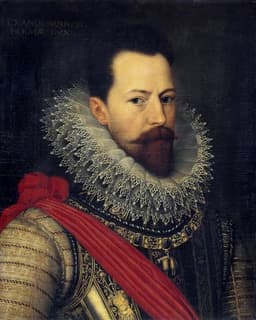
Alessandro Farnese Duke of Parma
General · Modern
69.9Total
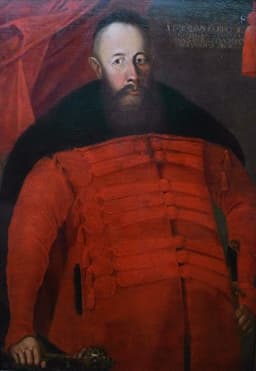
Stanislaw Koniecpolski
General · Modern
61.5Total
Basic Information
Born
1545
1591
Died
1592
1646
Era
Modern
Modern
Nationality
Spain
Poland-Lithuania
Occupation
General
General
Civilization
Western
Western
Score Comparison
Military (10%)
79.9
78.0
Political (20%)
69.2
55.0
Influence (20%)
68.0
56.7
Legacy (20%)
72.0
58.0
Leadership (15%)
62.0
62.0
Strategy (15%)
72.0
75.0
TOTAL
69.9
61.5
Alessandro Farnese Duke of Parma — Complete Timeline
1579 AD
Siege of MaastrichtWar◆ Major
Farnese led Spanish forces in a successful siege of Maastricht, a key rebel stronghold. The city was stormed after a brutal four-month siege, and its defenders were massacred, demonstrating Farnese's military effectiveness.
SiegeDutch RevoltSpanish Army
Impact: regionaldestructive
1585 AD
Siege of AntwerpWar
Farnese captured Antwerp, the largest city in the Netherlands, after a year-long siege. He constructed a bridge of boats across the Scheldt River to blockade the city, forcing its surrender and splitting the rebel provinces.
SiegeDutch RevoltMilitary Engineering
Impact: regional
Reconquest of the Southern NetherlandsWar◆ Major
Through a series of campaigns, Farnese reconquered the southern provinces of the Netherlands (modern-day Belgium) for Spain. This established the basis for the later split between the Dutch Republic and the Spanish Netherlands.
ReconquestNetherlandsSpanish Empire
Impact: regional
1590 AD
Invasion of FranceWar◆ Major
Farnese led a Spanish army into France to support the Catholic League against Henry of Navarre. He relieved the Siege of Paris and later the Siege of Rouen, but his campaigns were hampered by supply issues and political constraints.
French Wars of ReligionSpanish InterventionMilitary Campaign
Impact: regional
Stanislaw Koniecpolski — Complete Timeline
1620 AD
Battle of CecoraWar
Koniecpolski participated as a commander in the Polish defeat at Cecora against Ottoman forces. He was captured and held captive in Istanbul for several years. This event shaped his later military strategies against the Ottomans.
Polish-Ottoman WarBattleCaptivity
Impact: regionaltragic
1624 AD
Battle of MartynowWar
Koniecpolski defeated a large Tatar raid at Martynow, killing or capturing thousands of Tatars. This victory secured the southern border of the Polish-Lithuanian Commonwealth and enhanced his reputation as a defender against Tatar incursions.
Tatar RaidsBattleBorder Defense
Impact: regional
1629 AD
Battle of TrzcianaWar◆ Major
Koniecpolski commanded Polish-Lithuanian forces against Swedish troops under Gustavus Adolphus at Trzciana. The battle resulted in a Polish victory, with Gustavus Adolphus nearly captured. This engagement demonstrated Koniecpolski's military skill against a renowned opponent.
Polish-Swedish WarBattleGustavus Adolphus
Impact: regional
1633 AD
Siege of SmolenskWar◆ Major
Koniecpolski led Polish forces to relieve the besieged city of Smolensk during the Smolensk War. His actions forced the Russian army under Mikhail Shein to surrender, securing a Polish victory and confirming the Treaty of Polyanovka.
Smolensk WarSiegeRussia
Impact: regional
Expert Analysis
Origins
Alessandro Farnese (1545-1592) was born into a powerful Italian family, the son of Duke Ottavio Farnese of Parma and Margaret of Austria, an illegitimate daughter of Holy Roman Emperor Charles V. He was raised in the Spanish court and received a thorough military education under his uncle, King Philip II of Spain. Farnese's early experience included fighting in the Battle of Lepanto (1571) and the Siege of Leiden (1574).
Stanislaw Koniecpolski (1591-1646) was born into a wealthy Polish magnate family. His father, Aleksander Koniecpolski, was a voivode and castellan. Stanislaw received education at the Krakow Academy and studied military tactics under Grand Crown Hetman Stanislaw Zolkiewski. His first major campaign was against the Ottoman Empire in 1618, where he learned the art of border defense.
Rise to Power
Farnese rose to prominence in 1578 when King Philip II appointed him Governor-General of the Spanish Netherlands. His predecessor, Don John of Austria, had died suddenly. Farnese inherited a war against the Dutch rebels and faced the challenge of holding the southern provinces. His first major success was the Siege of Maastricht (1579), where he captured the city after a four-month siege, killing most of the garrison. This victory secured the southern flank and established his reputation as a siege master.
Koniecpolski's rise began during the Polish-Ottoman War (1620-1621). He was captured at the Battle of Cecora (1620) and spent two years in Ottoman captivity. After his release, he was appointed Field Crown Hetman in 1625. His greatest achievement came in 1629 at the Battle of Trzciana, where he decisively defeated the Swedish king Gustavus Adolphus, who was considered one of the best commanders of the era. This victory elevated Koniecpolski to the rank of Grand Crown Hetman in 1632.
Leadership & Governance
Farnese's leadership style was methodical and patient. He excelled in siege warfare, using engineering and blockade tactics. His most famous feat was the Siege of Antwerp (1584-1585), where he built a bridge of boats across the Scheldt River to cut off the city's access to the sea. The bridge withstood Dutch fire ships and allowed Farnese to starve the city into surrender. He scored 72.0 in strategy, reflecting his careful planning. Politically, he scored 69.2, as he skillfully negotiated the Union of Arras (1579) that brought the southern provinces back to Spanish allegiance.
Koniecpolski was a master of mobile warfare, using the Polish winged hussars and light cavalry. His strategy score of 75.0 reflects his ability to outmaneuver enemies. At the Battle of Trzciana, he used a feigned retreat to lure Swedish cavalry into a trap, then encircled them with hussars. He also scored 62.0 in leadership, similar to Farnese, but his political score of 55.0 was lower, as he lacked Farnese's diplomatic finesse and was often at odds with the Polish king.
Triumph & Tragedy
Farnese's greatest triumph was the reconquest of the Southern Netherlands (modern-day Belgium). By 1589, he had captured major cities like Bruges, Ghent, and Brussels, and the southern provinces were firmly under Spanish control. His tragedy came during the invasion of France (1590-1592) to support the Catholic League. Although he relieved the Siege of Paris (1590) and the Siege of Rouen (1592), he was forced to withdraw due to lack of supplies. He died in 1592 from a wound infection, leaving his French campaign unfinished.
Koniecpolski's greatest triumph was the Siege of Smolensk (1633-1634). He relieved the city from a Russian army under Mikhail Shein, forcing the Russians to surrender. This victory ended the Smolensk War and secured Polish control over the region. His tragedy was the Battle of Cecora (1620), where he was captured and held for two years. Additionally, he failed to prevent the Ottoman-Polish War of 1633-1634 from escalating, though he won several border battles.
Character & Destiny
Farnese was a disciplined and patient commander. He was known for his attention to detail and his ability to manage logistics. However, he was also cautious, which sometimes frustrated Philip II, who wanted faster results. His death at 47 cut short his career, but his reconquest of the Southern Netherlands had a lasting impact.
Koniecpolski was aggressive and bold, often leading from the front. He was a master of cavalry tactics and understood the importance of mobility. However, his impulsive nature led to his capture at Cecora. He died at 55 of natural causes, having defended Poland's southern and eastern borders for decades.
Legacy
Farnese's legacy is the creation of the Spanish Netherlands, which later became Belgium. His siege techniques influenced military engineering for generations. He scored 72.0 in legacy, reflecting his role in preserving Spanish control in the region. The bridge at Antwerp was studied by military engineers for centuries.
Koniecpolski's legacy is as one of Poland's greatest military commanders. He scored 58.0 in legacy, lower than Farnese, partly because Poland-Lithuania declined after his death. However, his victories against Sweden and the Ottomans are still remembered in Polish military history. He also influenced the development of Polish cavalry tactics.
Conclusion
Alessandro Farnese had a greater impact than Stanislaw Koniecpolski. While Koniecpolski's tactical brilliance (strategy 75.0 vs 72.0) was impressive, Farnese's strategic reconquest of the Southern Netherlands permanently changed the political map of Europe. Farnese's total score of 69.9 is higher than Koniecpolski's 61.5, and his military score of 79.9 reflects his effectiveness in siege warfare, which was the dominant form of conflict in his era. Koniecpolski's achievements were confined to Eastern Europe and did not alter the balance of power as significantly. Therefore, Farnese stands as the greater commander.
Rankings
🥇
Alessandro Farnese Duke of ParmaLeader
Mil: 79.9Pol: 69.2Inf: 68.0
69.9
🥈
Stanislaw Koniecpolski
Mil: 78.0Pol: 55.0Inf: 56.7
61.5
+8.4 behind
How This Comparison Works
Algorithm
Each figure is scored on 6 dimensions (0—100 scale) based on structured historical data: Military (10%), Political (20%), Influence (20%), Legacy (20%), Leadership (15%), Strategy (15%). The weighted total produces the final ranking.
Data Sources
Scores are computed from structured sub-indicators in the database. Scale factors adjust for era (Ancient ×0.85, Modern ×1.0) and civilization size (Eastern ×1.05, Other ×0.80) to account for differences in population and military scale.
Maximum 3 Figures
Comparisons are limited to 2—3 figures to ensure readability and statistical meaningfulness.
Error Margins
±5 points per dimension — Sub-scores are derived from historical records with inherent uncertainty. Two figures within 5 points on a dimension should be considered roughly equivalent in that area.
Total Score Accuracy
±3 points overall — The weighted combination of 6 dimensions produces a total score with approximately ±3 points of uncertainty. Differences of less than 3 points are not statistically significant— the figures are effectively tied.
Known Limitations
- Historical records are incomplete and uneven across civilizations
- Figures from oral-tradition societies may be underrepresented
- Occupation labels can misclassify multi-role figures
- Scores measure capability and impact, not moral character
- Quantitative scoring is a comparison tool, not absolute truth
Capability Radar
Military (10%) — Battles & Warfare
Battles
85
85
Win Rate
88
90
Expansion
80
75
Political (20%) — Governance & Reform
Reform
65
60
Diplomacy
78
70
Economy
60
55
Influence (20%) — Cultural & Global Reach
Cultural
60
60
Global
70
55
Legacy (20%) — Historical Impact
Historical
75
65
Longevity
65
50
Leadership (15%) — Power & Stability
Tenure
70
65
Stability
55
60
Strategy (15%) — Tactics & Innovation
Strategy
90
85
Tactics
92
88
Reform
75
70
Similar Comparisons
Comments & Discussion
No comments yet. Be the first to share your thoughts!