Loading...
Andrew Jackson vs Stanislaw Koniecpolski
Andrew Jackson leads by 1.2 pts · 2 figures compared
…

Andrew Jackson
General · Modern
62.7Total
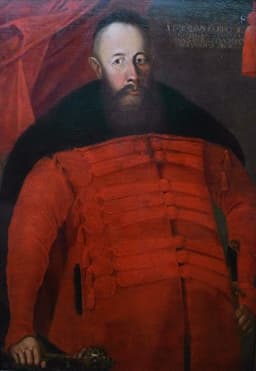
Stanislaw Koniecpolski
General · Modern
61.5Total
Basic Information
Born
1767
1591
Died
1845
1646
Era
Modern
Modern
Nationality
United States
Poland-Lithuania
Occupation
General
General
Civilization
Western
Western
Score Comparison
Military (10%)
70.0
78.0
Political (20%)
72.0
55.0
Influence (20%)
65.0
56.7
Legacy (20%)
55.0
58.0
Leadership (15%)
66.0
62.0
Strategy (15%)
50.0
75.0
TOTAL
62.7
61.5
Andrew Jackson — Complete Timeline
1806 AD
Assassination Attempt and Duel with Charles DickinsonOther
Jackson killed Charles Dickinson in a duel after Dickinson insulted his wife. Jackson was wounded but survived. This event reinforced his reputation for violence and honor in early American politics.
DuelPersonal LifeHonor
destructive
1815 AD
Battle of New OrleansWar◆ Major
Jackson commanded US forces to a decisive victory against the British at the Battle of New Orleans. This victory, occurring after the Treaty of Ghent was signed, made Jackson a national hero and boosted American morale.
War of 1812BattleUS Military
Impact: national
1830 AD
Indian Removal ActPolitical Action
Jackson signed the Indian Removal Act, authorizing the forced relocation of Native American tribes from the southeastern US to lands west of the Mississippi. This led to the Trail of Tears and the displacement of thousands.
Indian RemovalTrail of TearsNative American Policy
Impact: nationaldestructive
1832 AD
Nullification CrisisPolitical Action◆ Major
Jackson faced the Nullification Crisis when South Carolina declared federal tariffs null and void. Jackson threatened military force to enforce federal law, leading to a compromise tariff that defused the crisis.
Nullification CrisisStates' RightsFederal Authority
Impact: national
Bank War and Veto of the Second Bank RecharterPolitical Action◆ Major
Jackson vetoed the recharter of the Second Bank of the United States, arguing it was unconstitutional and favored elites. He then removed federal deposits, leading to the bank's demise and economic instability.
Bank WarEconomic PolicyPresidential Power
Impact: nationaldestructive
Stanislaw Koniecpolski — Complete Timeline
1620 AD
Battle of CecoraWar
Koniecpolski participated as a commander in the Polish defeat at Cecora against Ottoman forces. He was captured and held captive in Istanbul for several years. This event shaped his later military strategies against the Ottomans.
Polish-Ottoman WarBattleCaptivity
Impact: regionaltragic
1624 AD
Battle of MartynowWar
Koniecpolski defeated a large Tatar raid at Martynow, killing or capturing thousands of Tatars. This victory secured the southern border of the Polish-Lithuanian Commonwealth and enhanced his reputation as a defender against Tatar incursions.
Tatar RaidsBattleBorder Defense
Impact: regional
1629 AD
Battle of TrzcianaWar◆ Major
Koniecpolski commanded Polish-Lithuanian forces against Swedish troops under Gustavus Adolphus at Trzciana. The battle resulted in a Polish victory, with Gustavus Adolphus nearly captured. This engagement demonstrated Koniecpolski's military skill against a renowned opponent.
Polish-Swedish WarBattleGustavus Adolphus
Impact: regional
1633 AD
Siege of SmolenskWar◆ Major
Koniecpolski led Polish forces to relieve the besieged city of Smolensk during the Smolensk War. His actions forced the Russian army under Mikhail Shein to surrender, securing a Polish victory and confirming the Treaty of Polyanovka.
Smolensk WarSiegeRussia
Impact: regional
Expert Analysis
Origins
Andrew Jackson was born on March 15, 1767, in the Waxhaws region between North and South Carolina. His family was of Scots-Irish descent, and his father died before his birth. Jackson received a rudimentary education but was largely self-taught. He studied law briefly and became a frontier lawyer in Tennessee. His early experiences included fighting in the American Revolution as a teenage courier, where he was captured and mistreated by the British, fostering a lifelong animosity.
Stanislaw Koniecpolski was born around 1590–1594 in Koniecpol, Poland, into a powerful magnate family. He received a thorough military education, studying under experienced commanders. His family connections allowed him early access to military posts. Koniecpolski participated in the Polish–Muscovite War (1605–1618) as a young officer, gaining practical experience in warfare against Russia and the Tatars.
Rise to Power
Jackson's rise began with his legal career and appointment as a prosecutor in the Western District of North Carolina (later Tennessee). He became a delegate to the Tennessee constitutional convention in 1796 and was elected as Tennessee's first U.S. Representative, then Senator. His military reputation soared during the War of 1812. In 1814, he was appointed Major General of the U.S. Army and defeated the Creek Nation at the Battle of Horseshoe Bend. His decisive victory at the Battle of New Orleans on January 8, 1815, made him a national hero. This fame propelled him to the presidency in 1828.
Koniecpolski's rise was through military service in the Polish–Lithuanian Commonwealth. He distinguished himself in campaigns against the Tatars and Turks. In 1618, he became Field Crown Hetman. His major breakthrough came in 1627 when he was appointed Grand Crown Hetman, the highest military rank. He commanded the Polish forces against Sweden during the Polish–Swedish War (1626–1629). His victory at the Battle of Trzciana in 1629, where he defeated King Gustavus Adolphus of Sweden, cemented his reputation as a leading commander.
Leadership & Governance
Jackson's leadership style was autocratic and populist. As president, he expanded executive power, using the veto more than all predecessors combined. He dismantled the Second Bank of the United States, arguing it was a tool of the elite. He enforced the Indian Removal Act, leading to the forced relocation of Native Americans (Trail of Tears). He also threatened military force during the Nullification Crisis to preserve the Union. His governance reflected a belief in limited federal government but strong executive action. Jackson scored 72.0 in political leadership.
Koniecpolski focused primarily on military matters. He was a skilled strategist and tactician, scoring 75.0 in strategy. He modernized the Polish army, introducing western military reforms. He built fortifications and maintained a strong cavalry. Politically, he was a loyal servant of the Commonwealth, often clashing with the king over policy but never seizing power. He served as a senator and supported the election of King Władysław IV. His political score of 55.0 reflects his limited political ambition.
Triumph & Tragedy
Jackson's greatest triumph was the Battle of New Orleans, where he led a diverse force of regulars, militia, pirates, and free blacks to a crushing victory over the British. His greatest failure was the Indian Removal Act, which caused immense suffering and death for thousands of Native Americans. His legacy is marred by this policy. He also faced economic turmoil from the Bank War, leading to the Panic of 1837.
Koniecpolski's greatest triumph was the Battle of Trzciana, where he defeated Gustavus Adolphus, one of the era's top commanders. He also relieved Smolensk in 1634, forcing Russia to sign the Treaty of Polyanovka. His greatest failure was the Battle of Cecora in 1620, where he was captured and held for ransom. This defeat exposed southern Poland to Tatar raids. He later redeemed himself with victories like Martynow in 1624.
Character & Destiny
Jackson was combative, impulsive, and fiercely loyal. He fought duels, including one where he killed Charles Dickinson. His temper and determination shaped his presidency. His character led to both decisive action and controversial policies. Historical assessments note his role in expanding democracy for white men while undermining Native American sovereignty.
Koniecpolski was disciplined, strategic, and patient. He was known for his ability to recover from defeat. His character focused on military professionalism over personal ambition. He died in 1646, before the full collapse of the Commonwealth, but his military reforms delayed its decline.
Legacy
Jackson's legacy is dual: he is celebrated as a champion of the common man and the founder of the Democratic Party, but condemned for his treatment of Native Americans. His presidency strengthened the executive branch and set precedents for populist politics. His influence on American political culture is enduring, with a legacy score of 55.0.
Koniecpolski is remembered as one of Poland's greatest commanders. His victories against Sweden and Russia are celebrated in Polish history. He contributed to the Commonwealth's military reforms and border security. However, his legacy is less known globally, with an influence score of 56.7.
Conclusion
Andrew Jackson had a greater overall impact due to his broader influence on American political development. While Koniecpolski scored higher in military (78.0 vs 70.0) and strategy (75.0 vs 50.0), Jackson's political score of 72.0 and his role in shaping the presidency give him a higher total score of 62.7 versus 61.5. Jackson's policies affected millions and shaped a nation, whereas Koniecpolski's influence remained within the military sphere of a declining Commonwealth. Thus, Jackson holds the edge in historical significance.
Rankings
🥇
Andrew JacksonLeader
Mil: 70.0Pol: 72.0Inf: 65.0
62.7
🥈
Stanislaw Koniecpolski
Mil: 78.0Pol: 55.0Inf: 56.7
61.5
+1.2 behind
How This Comparison Works
Algorithm
Each figure is scored on 6 dimensions (0—100 scale) based on structured historical data: Military (10%), Political (20%), Influence (20%), Legacy (20%), Leadership (15%), Strategy (15%). The weighted total produces the final ranking.
Data Sources
Scores are computed from structured sub-indicators in the database. Scale factors adjust for era (Ancient ×0.85, Modern ×1.0) and civilization size (Eastern ×1.05, Other ×0.80) to account for differences in population and military scale.
Maximum 3 Figures
Comparisons are limited to 2—3 figures to ensure readability and statistical meaningfulness.
Error Margins
±5 points per dimension — Sub-scores are derived from historical records with inherent uncertainty. Two figures within 5 points on a dimension should be considered roughly equivalent in that area.
Total Score Accuracy
±3 points overall — The weighted combination of 6 dimensions produces a total score with approximately ±3 points of uncertainty. Differences of less than 3 points are not statistically significant— the figures are effectively tied.
Known Limitations
- Historical records are incomplete and uneven across civilizations
- Figures from oral-tradition societies may be underrepresented
- Occupation labels can misclassify multi-role figures
- Scores measure capability and impact, not moral character
- Quantitative scoring is a comparison tool, not absolute truth
Capability Radar
Military (10%) — Battles & Warfare
Battles
45
85
Win Rate
70
90
Expansion
60
75
Political (20%) — Governance & Reform
Reform
65
60
Diplomacy
55
70
Economy
50
55
Influence (20%) — Cultural & Global Reach
Cultural
65
60
Global
60
55
Legacy (20%) — Historical Impact
Historical
70
65
Longevity
65
50
Leadership (15%) — Power & Stability
Tenure
70
65
Stability
45
60
Strategy (15%) — Tactics & Innovation
Strategy
55
85
Tactics
65
88
Reform
40
70
Similar Comparisons
Comments & Discussion
No comments yet. Be the first to share your thoughts!