Loading...
Alessandro Farnese Duke of Parma vs Duke of Wellington
Duke of Wellington leads by 5.1 pts · 2 figures compared
…
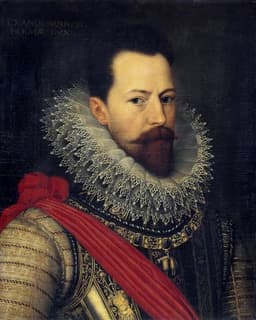
Alessandro Farnese Duke of Parma
General · Modern
69.9Total

Duke of Wellington
General · Modern
75.0Total
Basic Information
Born
1545
1769
Died
1592
1852
Era
Modern
Modern
Nationality
Spain
United Kingdom
Occupation
General
General
Civilization
Western
Western
Score Comparison
Military (10%)
79.9
78.0
Political (20%)
69.2
70.0
Influence (20%)
68.0
71.0
Legacy (20%)
72.0
80.0
Leadership (15%)
62.0
78.0
Strategy (15%)
72.0
72.0
TOTAL
69.9
75.0
Alessandro Farnese Duke of Parma — Complete Timeline
1579 AD
Siege of MaastrichtWar◆ Major
Farnese led Spanish forces in a successful siege of Maastricht, a key rebel stronghold. The city was stormed after a brutal four-month siege, and its defenders were massacred, demonstrating Farnese's military effectiveness.
SiegeDutch RevoltSpanish Army
Impact: regionaldestructive
1585 AD
Siege of AntwerpWar
Farnese captured Antwerp, the largest city in the Netherlands, after a year-long siege. He constructed a bridge of boats across the Scheldt River to blockade the city, forcing its surrender and splitting the rebel provinces.
SiegeDutch RevoltMilitary Engineering
Impact: regional
Reconquest of the Southern NetherlandsWar◆ Major
Through a series of campaigns, Farnese reconquered the southern provinces of the Netherlands (modern-day Belgium) for Spain. This established the basis for the later split between the Dutch Republic and the Spanish Netherlands.
ReconquestNetherlandsSpanish Empire
Impact: regional
1590 AD
Invasion of FranceWar◆ Major
Farnese led a Spanish army into France to support the Catholic League against Henry of Navarre. He relieved the Siege of Paris and later the Siege of Rouen, but his campaigns were hampered by supply issues and political constraints.
French Wars of ReligionSpanish InterventionMilitary Campaign
Impact: regional
Duke of Wellington — Complete Timeline
1803 AD
Battle of AssayeWar◆ Major
Wellington, then Sir Arthur Wellesley, led a British-Indian force to victory against the Maratha Confederacy at Assaye in India. Despite being outnumbered, his tactical skill secured British dominance in central India.
Maratha WarIndiaBattle
Impact: regional
1808 AD
Battle of VimeiroWar◆ Major
Wellington commanded British forces to defeat the French army at Vimeiro in Portugal. The victory halted the French invasion of Portugal and marked the beginning of the Peninsular War.
Peninsular WarPortugalBattle
Impact: regional
1815 AD
Battle of WaterlooWar
Wellington, commanding an Anglo-Allied army, defeated Napoleon Bonaparte at Waterloo in present-day Belgium. The battle ended the Napoleonic Wars and led to Napoleon's final exile to Saint Helena.
Napoleonic WarsBattleWaterloo
Impact: global
1828 AD
Prime Minister of the United KingdomPolitical Action◆ Major
Wellington served as Prime Minister of the UK from 1828 to 1830. His government passed the Catholic Relief Act 1829, granting Catholic emancipation, but his opposition to parliamentary reform led to his resignation.
PoliticsCatholic EmancipationReform
Impact: nationalconstructive
Expert Analysis
Origins
Alessandro Farnese, born in 1545 in Rome, was the son of Ottavio Farnese, Duke of Parma, and Margaret of Austria, illegitimate daughter of Holy Roman Emperor Charles V. Raised at the Spanish court alongside his cousin Philip II, Farnese received a thorough military education under the Duke of Alba. His noble lineage and Habsburg connections positioned him for high command.
Arthur Wellesley, later Duke of Wellington, was born in 1769 in Dublin, Ireland, into the Anglo-Irish aristocracy. As the third son of the Earl of Mornington, he attended Eton and a military academy in France. His early career was shaped by family patronage, purchasing a commission in the British Army in 1787. Unlike Farnese, Wellesley's rise was gradual and marked by service in India.
Rise to Power
Farnese's rise began during the Eighty Years' War. In 1578, after the death of Don John of Austria, Philip II appointed Farnese as Governor-General of the Spanish Netherlands. His first major success was the Siege of Maastricht (1579), where he stormed the city after a four-month siege, killing most of the garrison. This victory established his reputation. His turning point was the Siege of Antwerp (1584-1585), where he constructed a bridge of boats across the Scheldt to blockade the city, forcing its surrender. This feat earned him the command of the Army of Flanders.
Wellington's rise came through the Napoleonic Wars. His first major independent command was in India, where he won the Battle of Assaye (1803) against the Maratha Confederacy, despite being outnumbered. This earned him a knighthood. In the Peninsular War (1808-1814), he commanded British forces in Portugal. His victory at Vimeiro (1808) halted the French invasion, and his defensive lines at Torres Vedras (1810) forced French retreat. His turning point was the Battle of Salamanca (1812), which broke French power in Spain.
Leadership & Governance
Farnese's leadership style was methodical and diplomatic. He combined military force with negotiation, offering amnesty to rebel cities that surrendered. His governance of the Southern Netherlands restored Spanish control through a mix of reconquest and conciliation. He scored 62.0 in leadership, reflecting his reliance on Spanish authority rather than personal charisma. His political score of 69.2 was boosted by his ability to manage the complex court of Philip II.
Wellington's leadership was authoritative and pragmatic. He commanded through strict discipline and careful planning, famously stating that he 'never gave an order without knowing it could be executed.' His leadership score of 78.0 reflects his ability to inspire troops through competence rather than flamboyance. As Prime Minister (1828-1830), he passed the Catholic Relief Act 1829, a political achievement that scored 70.0 in political influence.
Triumph & Tragedy
Farnese's greatest triumph was the Reconquest of the Southern Netherlands (1579-1589), which secured modern-day Belgium for Spain. His bridge of boats at Antwerp was an engineering masterpiece. However, his tragedy came in France. Invading to support the Catholic League, he relieved Paris (1590) and Rouen (1592), but his army was ravaged by disease and he was undermined by Spanish court politics. He died in 1592 at age 47, his plans for a unified Netherlands unfulfilled.
Wellington's triumph was Waterloo (1815), where he defeated Napoleon decisively, ending the Napoleonic Wars. His defensive ridge and use of terrain were tactical masterpieces. His tragedy was political: as Prime Minister, he opposed parliamentary reform, earning the nickname 'the Iron Duke' for repressing protests. His government fell in 1830 over the Reform Bill. He died in 1852 at age 83, honored but controversial.
Character & Destiny
Farnese was patient and calculating, but his destiny was limited by Philip II's micromanagement. He scored 72.0 in strategy, reflecting his siegecraft, but his political score of 69.2 was constrained by court intrigue. His character—loyal, efficient, but not independent—led him to be replaced when his successes threatened the king's jealousy.
Wellington was pragmatic and blunt, with a strategic score of 72.0 equal to Farnese. His military score of 78.0 reflects his ability to win against superior forces. His character—decisive and principled—shaped his fate as a national hero despite political unpopularity. He scored 80.0 in legacy, higher than Farnese's 72.0, because Waterloo became a symbol of European stability.
Legacy
Farnese's legacy is the permanent division of the Netherlands. The Southern Netherlands remained Spanish until 1714, forming the basis of modern Belgium. His military methods influenced siege warfare, but his strategic vision was limited. He scores 72.0 in legacy, reflecting his impact on the Eighty Years' War.
Wellington's legacy is global. He is remembered as the victor of Waterloo, a battle that reshaped Europe. His political legacy includes Catholic emancipation and a model of civil-military relations. His scores—80.0 in legacy, 78.0 in military—reflect his enduring fame. His name adorns streets, squares, and a beef dish.
Conclusion
While Farnese was a superior siege commander with a military score of 79.9 to Wellington's 78.0, Wellington's overall impact was greater. His political score of 70.0 against Farnese's 69.2, and legacy score of 80.0 against 72.0, give him a total of 75.0 versus 69.9. Wellington's victory at Waterloo ended a global conflict, while Farnese's reconquest only prolonged a war. Wellington's influence extends into modern politics, whereas Farnese's impact is confined to military history. Thus, the Duke of Wellington had greater historical impact.
Rankings
🥇
Duke of WellingtonLeader
Mil: 78.0Pol: 70.0Inf: 71.0
75.0
🥈
Alessandro Farnese Duke of Parma
Mil: 79.9Pol: 69.2Inf: 68.0
69.9
+5.1 behind
How This Comparison Works
Algorithm
Each figure is scored on 6 dimensions (0—100 scale) based on structured historical data: Military (10%), Political (20%), Influence (20%), Legacy (20%), Leadership (15%), Strategy (15%). The weighted total produces the final ranking.
Data Sources
Scores are computed from structured sub-indicators in the database. Scale factors adjust for era (Ancient ×0.85, Modern ×1.0) and civilization size (Eastern ×1.05, Other ×0.80) to account for differences in population and military scale.
Maximum 3 Figures
Comparisons are limited to 2—3 figures to ensure readability and statistical meaningfulness.
Error Margins
±5 points per dimension — Sub-scores are derived from historical records with inherent uncertainty. Two figures within 5 points on a dimension should be considered roughly equivalent in that area.
Total Score Accuracy
±3 points overall — The weighted combination of 6 dimensions produces a total score with approximately ±3 points of uncertainty. Differences of less than 3 points are not statistically significant— the figures are effectively tied.
Known Limitations
- Historical records are incomplete and uneven across civilizations
- Figures from oral-tradition societies may be underrepresented
- Occupation labels can misclassify multi-role figures
- Scores measure capability and impact, not moral character
- Quantitative scoring is a comparison tool, not absolute truth
Capability Radar
Military (10%) — Battles & Warfare
Battles
85
85
Win Rate
88
90
Expansion
80
75
Political (20%) — Governance & Reform
Reform
65
65
Diplomacy
78
80
Economy
60
60
Influence (20%) — Cultural & Global Reach
Cultural
60
75
Global
70
80
Legacy (20%) — Historical Impact
Historical
75
85
Longevity
65
80
Leadership (15%) — Power & Stability
Tenure
70
75
Stability
55
70
Strategy (15%) — Tactics & Innovation
Strategy
90
88
Tactics
92
92
Reform
75
70
Similar Comparisons
Comments & Discussion
No comments yet. Be the first to share your thoughts!