Loading...
Alassane Ouattara vs Julius Caesar
Julius Caesar leads by 30.1 pts · 2 figures compared
…
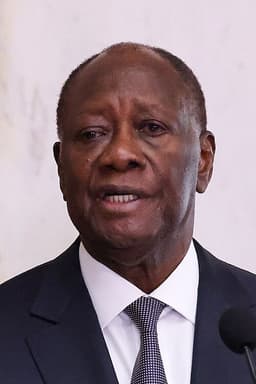
Alassane Ouattara
Politician · Modern
52.7Total

Julius Caesar
General · Ancient
82.8Total
Basic Information
Born
1942
-100
Died
—
-44
Era
Modern
Ancient
Nationality
Ivory Coast
Roman Republic
Occupation
Politician
General
Civilization
Other
Western
Score Comparison
Military (10%)
23.0
88.0
Political (20%)
65.7
78.0
Influence (20%)
55.7
85.0
Legacy (20%)
45.8
82.0
Leadership (15%)
72.0
80.0
Strategy (15%)
43.9
85.0
TOTAL
52.7
82.8
Alassane Ouattara — Complete Timeline
1990 AD
Appointed Prime Minister of Ivory CoastPolitical Action◆ Major
Ouattara was appointed Prime Minister by President F
Prime MinisterEconomic ReformIvory Coast
Impact: nationalconstructive
2000 AD
Excluded from Presidential ElectionsPolitical Action◆ Major
Ouattara was barred from running for president due to a nationality law requiring both parents to be Ivorian. His exclusion fueled political tensions and contributed to the country's instability and civil war.
ExclusionNationality LawIvory Coast
Impact: nationaldestructive
2010 AD
Elected President of Ivory CoastPolitical Action
Ouattara won the presidential election against incumbent Laurent Gbagbo, but Gbagbo refused to step down. The disputed result led to a five-month civil war, ending with Ouattara assuming office after Gbagbo's arrest.
ElectionCivil WarIvory Coast
Impact: regionalconstructive
2015 AD
Re-elected President of Ivory CoastPolitical Action◆ Major
Ouattara won a second term with 83.7% of the vote in an election deemed peaceful and credible by observers. His victory reflected support for his economic recovery policies and post-war reconciliation efforts.
ElectionIvory CoastRe-election
Impact: nationalconstructive
2020 AD
Controversial Third Term BidPolitical Action◆ Major
Ouattara announced he would run for a third term after the death of his chosen successor, sparking opposition protests and violence. The election was boycotted by the opposition, and Ouattara won with 94% of the vote.
Third TermElectionIvory Coast
Impact: nationaldestructive
Julius Caesar — Complete Timeline
58 BC
Gallic WarsWar◆ Major
Caesar, as proconsul of Gaul, launched a series of campaigns that conquered all of Gaul (modern France, Belgium, and parts of Switzerland). He fought numerous battles, including against the Helvetii, the Belgae, and the Gallic chieftain Vercingetorix. The wars brought immense wealth and a loyal army to Caesar.
Gallic WarsConquestRoman Expansion
Impact: regional
49 BC
Crossing the RubiconPolitical Action◆ Major
Caesar led Legio XIII across the Rubicon River into Italy, defying the Roman Senate's order to disband his army. This act triggered a civil war against Pompey and the Optimates, ultimately leading to Caesar's dictatorship and the end of the Roman Republic.
Roman Civil WarEnd of RepublicPower Struggle
Impact: global
48 BC
Battle of PharsalusWar◆ Major
Caesar's outnumbered army defeated the larger forces of Pompey the Great at Pharsalus in Greece. Caesar's tactical use of a reserve line to counter Pompey's cavalry charge proved decisive. Pompey fled to Egypt, where he was assassinated, leaving Caesar as the undisputed master of the Roman world.
Roman Civil WarBattleDecisive Victory
Impact: regional
44 BC
Appointment as Dictator for LifePolitical Action◆ Major
The Roman Senate appointed Caesar dictator perpetuo (dictator for life), granting him unprecedented personal power. This move concentrated military, legislative, and judicial authority in one person, effectively ending the Roman Republic's traditional system of checks and balances and alarming many senators.
DictatorshipEnd of RepublicPower Consolidation
Impact: regionaldestructive
Assassination on the Ides of MarchPolitical Action◆ Major
A group of Roman senators, led by Marcus Junius Brutus and Gaius Cassius Longinus, stabbed Caesar to death at a meeting of the Senate in the Theatre of Pompey. The assassination was intended to restore the Republic, but instead triggered another civil war that led to the rise of the Roman Empire.
AssassinationRoman PoliticsEnd of Republic
Impact: globaldestructive
Expert Analysis
alassane-ouattara-vs-julius-caesar
# The Dictator and the Economist: When History Repeats as Farce
On a January morning in 44 BCE, Julius Caesar stood before the Roman Senate, his toga stained with the blood of twenty-three stab wounds. He had conquered Gaul, crossed the Rubicon, and made himself master of the Mediterranean world—only to fall at the feet of his closest allies. Two thousand years later, in the sweltering heat of Abidjan, Alassane Ouattara sat in the presidential palace, a former IMF economist who had risen through the ranks of global finance to rule a nation torn by civil war. One man built an empire; the other rebuilt a country. Yet both faced the same ancient question: how does a leader seize power, and what does it cost to keep it?
Origins
Julius Caesar was born into the patrician Julian clan, a family with a storied past but little contemporary influence. Rome in the first century BCE was a republic in decay—corrupt senators, landless veterans, and slave revolts tearing at the fabric of tradition. Caesar’s uncle by marriage, Gaius Marius, had been a populist reformer; his father-in-law, Lucius Cornelius Cinna, a radical democrat. From childhood, Caesar breathed the air of political upheaval. He learned that Rome’s old rules could be bent, broken, or rewritten by a man with enough ambition and audacity.
Alassane Ouattara was born in 1942 in Dimbokro, Ivory Coast, then a French colony. His family was Muslim and relatively prosperous—his father a planter, his mother a trader. But unlike Caesar, Ouattara did not inherit a political legacy; he earned a PhD in economics from the University of Pennsylvania. The world he entered was one of decolonization, Cold War maneuvering, and the rise of strongmen across Africa. Ivory Coast’s first president, Félix Houphouët-Boigny, had ruled for three decades with a mix of paternalism and pragmatism. Ouattara watched and learned: power in post-colonial Africa flowed not from the sword but from access to international capital and the loyalty of ethnic networks.
Rise to Power
Caesar’s path to dominance was forged on battlefields. In 58 BCE, at age 42, he took command of the Roman province of Gaul. Over the next eight years, he conquered what is now France, Belgium, and parts of Germany, defeating over a million enemies and earning the undying loyalty of his legions. His Commentaries on the Gallic Wars were not just military reports—they were political propaganda, broadcast to Rome to shape public opinion. When the Senate ordered him to disband his army, Caesar refused. In 49 BCE, he crossed the Rubicon River, a line that meant civil war. “The die is cast,” he reportedly said. Within four years, he had defeated his rivals and declared himself dictator for life.
Ouattara’s rise was quieter but no less dramatic. In 1990, President Houphouët-Boigny appointed him Prime Minister, the first to hold that post. Ouattara was a technocrat, not a warrior—he negotiated loans with the IMF and balanced budgets while the country’s cocoa wealth evaporated. But when Houphouët-Boigny died in 1993, a power struggle erupted. Ouattara was sidelined by a nationalist faction that questioned his Ivorian citizenship. In 2000, a new constitution required both parents to be Ivorian-born—a rule clearly aimed at excluding him. He was barred from running for president, and the country slid into a decade of rebellion and partition. Ouattara waited, building alliances with northern ethnic groups and former rebels. When elections finally came in 2010, he won. But incumbent Laurent Gbagbo refused to accept defeat. The standoff killed over 3,000 people before French troops intervened and Gbagbo was arrested. Ouattara took office in April 2011, not as a conqueror but as a survivor of a broken system.
Leadership & Governance
Caesar governed as he fought: decisively and ruthlessly. He reformed the calendar, granted citizenship to provincials, and launched massive public works to employ Rome’s poor. His military strategy was based on speed, surprise, and the personal bond with his soldiers—he fought alongside them, shared their rations, and rewarded them with land. Yet his political wisdom was flawed. He pardoned his enemies, assuming they would be grateful; instead, they plotted his death. He centralized power, but never built institutions to sustain it. His reforms were brilliant improvisations, not a coherent system.
Ouattara governed as an economist: cautiously, with spreadsheets and growth targets. He secured debt relief, attracted foreign investment, and oversaw annual GDP growth of 8-9% between 2012 and 2019. He rebuilt roads, ports, and schools in a country shattered by war. His political style was transactional—he co-opted former rebels into his government and rewarded loyalists with cabinet posts. But his strategy had limits. He relied heavily on his own ethnic base, the Dioula, and struggled to heal the north-south divide that had sparked the civil war. When his chosen successor died in 2020, Ouattara ran for a controversial third term, triggering protests that left 85 dead. He won with 94% of the vote—a figure that echoed the one-party elections of Houphouët-Boigny’s era.
Triumph & Tragedy
Caesar’s greatest triumph was his conquest of Gaul, a feat that doubled Rome’s territory and made him the richest man in the Republic. His greatest tragedy was his assassination on the Ides of March, 44 BCE—a death that proved, as Shakespeare later wrote, that “ambition should be made of sterner stuff.” He died at 55, his work unfinished, his adopted heir Octavian left to finish the civil wars and found the Empire.
Ouattara’s greatest triumph was ending the 2010-2011 post-election crisis and restoring peace to Ivory Coast. His greatest tragedy is the incompleteness of that peace. The 2020 election crisis, the boycotts, and the lingering ethnic tensions show that economic growth alone cannot heal political wounds. At 82, he has outlived Caesar by nearly three decades, but his legacy remains fragile.
Character & Destiny
Caesar was driven by an insatiable need for glory. He believed in his own destiny—his divine ancestry, his luck, his genius. This hubris made him bold but blind. He ignored warnings of the conspiracy because he could not imagine his equals turning against him. Ouattara is driven by a technocrat’s conviction that the right policies can fix anything. He trusts numbers more than narratives, growth more than grievances. This pragmatism made him effective but aloof. He struggles to inspire loyalty beyond his inner circle.
Legacy
Caesar’s legacy is the Roman Empire itself. His name became a title—Kaiser, Tsar—that echoed across Europe for two millennia. He transformed the Republic into a monarchy, for better and worse. Ouattara’s legacy is more modest but no less significant. He proved that a former IMF economist could lead a post-conflict African nation to stability and prosperity. Yet he also showed that democracy in Africa remains fragile, dependent on the goodwill of strongmen who refuse to leave.
Conclusion
Two men, two millennia apart. One conquered the world with a sword; the other rebuilt a nation with a spreadsheet. Caesar died on the Senate floor, betrayed by friends. Ouattara still sits in the presidential palace, surrounded by advisors who once fought against him. The lesson is not that power corrupts—it is that power reveals. Caesar revealed the grandeur and tragedy of ambition unleashed. Ouattara reveals the promise and peril of order imposed. History does not repeat itself, but sometimes it rhymes—in the blood of assassins, in the silence of ballots, in the long, slow work of building something that outlasts the builder.
Rankings
🥇
Julius CaesarLeader
Mil: 88.0Pol: 78.0Inf: 85.0
82.8
🥈
Alassane Ouattara
Mil: 23.0Pol: 65.7Inf: 55.7
52.7
+30.1 behind
How This Comparison Works
Algorithm
Each figure is scored on 6 dimensions (0—100 scale) based on structured historical data: Military (10%), Political (20%), Influence (20%), Legacy (20%), Leadership (15%), Strategy (15%). The weighted total produces the final ranking.
Data Sources
Scores are computed from structured sub-indicators in the database. Scale factors adjust for era (Ancient ×0.85, Modern ×1.0) and civilization size (Eastern ×1.05, Other ×0.80) to account for differences in population and military scale.
Maximum 3 Figures
Comparisons are limited to 2—3 figures to ensure readability and statistical meaningfulness.
Error Margins
±5 points per dimension — Sub-scores are derived from historical records with inherent uncertainty. Two figures within 5 points on a dimension should be considered roughly equivalent in that area.
Total Score Accuracy
±3 points overall — The weighted combination of 6 dimensions produces a total score with approximately ±3 points of uncertainty. Differences of less than 3 points are not statistically significant— the figures are effectively tied.
Known Limitations
- Historical records are incomplete and uneven across civilizations
- Figures from oral-tradition societies may be underrepresented
- Occupation labels can misclassify multi-role figures
- Scores measure capability and impact, not moral character
- Quantitative scoring is a comparison tool, not absolute truth
Capability Radar
Military (10%) — Battles & Warfare
Battles
20
95
Win Rate
23
92
Expansion
27
97
Political (20%) — Governance & Reform
Reform
70
90
Diplomacy
68
85
Economy
75
82
Influence (20%) — Cultural & Global Reach
Cultural
30
88
Global
45
94
Legacy (20%) — Historical Impact
Historical
40
95
Longevity
35
96
Leadership (15%) — Power & Stability
Tenure
65
75
Stability
55
60
Strategy (15%) — Tactics & Innovation
Strategy
30
94
Tactics
32
96
Reform
38
88
Similar Comparisons
Comments & Discussion
CONQUEROR_TOLD6/17/2026
Classic military history perspective: Caesar won because he understood terrain, logistics, and loyalty—crossing the Rubicon wasn't just drama, it was a calculated risk to trap Pompey between armies. Ouattara's "victory" came from excel spreadsheets and IMF loans. You can't storm a Senate with quarterly reports. Caesar had legions; Quattara had austerity measures. Rome bled for power; Ivory Coast bled for a ballot box. Different eras, same blood—but Caesar at least knew how to die like a general.
暗流明6/17/2026
经济与战争的逻辑根本不对等——凯撒在卢比孔河赌的是三千年后的历史评判,而瓦塔拉在2010年赌的是十几万人的生存。凯撒的敌人庞培有海军,瓦塔拉的敌人巴博有米切尔支持的雇佣军。一个靠军团长投诚,一个靠联合国直升机押送。你可以赞颂征服,别把经济紧缩和军团冲锋混为一谈。本质都是权力游戏,但筹码完全不同。
CURSED_METRICS6/17/2026
Stop romanticizing body counts. Caesar's Gallic Wars killed an estimated 1 million people according to Plutarch; modern scholars call that exaggerated, but even half is catastrophic. Ouattara's post-election crisis killed roughly 3,000. By sheer scale, Caesar is the bigger monster, not the bigger man. If efficiency is your metric, Ouattara "won" with a fraction of the blood. But we still call Caesar a genius and Ouattara a strongman. Let's be honest: we romanticize ancient slaughter because it's
锈迹斑斑6/17/2026
凯撒遇刺时62岁,瓦塔拉今年82了还在执政。一个死于理想主义,一个死于不放手。凯撒的《高卢战记》至今被当作古典文学的典范;瓦塔拉的回忆录会是什么?IMF的贷款结构图?两人都试图重构权力秩序,但凯撒留下的是一部未完的史诗,瓦塔拉留下一部未完的经济改革草案。历史只会记住有故事的人。