Loading...
This comparison has not been analyzed yet.
One-time AI generation (~1 minute). Scores and timeline are already available below.
Al-Mustamsik of Cairo vs Toghon Temur
Al-Mustamsik of Cairo leads by 4.5 pts · 2 figures compared
…

Al-Mustamsik of Cairo
Emperor · Medieval
43.8Total
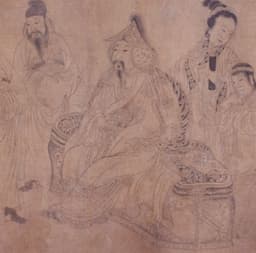
Toghon Temur
Emperor · Medieval
39.3Total
Basic Information
Born
1460
1320
Died
1521
1370
Era
Medieval
Medieval
Nationality
Abbasid Caliphate
China
Occupation
Emperor
Emperor
Civilization
Middle Eastern
Eastern
Score Comparison
Military (10%)
32.3
21.2
Political (20%)
39.4
30.7
Influence (20%)
45.5
49.4
Legacy (20%)
35.8
40.0
Leadership (15%)
55.3
41.5
Strategy (15%)
60.0
39.6
TOTAL
43.8
39.3
Al-Mustamsik of Cairo — Complete Timeline
1497 AD
Accession as CaliphPolitical Action
Al-Mustamsik became caliph after the death of Al-Mutawakkil II. His reign occurred during the final decades of the Mamluk Sultanate, a period of decline and external threats.
Caliphal SuccessionMamluk Decline
1516 AD
Abdication in Favor of SonPolitical Action◆ Major
Al-Mustamsik abdicated the caliphate in favor of his son Al-Mutawakkil III. This was likely done to ensure a smooth succession, but it occurred on the eve of the Ottoman conquest of Egypt.
AbdicationSuccession
Toghon Temur — Complete Timeline
1333 AD
Accession to the Yuan thronePolitical Action◆ Major
Toghon Temur was enthroned as Emperor of the Yuan dynasty at age 13, following the death of his predecessor and the fall of the El Temur regency. His reign would be the last of the Yuan dynasty in China.
Yuan dynastySuccessionLast emperor
Impact: national
1340 AD
Overthrow of Chancellor BayanPolitical Action◆ Major
Toghon Temur, with support from Bayan's nephew Toqto'a, orchestrated a coup that removed the powerful chancellor Bayan from power. This restored imperial authority and reversed Bayan's anti-Chinese policies.
CoupImperial authorityBayan
Impact: nationalconstructive
1351 AD
Outbreak of the Red Turban RebellionWar
Widespread rebellions, known as the Red Turban Rebellion, erupted across southern China against Yuan rule. Toghon Temur's government struggled to suppress the revolts, which were fueled by famine, corruption, and ethnic tensions.
RebellionYuan declineRed Turbans
Impact: nationaltragic
1368 AD
Flight to Shangdu and loss of ChinaWar
As Ming forces under Zhu Yuanzhang approached Dadu (Beijing), Toghon Temur fled north to Shangdu, the Yuan summer capital. This marked the end of Mongol rule over China proper and the beginning of the Northern Yuan dynasty.
Ming conquestYuan collapseFlight
Impact: globaltragic
1370 AD
Death in exileOther◆ Major
Toghon Temur died in Yingchang, a Mongol stronghold in Inner Mongolia, two years after fleeing China. His death left the Northern Yuan dynasty in a weakened state, unable to reclaim the lost territories.
DeathExileNorthern Yuan
Impact: regionaltragic
This comparison has not been analyzed yet.
One-time AI generation (~1 minute). Scores and timeline are already available below.
Rankings
🥇
Al-Mustamsik of CairoLeader
Mil: 32.3Pol: 39.4Inf: 45.5
43.8
🥈
Toghon Temur
Mil: 21.2Pol: 30.7Inf: 49.4
39.3
+4.5 behind
How This Comparison Works
Algorithm
Each figure is scored on 6 dimensions (0—100 scale) based on structured historical data: Military (10%), Political (20%), Influence (20%), Legacy (20%), Leadership (15%), Strategy (15%). The weighted total produces the final ranking.
Data Sources
Scores are computed from structured sub-indicators in the database. Scale factors adjust for era (Ancient ×0.85, Modern ×1.0) and civilization size (Eastern ×1.05, Other ×0.80) to account for differences in population and military scale.
Maximum 3 Figures
Comparisons are limited to 2—3 figures to ensure readability and statistical meaningfulness.
Error Margins
±5 points per dimension — Sub-scores are derived from historical records with inherent uncertainty. Two figures within 5 points on a dimension should be considered roughly equivalent in that area.
Total Score Accuracy
±3 points overall — The weighted combination of 6 dimensions produces a total score with approximately ±3 points of uncertainty. Differences of less than 3 points are not statistically significant— the figures are effectively tied.
Known Limitations
- Historical records are incomplete and uneven across civilizations
- Figures from oral-tradition societies may be underrepresented
- Occupation labels can misclassify multi-role figures
- Scores measure capability and impact, not moral character
- Quantitative scoring is a comparison tool, not absolute truth
Capability Radar
Military (10%) — Battles & Warfare
Battles
30
15
Win Rate
37
10
Expansion
37
5
Political (20%) — Governance & Reform
Reform
0
10
Diplomacy
5
15
Economy
0
10
Influence (20%) — Cultural & Global Reach
Cultural
5
20
Global
5
15
Legacy (20%) — Historical Impact
Historical
10
25
Longevity
5
15
Leadership (15%) — Power & Stability
Tenure
5
40
Stability
5
10
Strategy (15%) — Tactics & Innovation
Strategy
39
10
Tactics
41
10
Reform
45
5
Similar Comparisons
Comments & Discussion
No comments yet. Be the first to share your thoughts!