Loading...
Al-Amin vs Pachacuti
Pachacuti leads by 29.5 pts · 2 figures compared
…

Al-Amin
Emperor · Medieval
39.9Total
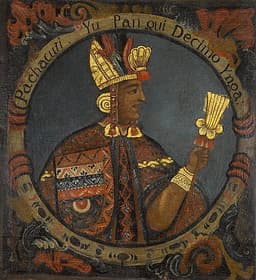
Pachacuti
Emperor · Medieval
69.4Total
Basic Information
Born
787
1418
Died
813
1472
Era
Medieval
Medieval
Nationality
Abbasid Caliphate
Inca Empire
Occupation
Emperor
Emperor
Civilization
Middle Eastern
Other
Score Comparison
Military (10%)
50.0
78.5
Political (20%)
30.7
58.1
Influence (20%)
47.9
65.0
Legacy (20%)
38.3
72.0
Leadership (15%)
33.6
78.0
Strategy (15%)
36.8
69.2
TOTAL
39.9
69.4
Al-Amin — Complete Timeline
811 AD
Fourth Fitna (Civil War)War
Al-Amin's reign was dominated by the Fourth Fitna, a civil war against his brother al-Mamun. The conflict began when al-Amin tried to remove al-Mamun from succession, leading to a devastating war that weakened the Abbasid Caliphate.
Impact: regionaldestructive
812 AD
Siege of BaghdadWar◆ Major
Al-Mamun's forces, led by Tahir ibn Husayn, besieged Baghdad in 812-813. The siege lasted over a year, causing widespread destruction and famine. Al-Amin was captured and executed in 813, ending his caliphate.
Impact: regionaltragic
813 AD
Execution of Al-AminPolitical Action◆ Major
After the fall of Baghdad, al-Amin was captured by Tahir's forces. He was executed on al-Mamun's orders, marking the end of the civil war and the beginning of al-Mamun's sole rule.
Impact: nationaltragic
Pachacuti — Complete Timeline
1438 AD
Conquest of the Chanka KingdomWar
Pachacuti led the Inca army to defeat the Chanka, a powerful rival, in a decisive battle near Cusco. This victory secured his position as Sapa Inca and initiated a period of rapid expansion, transforming the Inca from a small kingdom into a vast empire.
ConquestInca ExpansionChanka
Impact: regional
1440 AD
Reconstruction of CuscoCultural◆ Major
Pachacuti rebuilt Cusco as the imperial capital, designing it in the shape of a puma and constructing massive stone structures like Sacsayhuam
Urban PlanningArchitectureInca Empire
Impact: regionalconstructive
1450 AD
Initiation of Machu Picchu's ConstructionCultural◆ Major
Pachacuti ordered the construction of Machu Picchu, a royal estate and ceremonial site high in the Andes. The complex featured sophisticated dry-stone masonry and terraced agriculture, serving as a symbol of Inca engineering and a retreat for the emperor.
ArchitectureRoyal EstateInca Engineering
Impact: regionalconstructive
Expert Analysis
Pachacuti vs Al-Amin
### The Emperor and the Caliph: Two Paths to Power and Ruin
History is a theater of contrasts, and few are as stark as that between Pachacuti, the ninth Sapa Inca who forged a mountain empire from a single city-state, and Al-Amin, the Abbasid caliph who lost a world-spanning caliphate in a war against his own brother. One died atop the Andes, his legacy carved in stone; the other perished in a ditch outside Baghdad, his name a footnote to a fratricidal struggle. What drove these two rulers—both born to power, both inheritors of ancient civilizations—to such divergent ends?
### Origins
Pachacuti was born in 1418 into a world of high-altitude rivalries. The Inca were then a modest kingdom in the Cusco Valley, surrounded by more powerful neighbors like the Chanka. His father, Viracocha Inca, was a capable ruler, but Pachacuti’s early life was one of training in the harsh Andean climate—learning the art of war, the management of *ayllus* (kinship groups), and the sacred geography of the sun god Inti. The Inca world was one of oral tradition, steeped in ritual, where the land itself was alive with meaning.
Al-Amin, born in 787, entered a very different universe: the Abbasid Caliphate, a sprawling empire stretching from North Africa to Central Asia. His father, Harun al-Rashid, was the legendary caliph of *One Thousand and One Nights*, a patron of learning and commerce. Baghdad was the jewel of the world—a city of scholars, merchants, and poets. Al-Amin grew up in a palace of silk and marble, surrounded by courtiers and theologians, his education steeped in the Quran, Greek philosophy, and Persian statecraft. But he was also the son of a divided inheritance: Harun had named both Al-Amin and his half-brother Al-Mamun as heirs, a decision that planted a seed of civil war.
### Rise to Power
Pachacuti’s rise was forged in crisis. In 1438, the Chanka—a formidable confederation—descended on Cusco. Viracocha Inca fled, but young Pachacuti rallied the city’s defenders. The Battle of the Chanka was not just a military victory; it was a spiritual transformation. According to Inca myth, the very stones of Cusco rose up to fight alongside him. Pachacuti emerged not merely as a general but as a living god, a *Sapa Inca* who had saved his people. From that moment, he was the architect of an empire.
Al-Amin’s path was smoother—and therefore more treacherous. He became caliph in 809 upon Harun’s death, inheriting the western half of the caliphate, while Al-Mamun ruled the east from Merv. The arrangement was fragile. Al-Amin, surrounded by ambitious courtiers, soon began to provoke his brother, denouncing him as a heretic and demanding he renounce his claim. In 811, the Fourth Fitna erupted—a civil war that would consume the caliphate. Unlike Pachacuti, who had faced a clear external enemy, Al-Amin’s enemy was his own blood.
### Leadership & Governance
Pachacuti’s genius lay in synthesis. He did not merely conquer; he incorporated. After defeating the Chanka, he embarked on a systematic campaign to subdue the Andean peoples—from the Lake Titicaca basin to the highlands of Ecuador. His military strategy was brutal but efficient: he offered a choice—submit and be absorbed, or resist and be annihilated. Those who surrendered were allowed to keep their local leaders, but their children were sent to Cusco to learn Inca ways. This policy of *mitma* (forced resettlement) and *quechua* (language standardization) created a unified imperial culture.
Pachacuti also rebuilt Cusco as a sacred city, shaped like a puma—a symbol of earthly power. He ordered the construction of Machu Picchu around 1450, a royal estate perched on a knife-edge ridge, a testament to his vision of harmony between man and mountain. His administrative reforms—the decimal system of provinces, the *mita* labor tax, the storehouses that fed his armies—were as revolutionary as his conquests. By his death in 1472, the Inca Empire stretched 2,500 miles.
Al-Amin’s governance was a study in failure. He was not a fool—he was a patron of poetry and a man of charm—but he lacked the political cunning of his brother. Rather than consolidate power through diplomacy, he alienated the powerful Khurasanian army that had long supported the Abbasids. He appointed his own favorites, many of them corrupt, and ignored the growing discontent in the provinces. When war came, he was trapped in Baghdad, a city of 1.5 million people that was more a maze of palaces than a fortress. The siege of Baghdad in 812-813 was a catastrophe: Al-Mamun’s general, Tahir ibn Husayn, cut off food and water, and the city descended into famine and chaos. Al-Amin’s military strategy was nonexistent—he relied on mercenaries and empty promises.
### Triumph & Tragedy
Pachacuti’s greatest triumph was the transformation of the Inca from a hill kingdom into a continental power. He died in his bed, surrounded by his sons, his empire at its zenith. But there was a tragedy: his reforms were so personal, so tied to his own charisma, that they would later prove brittle. His son Topa Inca would expand the empire further, but the lack of a written language and the overcentralization of power made the Inca vulnerable to a handful of Spanish adventurers.
Al-Amin’s tragedy was total. He was captured in 813 while trying to escape Baghdad by boat. Tahir’s soldiers dragged him ashore, and he was executed—a caliph killed by his own brother’s order. His body was left unburied for days. The Fourth Fitna did not end with his death; it left the Abbasid Caliphate shattered. Al-Mamun’s victory came at the cost of Baghdad’s prestige, the rise of regional warlords, and the slow decay of central authority. Al-Amin’s legacy is a cautionary tale of how a dynasty can destroy itself from within.
### Character & Destiny
Pachacuti was a man of relentless will and practical vision. He saw the Andean mountains not as barriers but as a canvas. His personality—confident, ruthless, yet architecturally minded—shaped an empire that reflected his own order. He believed that the gods had chosen him, and he acted accordingly.
Al-Amin was a creature of the court, a prince who had never known defeat. His personality was that of a spoiled heir—charming in peace, paralyzed in war. He trusted flatterers and underestimated his brother. His destiny was not to build but to be consumed by the forces he failed to control.
### Legacy
Today, Pachacuti is remembered as the Napoleon of the Andes, the founder of an empire that still inspires awe. Machu Picchu, his mountain retreat, draws millions of visitors. His name is synonymous with Inca greatness.
Al-Amin is a ghost in the history books. He is remembered, if at all, as the caliph who lost everything—a symbol of what happens when a civilization turns its swords inward. The Abbasid Golden Age continued under Al-Mamun, but the wound of the civil war never fully healed.
### Conclusion
Standing at the gate of Machu Picchu, one feels the weight of Pachacuti’s ambition. Walking the ruins of medieval Baghdad, one senses the echo of Al-Amin’s fall. Two rulers, two worlds, two fates. One built on stone and blood, the other on silk and sand. Their stories remind us that power is not a gift—it is a test. And the test is always the same: what do you do when the enemy is at the gate, or worse, when the enemy is your own brother?
Rankings
🥇
PachacutiLeader
Mil: 78.5Pol: 58.1Inf: 65.0
69.4
🥈
Al-Amin
Mil: 50.0Pol: 30.7Inf: 47.9
39.9
+29.5 behind
How This Comparison Works
Algorithm
Each figure is scored on 6 dimensions (0—100 scale) based on structured historical data: Military (10%), Political (20%), Influence (20%), Legacy (20%), Leadership (15%), Strategy (15%). The weighted total produces the final ranking.
Data Sources
Scores are computed from structured sub-indicators in the database. Scale factors adjust for era (Ancient ×0.85, Modern ×1.0) and civilization size (Eastern ×1.05, Other ×0.80) to account for differences in population and military scale.
Maximum 3 Figures
Comparisons are limited to 2—3 figures to ensure readability and statistical meaningfulness.
Error Margins
±5 points per dimension — Sub-scores are derived from historical records with inherent uncertainty. Two figures within 5 points on a dimension should be considered roughly equivalent in that area.
Total Score Accuracy
±3 points overall — The weighted combination of 6 dimensions produces a total score with approximately ±3 points of uncertainty. Differences of less than 3 points are not statistically significant— the figures are effectively tied.
Known Limitations
- Historical records are incomplete and uneven across civilizations
- Figures from oral-tradition societies may be underrepresented
- Occupation labels can misclassify multi-role figures
- Scores measure capability and impact, not moral character
- Quantitative scoring is a comparison tool, not absolute truth
Capability Radar
Military (10%) — Battles & Warfare
Battles
20
85
Win Rate
15
90
Expansion
5
90
Political (20%) — Governance & Reform
Reform
10
92
Diplomacy
10
75
Economy
15
80
Influence (20%) — Cultural & Global Reach
Cultural
15
85
Global
10
65
Legacy (20%) — Historical Impact
Historical
20
80
Longevity
10
70
Leadership (15%) — Power & Stability
Tenure
20
85
Stability
10
82
Strategy (15%) — Tactics & Innovation
Strategy
10
88
Tactics
15
80
Reform
5
85
Similar Comparisons
Comments & Discussion
Pachacuti's Empire Builder6/16/2026
Pachacuti crushed the Chancas with 30,000 soldiers after his daddy ran away. That's leadership. Meanwhile Al-Amin got his beard shaved by his brother's general Tahir before drowning in the Tigris. You want real empire building? Tear down Vilcashuamán and build Machu Picchu from scratch. This isn't a contest between equals—it's a stonemason versus a silk-pajama prince.
安第斯之鹰6/16/2026
印加帝国的根基可不是布匹和诗歌,而是三千公里的石路和驿站系统。帕查库蒂把安第斯山脉变成了提线木偶——他在科亚苏约的军事殖民地,把库斯科的方石搬进了查查波亚斯的云林。反观阿明,第七天就丢了巴格达的军械库。一个统治者用白银修水库,另一个用国库雇诗人。差距比大峡谷还深。
Skeptical Scrolls6/16/2026
Let's be blunt: Pachacuti is half myth—we've got no contemporary accounts, just Spanish corruption of oral traditions. Al-Amin? We've got coins, court documents, and al-Tabari's eyewitness accounts. Calling Pachacuti a "great emperor" is rearranging fog; we know Al-Amin lost control of Baghdad's eastern gate at dawn on a Tuesday. Comparisons like this tell us more about modern nationalism than about history.
断代考据人6/16/2026
帕查库蒂的"改革"大多是西班牙传教士捏造的政治神学。没有一份前哥伦比亚时期的文献能证实他"重建库斯科"。相反,阿明之死的细节在福尔坎·巴沙里的编年史中白纸黑字——从水战到割首级的时辰全可查证。拿神话对史料,这不是对比,是欺负死人不会说话。
Caliphate's Last Scholar6/16/2026
Al-Amin's real sin wasn't weakness—it was trusting al-Ma'mun's honeyed letters while Baghdad starved. He could've routed al-Ma'mun at Rayy in 811 if he'd listened to Ali ibn Isa. Instead, he wasted gold on poets while the east burned. Pachacuti, for all his stone brutality, never made that call. One died ignorant; the other died knowing, and still chose silk over strategy.
丝路寒刀6/16/2026
阿明与帕查库蒂之间横亘着一道无法跨越的鸿沟:兄弟相残与异族之战的伦理完全不同。印加用查纳普式的"献祭战争"来整合帝国,而阿明面对的血缘叛乱瓦解了整个伊斯兰世界的乌玛。帕查库蒂可以征服而不弑亲,阿明却连自己的奴隶都控制不住。这不是统治术的差异,是文明底色的