Loading...
This comparison has not been analyzed yet.
One-time AI generation (~1 minute). Scores and timeline are already available below.
Abdullah Khan II vs Gia Long
Gia Long leads by 1.8 pts · 2 figures compared
…

Abdullah Khan II
Emperor · Modern
63.6Total
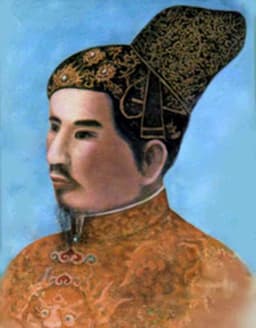
Gia Long
Emperor · Modern
65.4Total
Basic Information
Born
1533
1762
Died
1598
1820
Era
Modern
Modern
Nationality
Khanate of Bukhara
Vietnam
Occupation
Emperor
Emperor
Civilization
Eastern
Eastern
Score Comparison
Military (10%)
78.8
78.0
Political (20%)
70.0
70.3
Influence (20%)
60.0
61.0
Legacy (20%)
50.0
54.0
Leadership (15%)
79.8
78.0
Strategy (15%)
58.0
66.3
TOTAL
63.6
65.4
Abdullah Khan II — Complete Timeline
1557 AD
Reunification of the Uzbek khanatesPolitical Action◆ Major
Abdullah Khan II, a Shaybanid ruler, began a campaign to reunite the fragmented Uzbek khanates of Transoxiana. He gradually conquered Bukhara, Samarkand, and other cities, consolidating power under his rule.
ShaybanidsReunificationTransoxiana
Impact: regionalconstructive
1588 AD
Conquest of KhorasanWar◆ Major
Abdullah Khan II launched a military campaign against the Safavid Empire, capturing the city of Herat and much of Khorasan. This expanded the Khanate of Bukhara's territory and challenged Safavid dominance in the region.
ShaybanidsConquestSafavids
Impact: regionaldestructive
1590 AD
Reforms and centralizationReform◆ Major
Abdullah Khan II implemented administrative and fiscal reforms to centralize the Khanate of Bukhara. He reduced the power of tribal leaders, standardized taxation, and promoted trade, strengthening the state's economy and governance.
ShaybanidsReformCentralization
Impact: regionalconstructive
1598 AD
Death and succession crisisPolitical Action◆ Major
Abdullah Khan II died in 1598, leaving no capable heir. His death led to a succession crisis and the rapid decline of the Shaybanid dynasty, which was soon replaced by the Jani-Begids (Ashtarkhanids) in Bukhara.
ShaybanidsDeathSuccession
Impact: regionaltragic
Gia Long — Complete Timeline
1787 AD
Treaty of Versailles with FrancePolitical Action◆ Major
Nguyen Anh signed the Treaty of Versailles with King Louis XVI, securing French military and financial support in exchange for trade concessions and the cession of Da Nang and Poulo Condore. This treaty marked the beginning of French involvement in Vietnam.
French ColonialismTreatyNguyen Dynasty
Impact: regional
1788 AD
Capture of SaigonWar◆ Major
Nguyen Anh (later Gia Long) captured Saigon from the Tay Son forces with the help of French military advisors. This victory established his base of power in the Mekong Delta region.
Tay Son WarNguyen DynastyFrench Support
Impact: regional
1801 AD
Battle of Thien MuWar◆ Major
Nguyen Anh's forces, supported by French-built ships and artillery, defeated the Tay Son navy at Thien Mu. This naval victory allowed him to capture Hue, the Tay Son capital.
Tay Son WarNaval BattleFrench Support
Impact: national
1802 AD
Founding of the Nguyen DynastyPolitical Action
Nguyen Anh ascended the throne as Emperor Gia Long, founding the Nguyen dynasty. He unified Vietnam from the Red River Delta to the Mekong Delta, establishing the country's modern borders.
Nguyen DynastyUnificationVietnamese History
Impact: regionalconstructive
1804 AD
Construction of the Hue CitadelCultural◆ Major
Emperor Gia Long ordered the construction of the Hue Citadel, a massive fortified palace complex modeled on the Forbidden City in Beijing. The citadel served as the imperial capital of the Nguyen dynasty until 1945.
ArchitectureHueImperial Capital
Impact: nationalconstructive
This comparison has not been analyzed yet.
One-time AI generation (~1 minute). Scores and timeline are already available below.
Rankings
🥇
Gia LongLeader
Mil: 78.0Pol: 70.3Inf: 61.0
65.4
🥈
Abdullah Khan II
Mil: 78.8Pol: 70.0Inf: 60.0
63.6
+1.8 behind
How This Comparison Works
Algorithm
Each figure is scored on 6 dimensions (0—100 scale) based on structured historical data: Military (10%), Political (20%), Influence (20%), Legacy (20%), Leadership (15%), Strategy (15%). The weighted total produces the final ranking.
Data Sources
Scores are computed from structured sub-indicators in the database. Scale factors adjust for era (Ancient ×0.85, Modern ×1.0) and civilization size (Eastern ×1.05, Other ×0.80) to account for differences in population and military scale.
Maximum 3 Figures
Comparisons are limited to 2—3 figures to ensure readability and statistical meaningfulness.
Error Margins
±5 points per dimension — Sub-scores are derived from historical records with inherent uncertainty. Two figures within 5 points on a dimension should be considered roughly equivalent in that area.
Total Score Accuracy
±3 points overall — The weighted combination of 6 dimensions produces a total score with approximately ±3 points of uncertainty. Differences of less than 3 points are not statistically significant— the figures are effectively tied.
Known Limitations
- Historical records are incomplete and uneven across civilizations
- Figures from oral-tradition societies may be underrepresented
- Occupation labels can misclassify multi-role figures
- Scores measure capability and impact, not moral character
- Quantitative scoring is a comparison tool, not absolute truth
Capability Radar
Military (10%) — Battles & Warfare
Battles
75
75
Win Rate
80
80
Expansion
78
80
Political (20%) — Governance & Reform
Reform
72
75
Diplomacy
68
70
Economy
65
65
Influence (20%) — Cultural & Global Reach
Cultural
55
55
Global
45
40
Legacy (20%) — Historical Impact
Historical
60
60
Longevity
50
55
Leadership (15%) — Power & Stability
Tenure
70
70
Stability
60
60
Strategy (15%) — Tactics & Innovation
Strategy
75
85
Tactics
70
70
Reform
65
75
Similar Comparisons
Comments & Discussion
No comments yet. Be the first to share your thoughts!