Loading...
This comparison has not been analyzed yet.
One-time AI generation (~1 minute). Scores and timeline are already available below.
Abd al-Mumin vs Al-Mustansir I
Abd al-Mumin leads by 19.7 pts · 2 figures compared
…
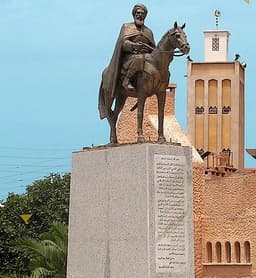
Abd al-Mumin
Emperor · Medieval
64.7Total

Al-Mustansir I
Emperor · Medieval
45.0Total
Basic Information
Born
1094
1192
Died
1163
1242
Era
Medieval
Medieval
Nationality
Almohad Caliphate
Abbasid Caliphate
Occupation
Emperor
Emperor
Civilization
Middle Eastern
Middle Eastern
Score Comparison
Military (10%)
78.5
20.0
Political (20%)
70.0
35.1
Influence (20%)
58.3
56.4
Legacy (20%)
52.0
47.5
Leadership (15%)
79.8
48.4
Strategy (15%)
68.0
45.0
TOTAL
64.7
45.0
Abd al-Mumin — Complete Timeline
1130 AD
Proclamation as CaliphPolitical Action
After the death of Ibn Tumart, Abd al-Mumin was proclaimed caliph of the Almohad movement. He consolidated the Berber tribes of the High Atlas under Almohad doctrine, establishing the foundation for a new dynasty that would challenge Almoravid rule.
Almohad CaliphateSuccessionDynasty Foundation
Impact: regionalconstructive
1147 AD
Conquest of MarrakeshWar◆ Major
Abd al-Mumin captured Marrakesh, the capital of the Almoravid Empire, after a prolonged siege. The Almoravid ruler Ishaq ibn Ali was killed, and the city became the Almohad capital, marking the end of Almoravid rule in North Africa.
Almohad ConquestMarrakeshAlmoravid Fall
Impact: regionaldestructive
1152 AD
Conquest of the MaghrebWar◆ Major
Abd al-Mumin extended Almohad control across the Maghreb, conquering cities such as Fez, Tlemcen, and Algiers. He defeated local Berber dynasties and unified the region from the Atlantic to Tripolitania under a single centralized administration.
Maghreb UnificationAlmohad ExpansionBerber Conquest
Impact: regionalconstructive
1154 AD
Invasion of Al-AndalusWar◆ Major
Abd al-Mumin launched a campaign into Al-Andalus, capturing cities including C
Al-AndalusAlmohad ExpansionIberian Campaign
Impact: regionalconstructive
1156 AD
Establishment of Almohad AdministrationReform◆ Major
Abd al-Mumin implemented a centralized administrative system across his empire, appointing governors and judges loyal to the Almohad doctrine. He standardized taxation and military organization, creating a stable state structure that lasted for decades.
Administrative ReformAlmohad StateCentralization
Impact: regionalconstructive
Al-Mustansir I — Complete Timeline
1233 AD
Built the Mustansiriya MadrasaCultural
Al-Mustansir I founded the Mustansiriya Madrasa in Baghdad, a major educational institution teaching Islamic law, medicine, mathematics, and literature. It became one of the largest and most advanced universities of the medieval Islamic world.
EducationMadrasaBaghdad
Impact: globalconstructive
1240 AD
Reformed the Abbasid MilitaryReform◆ Major
Al-Mustansir I reorganized the Abbasid army, recruiting Turkic slave soldiers (mamluks) and strengthening defenses against Mongol threats. He built a new garrison city near Baghdad to house these troops.
Military ReformMamluksMongol Threat
Impact: regional
This comparison has not been analyzed yet.
One-time AI generation (~1 minute). Scores and timeline are already available below.
Rankings
🥇
Abd al-MuminLeader
Mil: 78.5Pol: 70.0Inf: 58.3
64.7
🥈
Al-Mustansir I
Mil: 20.0Pol: 35.1Inf: 56.4
45.0
+19.7 behind
How This Comparison Works
Algorithm
Each figure is scored on 6 dimensions (0—100 scale) based on structured historical data: Military (10%), Political (20%), Influence (20%), Legacy (20%), Leadership (15%), Strategy (15%). The weighted total produces the final ranking.
Data Sources
Scores are computed from structured sub-indicators in the database. Scale factors adjust for era (Ancient ×0.85, Modern ×1.0) and civilization size (Eastern ×1.05, Other ×0.80) to account for differences in population and military scale.
Maximum 3 Figures
Comparisons are limited to 2—3 figures to ensure readability and statistical meaningfulness.
Error Margins
±5 points per dimension — Sub-scores are derived from historical records with inherent uncertainty. Two figures within 5 points on a dimension should be considered roughly equivalent in that area.
Total Score Accuracy
±3 points overall — The weighted combination of 6 dimensions produces a total score with approximately ±3 points of uncertainty. Differences of less than 3 points are not statistically significant— the figures are effectively tied.
Known Limitations
- Historical records are incomplete and uneven across civilizations
- Figures from oral-tradition societies may be underrepresented
- Occupation labels can misclassify multi-role figures
- Scores measure capability and impact, not moral character
- Quantitative scoring is a comparison tool, not absolute truth
Capability Radar
Military (10%) — Battles & Warfare
Battles
85
5
Win Rate
90
5
Expansion
90
5
Political (20%) — Governance & Reform
Reform
85
30
Diplomacy
70
30
Economy
75
30
Influence (20%) — Cultural & Global Reach
Cultural
65
50
Global
55
30
Legacy (20%) — Historical Impact
Historical
70
45
Longevity
60
40
Leadership (15%) — Power & Stability
Tenure
80
40
Stability
70
20
Strategy (15%) — Tactics & Innovation
Strategy
85
5
Tactics
80
5
Reform
75
5
Similar Comparisons
Comments & Discussion
No comments yet. Be the first to share your thoughts!