Loading...
Abd al-Mumin vs Julius Caesar
Julius Caesar leads by 18.1 pts · 2 figures compared
…
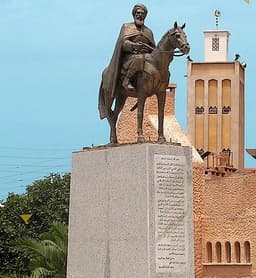
Abd al-Mumin
Emperor · Medieval
64.7Total

Julius Caesar
General · Ancient
82.8Total
Basic Information
Born
1094
-100
Died
1163
-44
Era
Medieval
Ancient
Nationality
Almohad Caliphate
Roman Republic
Occupation
Emperor
General
Civilization
Middle Eastern
Western
Score Comparison
Military (10%)
78.5
88.0
Political (20%)
70.0
78.0
Influence (20%)
58.3
85.0
Legacy (20%)
52.0
82.0
Leadership (15%)
79.8
80.0
Strategy (15%)
68.0
85.0
TOTAL
64.7
82.8
Abd al-Mumin — Complete Timeline
1130 AD
Proclamation as CaliphPolitical Action
After the death of Ibn Tumart, Abd al-Mumin was proclaimed caliph of the Almohad movement. He consolidated the Berber tribes of the High Atlas under Almohad doctrine, establishing the foundation for a new dynasty that would challenge Almoravid rule.
Almohad CaliphateSuccessionDynasty Foundation
Impact: regionalconstructive
1147 AD
Conquest of MarrakeshWar◆ Major
Abd al-Mumin captured Marrakesh, the capital of the Almoravid Empire, after a prolonged siege. The Almoravid ruler Ishaq ibn Ali was killed, and the city became the Almohad capital, marking the end of Almoravid rule in North Africa.
Almohad ConquestMarrakeshAlmoravid Fall
Impact: regionaldestructive
1152 AD
Conquest of the MaghrebWar◆ Major
Abd al-Mumin extended Almohad control across the Maghreb, conquering cities such as Fez, Tlemcen, and Algiers. He defeated local Berber dynasties and unified the region from the Atlantic to Tripolitania under a single centralized administration.
Maghreb UnificationAlmohad ExpansionBerber Conquest
Impact: regionalconstructive
1154 AD
Invasion of Al-AndalusWar◆ Major
Abd al-Mumin launched a campaign into Al-Andalus, capturing cities including C
Al-AndalusAlmohad ExpansionIberian Campaign
Impact: regionalconstructive
1156 AD
Establishment of Almohad AdministrationReform◆ Major
Abd al-Mumin implemented a centralized administrative system across his empire, appointing governors and judges loyal to the Almohad doctrine. He standardized taxation and military organization, creating a stable state structure that lasted for decades.
Administrative ReformAlmohad StateCentralization
Impact: regionalconstructive
Julius Caesar — Complete Timeline
58 BC
Gallic WarsWar◆ Major
Caesar, as proconsul of Gaul, launched a series of campaigns that conquered all of Gaul (modern France, Belgium, and parts of Switzerland). He fought numerous battles, including against the Helvetii, the Belgae, and the Gallic chieftain Vercingetorix. The wars brought immense wealth and a loyal army to Caesar.
Gallic WarsConquestRoman Expansion
Impact: regional
49 BC
Crossing the RubiconPolitical Action◆ Major
Caesar led Legio XIII across the Rubicon River into Italy, defying the Roman Senate's order to disband his army. This act triggered a civil war against Pompey and the Optimates, ultimately leading to Caesar's dictatorship and the end of the Roman Republic.
Roman Civil WarEnd of RepublicPower Struggle
Impact: global
48 BC
Battle of PharsalusWar◆ Major
Caesar's outnumbered army defeated the larger forces of Pompey the Great at Pharsalus in Greece. Caesar's tactical use of a reserve line to counter Pompey's cavalry charge proved decisive. Pompey fled to Egypt, where he was assassinated, leaving Caesar as the undisputed master of the Roman world.
Roman Civil WarBattleDecisive Victory
Impact: regional
44 BC
Appointment as Dictator for LifePolitical Action◆ Major
The Roman Senate appointed Caesar dictator perpetuo (dictator for life), granting him unprecedented personal power. This move concentrated military, legislative, and judicial authority in one person, effectively ending the Roman Republic's traditional system of checks and balances and alarming many senators.
DictatorshipEnd of RepublicPower Consolidation
Impact: regionaldestructive
Assassination on the Ides of MarchPolitical Action◆ Major
A group of Roman senators, led by Marcus Junius Brutus and Gaius Cassius Longinus, stabbed Caesar to death at a meeting of the Senate in the Theatre of Pompey. The assassination was intended to restore the Republic, but instead triggered another civil war that led to the rise of the Roman Empire.
AssassinationRoman PoliticsEnd of Republic
Impact: globaldestructive
Expert Analysis
abd-al-mumin-vs-julius-caesar
### The Conqueror and the Caliph: Why Caesar Changed the World and Abd al-Mumin Did Not
On a January morning in 49 BCE, Julius Caesar stood at the edge of the Rubicon River, a small stream in northern Italy. To cross with his army was treason, a declaration of civil war against the Roman Republic. He paused, then uttered a phrase that would echo through millennia: *“The die is cast.”* He crossed. The world never looked back. Some twelve centuries later, in 1130, a Berber chieftain named Abd al-Mumin stood before a council of mountain warriors in the Atlas range of North Africa. His mentor, the mystic Ibn Tumart, had just died. The council proclaimed Abd al-Mumin caliph of the Almohad movement. He, too, crossed a threshold. But his die landed with a softer thud. Both men forged empires from chaos. Both led armies, reformed states, and died leaving legacies that still shape memory. Yet one name is known to every schoolchild; the other is obscure outside specialist circles. The difference is not merely one of scale or luck. It lies in the very nature of their ambitions, the worlds they inhabited, and the tools history gave them.
### Origins: The Senator’s Son and the Berber Scholar
Julius Caesar was born into the patrician Julian clan in 100 BCE, but his family was not wealthy. Rome was a republic in crisis—torn by class conflict between the patrician Senate and the populist populares, haunted by the ghost of the dictator Sulla. Caesar grew up in the shadow of civil war. His aunt was married to the great general Marius; his own marriage to Cornelia, daughter of Marius’s ally Cinna, marked him as a populist from the start. He learned that politics was a knife fight, that survival meant building personal loyalty among soldiers and the urban poor. He was ambitious, charming, and ruthless—a product of a system where one man could, if he dared, break the rules.
Abd al-Mumin was born in 1094 in the village of Tagra, in what is now Algeria, into a humble Berber family of the Zenata tribe. His world was the Maghreb of the Almoravids—a stern, puritanical empire of veiled desert warriors that stretched from Senegal to Spain. But the Almoravids were weakening, and a new religious fire was kindling in the mountains. Abd al-Mumin was a scholar, a student of Islamic law and theology. He met Ibn Tumart, a charismatic reformer who preached a strict, unitary vision of Islam (tawhid) and condemned the Almoravids as heretics. Where Caesar seized the Roman political arena, Abd al-Mumin was seized by a religious movement. His origins were not in senatorial ambition but in spiritual discipleship. He was a lieutenant who became a leader by inheritance, not by usurpation.
### Rise to Power: Crossing the Rubicon and Crossing the Mountains
Caesar’s rise was a masterpiece of calculated risk. He climbed the Roman ladder—quaestor, aedile, praetor—but his true springboard was the governorship of Gaul (58–50 BCE). In eight years of brutal, brilliant warfare, he conquered a vast territory (modern France, Belgium, and parts of Germany), amassed a fortune, and forged a loyal army. His *Commentaries on the Gallic War* were propaganda as much as history, painting him as a civilizing hero. When the Senate ordered him to disband his army and return to Rome as a private citizen—to face certain prosecution—he gambled. The Rubicon crossing was not just a military act; it was a political revolution. Caesar was declaring that personal loyalty to him trumped the Republic’s laws.
Abd al-Mumin’s rise was slower and more religious. After Ibn Tumart’s death in 1130, he was proclaimed caliph, but the Almohad movement was still a guerrilla force in the High Atlas. For seventeen years, he fought a grinding war against the Almoravids, building his base among the Masmuda Berbers. His key turning point came in 1147: the conquest of Marrakesh, the Almoravid capital. He captured the city after a prolonged siege and killed the Almoravid ruler Ishaq. This was his Rubicon. But where Caesar’s crossing shattered a political order, Abd al-Mumin’s victory replaced one dynasty with another. He did not destroy the idea of empire; he inherited it.
### Leadership & Governance: The Dictator and the Administrator
Caesar ruled as a dictator—first for ten years, then for life. He centralized power, reformed the calendar (the Julian calendar we still use, with minor adjustments), expanded citizenship to provincials, and launched public works. He was a military genius (score: 88), but his political acumen (78) was equally sharp: he understood that the Republic was broken and that only a strongman could fix it. Yet he never fully consolidated his rule. He was too impatient, too contemptuous of the old elite. He packed the Senate with his supporters, but he did not build lasting institutions. His reforms were brilliant improvisations, not a new constitution.
Abd al-Mumin, by contrast, was a builder. After conquering Marrakesh, he spent the next decade extending Almohad control across the Maghreb—capturing Fez, Tlemcen, and Algiers in 1152, then invading Al-Andalus in 1154 and taking Córdoba and Seville. But his lasting achievement was administrative. In 1156, he established a centralized bureaucracy, appointing governors and judges loyal to the Almohad creed. He created a unified state where before there had been tribal confederations. His leadership score (78) reflects a steady, methodical ruler. He was not a charismatic genius like Caesar; he was a patient organizer.
### Triumph & Tragedy: The Ides of March and the Succession
Caesar’s greatest triumph was his own life—the conquest of Gaul, the defeat of his rival Pompey at Pharsalus (48 BCE), his affair with Cleopatra, his return to Rome as master of the world. His tragedy was that he could not stop. He refused to restore the Republic, even in name. On the Ides of March, 44 BCE, a conspiracy of senators stabbed him to death at the foot of Pompey’s Theater. He fell, according to tradition, at the base of a statue of his defeated enemy. His murder triggered another civil war, which ended only with the rise of his adopted heir, Octavian (Augustus), who finally founded the Roman Empire.
Abd al-Mumin’s triumph was the creation of the Almohad Empire, which stretched from the Atlantic to Tripoli, from the Sahara to the Ebro River in Spain. He died in 1163, old and respected, having ruled for 33 years. His tragedy was that his empire did not long outlast him. His successors, the Almohad caliphs, grew weak, lost Spain to the Christian Reconquista, and were eventually overthrown by the Marinids. The empire he built crumbled within a century. Where Caesar’s death sparked a transformation that created a new world order, Abd al-Mumin’s death marked the beginning of a slow decline.
### Character & Destiny: The Gambler and the Believer
Caesar was a gambler. He lived by the sword and died by it. He was generous to his enemies (he pardoned many) but ruthless to those who stood in his way. His ambition was personal: he wanted to be first in Rome, and he achieved it. But his very success made him a target. He knew the risks; he dismissed his bodyguard, saying, “It is more important for the Republic that I should not live in fear.” That arrogance was his flaw.
Abd al-Mumin was a believer. His legitimacy came not from personal glory but from his role as the successor of Ibn Tumart, the Mahdi. He was a caliph, a religious leader. His wars were holy wars (jihad). His administration was an expression of divine law. He was less flamboyant than Caesar, but more stable. He did not need to be loved; he needed to be obeyed. His destiny was to build a system, not a legend.
### Legacy: The Name That Lives and the Empire That Faded
Caesar’s legacy is immeasurable. His name became a title: Kaiser, Tsar. His conquests spread Roman civilization across Europe. His political reforms, though incomplete, paved the way for the empire that lasted five centuries in the west and a thousand years in the east. He is remembered as a man of action, a writer, a lover, a tyrant, a martyr. His story is the archetype of ambition and downfall.
Abd al-Mumin’s legacy is more confined. He united the Maghreb under a single Berber dynasty for the first time since the Roman era. He left a unified state, a religious orthodoxy, and a memory of Berber power. But his empire was ephemeral. Today, he is a footnote in histories of medieval Islam, a name known to scholars of the Almohads. He did not change the world; he changed a region, for a time.
### Conclusion: What Drives the Difference?
The difference between Julius Caesar and Abd al-Mumin is not a matter of merit. Both were brilliant leaders in their contexts. But Caesar operated on a central stage of world history—the Mediterranean, the heart of the classical world. His actions broke an ancient republic and created an empire that shaped Western civilization. Abd al-Mumin operated on a periphery—the Maghreb, a region that, however rich in culture, was never the pivot of global power. His empire was a phase in a longer story of Islamic dynasties. Caesar’s ambition was personal and political; Abd al-Mumin’s was religious and institutional. One gambled for immortality; the other built for stability. One died in a theater of betrayal; the other died in bed. Their legacies mirror their worlds: Caesar’s is a story we still tell, because it is about power, freedom, and the price of greatness. Abd al-Mumin’s is a story we have mostly forgotten, because it is about faith, order, and the quiet labor of empire. Both crossed their Rubicons. Only one made the crossing unforgettable.
Rankings
🥇
Julius CaesarLeader
Mil: 88.0Pol: 78.0Inf: 85.0
82.8
🥈
Abd al-Mumin
Mil: 78.5Pol: 70.0Inf: 58.3
64.7
+18.1 behind
How This Comparison Works
Algorithm
Each figure is scored on 6 dimensions (0—100 scale) based on structured historical data: Military (10%), Political (20%), Influence (20%), Legacy (20%), Leadership (15%), Strategy (15%). The weighted total produces the final ranking.
Data Sources
Scores are computed from structured sub-indicators in the database. Scale factors adjust for era (Ancient ×0.85, Modern ×1.0) and civilization size (Eastern ×1.05, Other ×0.80) to account for differences in population and military scale.
Maximum 3 Figures
Comparisons are limited to 2—3 figures to ensure readability and statistical meaningfulness.
Error Margins
±5 points per dimension — Sub-scores are derived from historical records with inherent uncertainty. Two figures within 5 points on a dimension should be considered roughly equivalent in that area.
Total Score Accuracy
±3 points overall — The weighted combination of 6 dimensions produces a total score with approximately ±3 points of uncertainty. Differences of less than 3 points are not statistically significant— the figures are effectively tied.
Known Limitations
- Historical records are incomplete and uneven across civilizations
- Figures from oral-tradition societies may be underrepresented
- Occupation labels can misclassify multi-role figures
- Scores measure capability and impact, not moral character
- Quantitative scoring is a comparison tool, not absolute truth
Capability Radar
Military (10%) — Battles & Warfare
Battles
85
95
Win Rate
90
92
Expansion
90
97
Political (20%) — Governance & Reform
Reform
85
90
Diplomacy
70
85
Economy
75
82
Influence (20%) — Cultural & Global Reach
Cultural
65
88
Global
55
94
Legacy (20%) — Historical Impact
Historical
70
95
Longevity
60
96
Leadership (15%) — Power & Stability
Tenure
80
75
Stability
70
60
Strategy (15%) — Tactics & Innovation
Strategy
85
94
Tactics
80
96
Reform
75
88
Similar Comparisons
Comments & Discussion
No comments yet. Be the first to share your thoughts!