Loading...
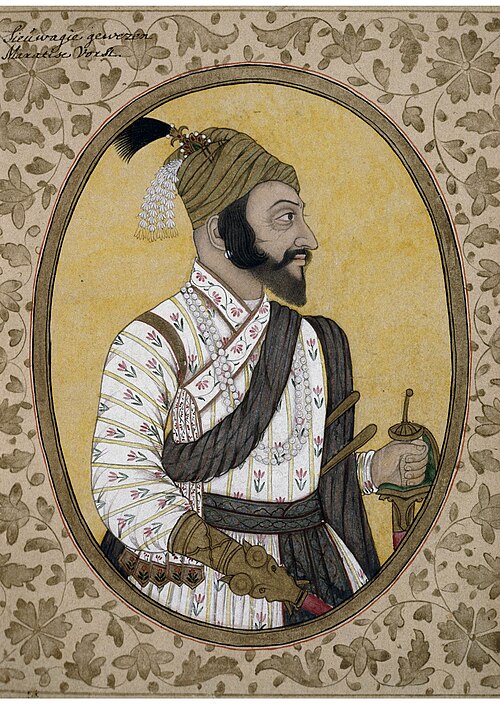
Shivaji
ModernEmperorIndia1630 — 1680
Founder of the Maratha Empire, pioneer of guerrilla warfare.
Compare Shivaji with another historical figure:
Quick Facts
Born
1630
Died
1680
Country
India
Era
Modern
Occupation
Emperor
Score Overview
Military (10%)80
Political (20%)72
Influence (20%)82
Legacy (20%)40
Leadership (15%)80
Strategy (15%)72
Total Score68.5
Shivaji — Complete Timeline
1646 AD
Capture of Torna FortWar◆ Major
Shivaji captured the Torna Fort from the Bijapur Sultanate at age 16, his first major military action. This victory provided him with a strategic base and treasure to fund further campaigns, marking the beginning of Maratha expansion.
Military CampaignFort Capture
Impact: regional
1659 AD
Battle of PratapgadWar◆ Major
Shivaji defeated the Bijapur general Afzal Khan at the Battle of Pratapgad. Shivaji killed Afzal Khan in a personal encounter, and the Maratha forces routed the Bijapur army, eliminating a major threat to his nascent kingdom.
BattleMaratha-Bijapur Conflict
Impact: regional
1664 AD
Sack of SuratWar◆ Major
Shivaji attacked and plundered the wealthy Mughal port city of Surat, seizing vast amounts of treasure. This raid demonstrated Maratha military capability and weakened Mughal economic power, while enriching Shivaji's treasury.
RaidMughal-Maratha Conflict
Impact: regional
1665 AD
Treaty of PurandarPolitical Action◆ Major
Shivaji signed the Treaty of Purandar with the Mughal general Jai Singh I, ceding 23 forts to the Mughals and agreeing to serve as a Mughal vassal. This treaty temporarily ended hostilities but allowed Shivaji to retain his core territory.
TreatyMughal-Maratha Relations
Impact: regional
1666 AD
Escape from AgraPolitical Action◆ Major
Shivaji escaped from house arrest in Agra, where he had been detained by Emperor Aurangzeb. He hid in a basket of sweets and fled to the Deccan, resuming his campaign against the Mughals and rebuilding Maratha power.
EscapeMughal-Maratha Conflict
Impact: regional
1674 AD
Coronation at RaigadPolitical Action◆ Major
Shivaji was formally crowned as Chhatrapati (emperor) at Raigad Fort, establishing the Maratha Empire. The coronation included Hindu rituals and the assumption of royal titles, legitimizing his rule and sovereignty.
CoronationState Formation
Impact: regionalconstructive
Detailed Scores
▶View all detailed scores
Military
Strategy
7
Tactics
7
Battles
7
Army Scale
6
War Impact
7
Political
Governance
7
Reform
7
Stability
7
Policy
8
Power
8
Influence
History
9
Global
8
Culture
8
Ideology
9
Legacy
8
People often compare with
See how Shivaji stacks up against other historical figures
Popular Comparisons
Shivaji vs Idris Alooma
vs Idris Alooma65
Shivaji vs Kirti Sri Rajasinha
vs Kirti Sri Rajasinha58
Shivaji vs Daulat Rao Sindhia
vs Daulat Rao Sindhia51
Shivaji vs Yadavindra Singh
vs Yadavindra Singh49
Shivaji vs Charles I of Wurttemberg
vs Charles I of Wurttemberg49
Shivaji vs Dawit III
vs Dawit III48