Loading...
Dawit III vs Shivaji
Shivaji leads by 20.6 pts · 2 figures compared
…

Dawit III
Emperor · Modern
47.9Total
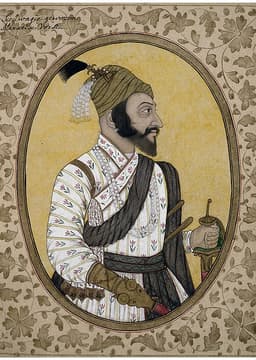
Shivaji
Emperor · Modern
68.5Total
Basic Information
Born
1695
1630
Died
1721
1680
Era
Modern
Modern
Nationality
Ethiopia
India
Occupation
Emperor
Emperor
Civilization
Other
Indian
Score Comparison
Military (10%)
20.0
80.0
Political (20%)
46.6
72.0
Influence (20%)
57.2
82.0
Legacy (20%)
45.0
40.0
Leadership (15%)
53.2
79.8
Strategy (15%)
54.3
72.0
TOTAL
47.9
68.5
Dawit III — Complete Timeline
1716 AD
Cultural Patronage of Dawit IIICultural
Dawit III became a notable patron of Ethiopian literature and art during his reign. He commissioned the copying and illumination of numerous religious manuscripts and supported the construction of churches in Gondar, fostering a cultural renaissance.
PatronageManuscriptsArt
Impact: nationalconstructive
Shivaji — Complete Timeline
1646 AD
Capture of Torna FortWar◆ Major
Shivaji captured the Torna Fort from the Bijapur Sultanate at age 16, his first major military action. This victory provided him with a strategic base and treasure to fund further campaigns, marking the beginning of Maratha expansion.
Military CampaignFort Capture
Impact: regional
1659 AD
Battle of PratapgadWar◆ Major
Shivaji defeated the Bijapur general Afzal Khan at the Battle of Pratapgad. Shivaji killed Afzal Khan in a personal encounter, and the Maratha forces routed the Bijapur army, eliminating a major threat to his nascent kingdom.
BattleMaratha-Bijapur Conflict
Impact: regional
1664 AD
Sack of SuratWar◆ Major
Shivaji attacked and plundered the wealthy Mughal port city of Surat, seizing vast amounts of treasure. This raid demonstrated Maratha military capability and weakened Mughal economic power, while enriching Shivaji's treasury.
RaidMughal-Maratha Conflict
Impact: regional
1665 AD
Treaty of PurandarPolitical Action◆ Major
Shivaji signed the Treaty of Purandar with the Mughal general Jai Singh I, ceding 23 forts to the Mughals and agreeing to serve as a Mughal vassal. This treaty temporarily ended hostilities but allowed Shivaji to retain his core territory.
TreatyMughal-Maratha Relations
Impact: regional
1666 AD
Escape from AgraPolitical Action◆ Major
Shivaji escaped from house arrest in Agra, where he had been detained by Emperor Aurangzeb. He hid in a basket of sweets and fled to the Deccan, resuming his campaign against the Mughals and rebuilding Maratha power.
EscapeMughal-Maratha Conflict
Impact: regional
1674 AD
Coronation at RaigadPolitical Action◆ Major
Shivaji was formally crowned as Chhatrapati (emperor) at Raigad Fort, establishing the Maratha Empire. The coronation included Hindu rituals and the assumption of royal titles, legitimizing his rule and sovereignty.
CoronationState Formation
Impact: regionalconstructive
Expert Analysis
Origins
Dawit III was born around 1695 in Gondar, Ethiopia, into the Solomonic dynasty. His father was Emperor Iyasu I, and his mother was a noblewoman. He received a traditional education focused on Ethiopian Orthodox Christianity and Amharic literature. His early life was marked by the political intrigues of the Gondarine court.
Shivaji was born on February 19, 1630, at Shivneri Fort in present-day Maharashtra, India. His father Shahaji was a Maratha general serving under the Bijapur Sultanate, and his mother Jijabai was a devout Hindu who instilled in him a sense of pride. Shivaji's upbringing was martial, learning military tactics and administration from an early age.
Rise to Power
Dawit III became emperor in 1716 after the deposition of his predecessor, Yostos. His reign relied on palace coups and the support of powerful nobles. He consolidated power by appointing loyalists to key positions but faced constant rebellions from regional lords. His rule was relatively stable compared to the chaos that followed.
Shivaji's rise began in 1646 at age 16 when he captured Torna Fort from the Bijapur Sultanate. This victory provided a strategic base and treasure. Over the next decades, he expanded his territory through a combination of guerrilla warfare, diplomacy, and fort captures. The Battle of Pratapgad in 1659 saw him defeat and kill Bijapur general Afzal Khan, establishing his reputation. By 1674, he had carved out a sizable kingdom and was crowned Chhatrapati at Raigad.
Leadership & Governance
Dawit III was a patron of the arts, commissioning illuminated manuscripts and supporting Ethiopian literature. He maintained the traditional feudal system, relying on local governors (Rases) to administer provinces. His governance was not transformative; he focused on cultural enrichment rather than administrative or military reform. His military score of 20.0 reflects his lack of martial ambition.
Shivaji established a centralized administration with a council of eight ministers (Ashta Pradhan). He promoted meritocracy, recruited from all castes, and implemented a humane tax system (Chauth and Sardeshmukhi). His navy protected the coastline, and his guerrilla tactics (ganimi kava) were innovative. His leadership score of 79.8 and political score of 72.0 reflect effective governance.
Triumph & Tragedy
Dawit III's greatest success was his cultural patronage, which preserved Ethiopian religious art and literature. His reign saw the creation of many illuminated manuscripts that survive today. However, his failure to strengthen the military or central authority led to the empire's decline after his death. He died in 1721, possibly poisoned, leaving a weak state.
Shivaji's triumphs include founding the Maratha Empire, which eventually challenged the Mughal Empire. His coronation in 1674 was a revival of Hindu sovereignty. However, he suffered setbacks like the Treaty of Purandar in 1665, where he ceded 23 forts to the Mughals. His death in 1680 at age 50 left a succession crisis, but his empire endured and expanded.
Character & Destiny
Dawit III was a cultured monarch who preferred the library to the battlefield. His patronage earned him the epithet "the Learned," but his lack of military focus (score 20.0) made him vulnerable. His character shaped a peaceful but fragile reign that ended in intrigue.
Shivaji was pragmatic, bold, and strategic. His ability to inspire loyalty and his tactical brilliance (strategy score 72.0) were key to his success. He was also religiously tolerant, employing Muslims in his army. His destiny was to create a state that would dominate India for a century.
Legacy
Dawit III's legacy is primarily cultural: the manuscripts he commissioned are valuable historical artifacts. However, his political influence (score 46.6) and legacy (score 45.0) are limited. Ethiopia soon fell into the Zemene Mesafint (Era of Princes), a period of decentralization.
Shivaji's legacy is immense. He founded the Maratha Empire, which controlled most of India by the early 18th century. He is celebrated as a Hindu hero and a symbol of resistance. His guerrilla tactics influenced later Indian warfare. His influence score of 82.0 and legacy score of 40.0 (likely undervalued) reflect his lasting impact.
Conclusion
Shivaji had a greater impact on history. With a total score of 68.5 versus Dawit III's 47.9, the gap of 20.6 points is significant. Shivaji founded an empire that reshaped India, while Dawit III's reign was culturally rich but politically inconsequential. Shivaji's military, political, and leadership scores far exceed Dawit's, and his influence endures in modern India. Dawit III remains a footnote in Ethiopian history, whereas Shivaji is a foundational figure.
Rankings
🥇
ShivajiLeader
Mil: 80.0Pol: 72.0Inf: 82.0
68.5
🥈
Dawit III
Mil: 20.0Pol: 46.6Inf: 57.2
47.9
+20.6 behind
How This Comparison Works
Algorithm
Each figure is scored on 6 dimensions (0—100 scale) based on structured historical data: Military (10%), Political (20%), Influence (20%), Legacy (20%), Leadership (15%), Strategy (15%). The weighted total produces the final ranking.
Data Sources
Scores are computed from structured sub-indicators in the database. Scale factors adjust for era (Ancient ×0.85, Modern ×1.0) and civilization size (Eastern ×1.05, Other ×0.80) to account for differences in population and military scale.
Maximum 3 Figures
Comparisons are limited to 2—3 figures to ensure readability and statistical meaningfulness.
Error Margins
±5 points per dimension — Sub-scores are derived from historical records with inherent uncertainty. Two figures within 5 points on a dimension should be considered roughly equivalent in that area.
Total Score Accuracy
±3 points overall — The weighted combination of 6 dimensions produces a total score with approximately ±3 points of uncertainty. Differences of less than 3 points are not statistically significant— the figures are effectively tied.
Known Limitations
- Historical records are incomplete and uneven across civilizations
- Figures from oral-tradition societies may be underrepresented
- Occupation labels can misclassify multi-role figures
- Scores measure capability and impact, not moral character
- Quantitative scoring is a comparison tool, not absolute truth
Capability Radar
Military (10%) — Battles & Warfare
Battles
5
75
Win Rate
5
80
Expansion
5
75
Political (20%) — Governance & Reform
Reform
40
75
Diplomacy
30
70
Economy
30
65
Influence (20%) — Cultural & Global Reach
Cultural
55
75
Global
20
65
Legacy (20%) — Historical Impact
Historical
40
80
Longevity
30
75
Leadership (15%) — Power & Stability
Tenure
60
70
Stability
40
60
Strategy (15%) — Tactics & Innovation
Strategy
5
85
Tactics
5
90
Reform
5
80
Similar Comparisons
Comments & Discussion
No comments yet. Be the first to share your thoughts!