Loading...
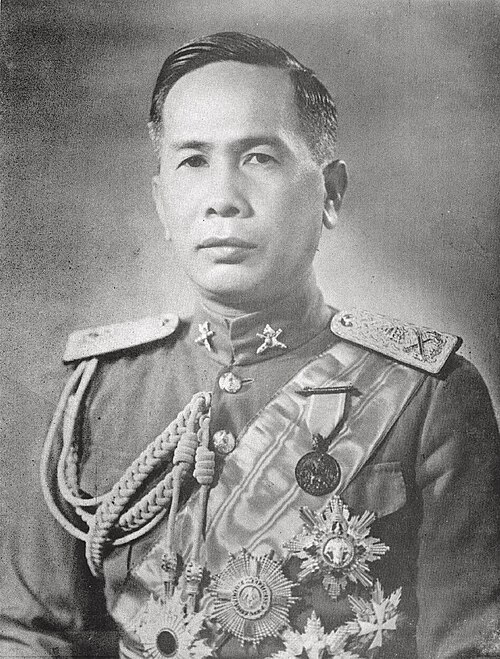
Plaek Phibunsongkhram
ModernGeneralThailand1897 — 1964
Thai military dictator who allied with Japan in WWII.
Compare Plaek Phibunsongkhram with another historical figure:
Quick Facts
Born
1897
Died
1964
Country
Thailand
Era
Modern
Occupation
General
Score Overview
Military (10%)30
Political (20%)63
Influence (20%)60
Legacy (20%)48
Leadership (15%)62
Strategy (15%)60
Total Score54.6
Plaek Phibunsongkhram — Complete Timeline
1932 AD
1932 Siamese Coup d'État ParticipationPolitical Action◆ Major
Plaek Phibunsongkhram, then a young army officer, supported the People's Party in the bloodless coup that ended absolute monarchy in Siam. This event launched his political career and aligned him with the new constitutional regime.
CoupConstitutional RevolutionPolitical Rise
Impact: national
1938 AD
Appointment as Prime MinisterPolitical Action◆ Major
Phibunsongkhram became Prime Minister of Thailand after succeeding Phraya Phahonphonphayuhasena. He consolidated power as a military dictator, promoting ultranationalist policies and a cult of personality.
Prime MinisterDictatorshipNationalism
Impact: national
1939 AD
Promotion of Thai Cultural MandatesReform◆ Major
Phibunsongkhram issued a series of cultural mandates (ratthaniyom) to modernize and nationalize Thai society. These included changing the country's name from Siam to Thailand, promoting Western dress, and suppressing regional identities.
Cultural ReformNationalismModernization
Impact: nationalconstructive
1941 AD
Alliance with Imperial Japan and Entry into World War IIWar
After Japan invaded Thailand on December 8, 1941, Phibunsongkhram signed a military alliance with Japan and declared war on the Allies. This decision led to Thailand's occupation by Japan and its use as a base for the Burma campaign.
World War IIJapan AllianceOccupation
Impact: globaldestructive
1944 AD
Overthrow and Exile after World War IIPolitical Action◆ Major
Facing Allied pressure and domestic opposition, Phibunsongkhram resigned as Prime Minister in 1944. He was briefly imprisoned for war crimes but later acquitted, and went into exile in Japan and the United States before returning to Thailand.
ResignationExilePost-War
Impact: nationaltragic
1948 AD
Return to Power and Second PremiershipPolitical Action◆ Major
Phibunsongkhram returned to Thailand and, with military support, became Prime Minister again in 1948. His second term saw alignment with the United States during the Cold War, suppression of communists, and economic development.
Return to PowerCold WarMilitary Rule
Impact: national
Detailed Scores
▶View all detailed scores
Military
Strategy
7
Tactics
7
Battles
7
Army Scale
7
War Impact
7
Political
Governance
7
Reform
7
Stability
7
Policy
8
Power
7
Influence
History
9
Global
9
Culture
9
Ideology
10
Legacy
9
People often compare with
See how Plaek Phibunsongkhram stacks up against other historical figures
Popular Comparisons
Plaek Phibunsongkhram vs Carl Gustaf Emil Mannerheim
vs Carl Gustaf Emil Mannerheim63
Plaek Phibunsongkhram vs Chosokabe Motochika
vs Chosokabe Motochika56
Plaek Phibunsongkhram vs Hu Zongnan
vs Hu Zongnan47
Plaek Phibunsongkhram vs Juan Alvarez
vs Juan Alvarez47
Plaek Phibunsongkhram vs Umaro Sissoco Embalo
vs Umaro Sissoco Embalo43
Plaek Phibunsongkhram vs Ri Yong-mu
vs Ri Yong-mu42