Loading...
This comparison has not been analyzed yet.
One-time AI generation (~1 minute). Scores and timeline are already available below.
Plaek Phibunsongkhram vs Ri Yong-mu
Plaek Phibunsongkhram leads by 12.8 pts · 2 figures compared
…
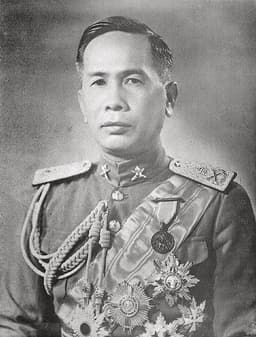
Plaek Phibunsongkhram
General · Modern
54.6Total

Ri Yong-mu
General · Modern
41.8Total
Basic Information
Born
1897
1923
Died
1964
—
Era
Modern
Modern
Nationality
Thailand
North Korea
Occupation
General
General
Civilization
Eastern
Eastern
Score Comparison
Military (10%)
30.0
22.6
Political (20%)
62.7
26.4
Influence (20%)
60.0
50.2
Legacy (20%)
47.5
41.7
Leadership (15%)
62.0
57.6
Strategy (15%)
60.0
39.6
TOTAL
54.6
41.8
Plaek Phibunsongkhram — Complete Timeline
1932 AD
1932 Siamese Coup d'État ParticipationPolitical Action◆ Major
Plaek Phibunsongkhram, then a young army officer, supported the People's Party in the bloodless coup that ended absolute monarchy in Siam. This event launched his political career and aligned him with the new constitutional regime.
CoupConstitutional RevolutionPolitical Rise
Impact: national
1938 AD
Appointment as Prime MinisterPolitical Action◆ Major
Phibunsongkhram became Prime Minister of Thailand after succeeding Phraya Phahonphonphayuhasena. He consolidated power as a military dictator, promoting ultranationalist policies and a cult of personality.
Prime MinisterDictatorshipNationalism
Impact: national
1939 AD
Promotion of Thai Cultural MandatesReform◆ Major
Phibunsongkhram issued a series of cultural mandates (ratthaniyom) to modernize and nationalize Thai society. These included changing the country's name from Siam to Thailand, promoting Western dress, and suppressing regional identities.
Cultural ReformNationalismModernization
Impact: nationalconstructive
1941 AD
Alliance with Imperial Japan and Entry into World War IIWar
After Japan invaded Thailand on December 8, 1941, Phibunsongkhram signed a military alliance with Japan and declared war on the Allies. This decision led to Thailand's occupation by Japan and its use as a base for the Burma campaign.
World War IIJapan AllianceOccupation
Impact: globaldestructive
1944 AD
Overthrow and Exile after World War IIPolitical Action◆ Major
Facing Allied pressure and domestic opposition, Phibunsongkhram resigned as Prime Minister in 1944. He was briefly imprisoned for war crimes but later acquitted, and went into exile in Japan and the United States before returning to Thailand.
ResignationExilePost-War
Impact: nationaltragic
1948 AD
Return to Power and Second PremiershipPolitical Action◆ Major
Phibunsongkhram returned to Thailand and, with military support, became Prime Minister again in 1948. His second term saw alignment with the United States during the Cold War, suppression of communists, and economic development.
Return to PowerCold WarMilitary Rule
Impact: national
Ri Yong-mu — Complete Timeline
1970 AD
Purged and RehabilitatedPolitical Action◆ Major
Ri Yong-mu was purged from his positions in the 1970s, reportedly due to factional struggles within the North Korean elite. He was later rehabilitated and returned to high office, demonstrating the volatile nature of North Korean politics.
PurgeNorth KoreaPolitical Struggle
Impact: nationaldestructive
1992 AD
Promoted to Vice MarshalPolitical Action◆ Major
Ri Yong-mu was promoted to the rank of Vice Marshal, a high military rank in North Korea. This promotion placed him among the top military leaders loyal to Kim Il-sung and later Kim Jong-il.
Military RankNorth KoreaPromotion
Impact: national
1998 AD
Appointed to the National Defense CommissionPolitical Action◆ Major
Ri Yong-mu was appointed as a member of the National Defense Commission, North Korea's highest governing body. He served in this role for many years, contributing to military and security decisions.
Political AppointmentNorth KoreaNational Defense Commission
Impact: national
This comparison has not been analyzed yet.
One-time AI generation (~1 minute). Scores and timeline are already available below.
Rankings
🥇
Plaek PhibunsongkhramLeader
Mil: 30.0Pol: 62.7Inf: 60.0
54.6
🥈
Ri Yong-mu
Mil: 22.6Pol: 26.4Inf: 50.2
41.8
+12.8 behind
How This Comparison Works
Algorithm
Each figure is scored on 6 dimensions (0—100 scale) based on structured historical data: Military (10%), Political (20%), Influence (20%), Legacy (20%), Leadership (15%), Strategy (15%). The weighted total produces the final ranking.
Data Sources
Scores are computed from structured sub-indicators in the database. Scale factors adjust for era (Ancient ×0.85, Modern ×1.0) and civilization size (Eastern ×1.05, Other ×0.80) to account for differences in population and military scale.
Maximum 3 Figures
Comparisons are limited to 2—3 figures to ensure readability and statistical meaningfulness.
Error Margins
±5 points per dimension — Sub-scores are derived from historical records with inherent uncertainty. Two figures within 5 points on a dimension should be considered roughly equivalent in that area.
Total Score Accuracy
±3 points overall — The weighted combination of 6 dimensions produces a total score with approximately ±3 points of uncertainty. Differences of less than 3 points are not statistically significant— the figures are effectively tied.
Known Limitations
- Historical records are incomplete and uneven across civilizations
- Figures from oral-tradition societies may be underrepresented
- Occupation labels can misclassify multi-role figures
- Scores measure capability and impact, not moral character
- Quantitative scoring is a comparison tool, not absolute truth
Capability Radar
Military (10%) — Battles & Warfare
Battles
40
10
Win Rate
35
10
Expansion
45
5
Political (20%) — Governance & Reform
Reform
60
5
Diplomacy
50
10
Economy
45
5
Influence (20%) — Cultural & Global Reach
Cultural
30
5
Global
40
5
Legacy (20%) — Historical Impact
Historical
45
10
Longevity
30
30
Leadership (15%) — Power & Stability
Tenure
70
40
Stability
40
20
Strategy (15%) — Tactics & Innovation
Strategy
40
10
Tactics
30
10
Reform
55
5
Similar Comparisons
Comments & Discussion
No comments yet. Be the first to share your thoughts!