Loading...
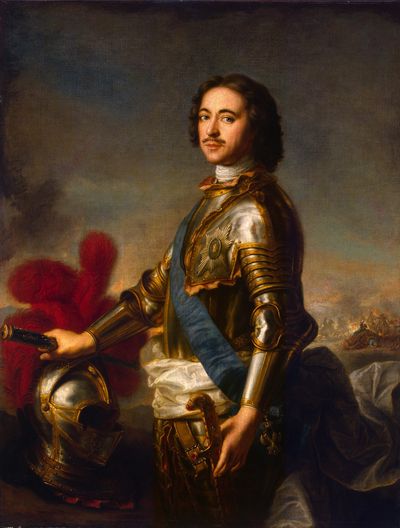
Peter the Great
ModernEmperorRussia1672 — 1725
俄罗斯帝国沙皇,推行西化改革,使俄罗斯成为欧洲强国。建立圣彼得堡。
Compare Peter the Great with another historical figure:
Quick Facts
Born
1672
Died
1725
Country
Russia
Era
Modern
Occupation
Emperor
Score Overview
Military (10%)75
Political (20%)90
Influence (20%)68
Legacy (20%)65
Leadership (15%)78
Strategy (15%)72
Total Score73.2
Peter the Great — Complete Timeline
1697 AD
Grand EmbassyPolitical Action◆ Major
Peter the Great traveled incognito to Western Europe as part of a diplomatic mission. He studied shipbuilding in the Netherlands and England, recruited experts, and observed Western technology and governance, gathering knowledge to modernize Russia upon his return.
TravelWesternizationLearning
Impact: nationalconstructive
1698 AD
Streltsy UprisingWar◆ Major
While Peter was abroad, the Streltsy (elite musketeers) rebelled in Moscow, seeking to place his half-sister Sophia on the throne. Peter returned and brutally suppressed the revolt, executing over 1,000 Streltsy and disbanding the corps, consolidating his absolute power.
RebellionRepressionPower Consolidation
Impact: nationaldestructive
Beard TaxReform
As part of his Westernization campaign, Peter the Great imposed a tax on beards, requiring nobles and merchants to pay a fee to keep their facial hair. Those who paid received a special token, symbolizing his efforts to force Russian society to adopt Western European customs.
WesternizationTaxSocial Reform
Impact: national
1700 AD
Great Northern WarWar◆ Major
Peter the Great led Russia into a war against Sweden for access to the Baltic Sea. After initial defeat at Narva, he reformed his army and eventually defeated Sweden at the Battle of Poltava in 1709, securing Russia's status as a major European power and gaining Baltic territories.
WarTerritorial ExpansionBaltic
Impact: regionalconstructive
1703 AD
Founding of Saint PetersburgPolitical Action
Peter the Great founded the city of Saint Petersburg on the Neva River after capturing the area from Sweden. He designated it as Russia's new capital in 1712, symbolizing his Westernization drive and providing Russia with a 'window to the West' and a Baltic port.
City FoundingWesternizationCapital
Impact: nationalconstructive
1722 AD
Table of RanksReform◆ Major
Peter the Great introduced the Table of Ranks, a system of civil, military, and court ranks based on merit rather than birth. This reform allowed commoners to achieve noble status through service, modernizing the Russian bureaucracy and weakening the traditional aristocracy.
BureaucracyMeritocracySocial Reform
Impact: nationalprogressive
Detailed Scores
▶View all detailed scores
Military
Strategy
7
Tactics
7
Battles
7
Army Scale
7
War Impact
8
Political
Governance
8
Reform
8
Stability
8
Policy
8
Power
8
Influence
History
8
Global
8
Culture
8
Ideology
8
Legacy
8
People often compare with
See how Peter the Great stacks up against other historical figures
Popular Comparisons
Peter the Great vs Akbar the Great
vs Akbar the Great70
Peter the Great vs Catherine the Great
vs Catherine the Great67
Peter the Great vs Louis XIV
vs Louis XIV65
Peter the Great vs Iyasu I
vs Iyasu I61
Peter the Great vs Mohammed VI of Morocco
vs Mohammed VI of Morocco60
Peter the Great vs Mindon Min
vs Mindon Min59