Loading...
Catherine the Great vs Peter the Great
Peter the Great leads by 6.4 pts · 2 figures compared
…
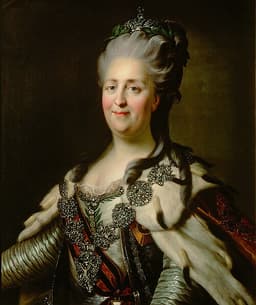
Catherine the Great
Emperor · Modern
66.8Total
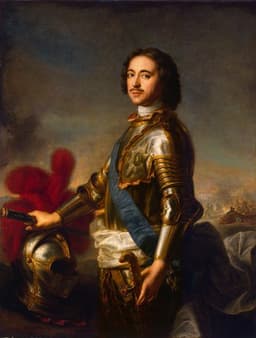
Peter the Great
Emperor · Modern
73.2Total
Basic Information
Born
1729
1672
Died
1796
1725
Era
Modern
Modern
Nationality
Russia
Russia
Occupation
Emperor
Emperor
Civilization
Western
Western
Score Comparison
Military (10%)
78.5
75.0
Political (20%)
90.0
90.0
Influence (20%)
65.0
68.0
Legacy (20%)
40.0
65.0
Leadership (15%)
80.0
78.0
Strategy (15%)
72.0
72.0
TOTAL
66.8
73.2
Catherine the Great — Complete Timeline
1762 AD
Coup d'État of 1762Political Action
Catherine II led a coup d'
CoupAccessionPower
Impact: national
1764 AD
Hermitage Museum FoundedCultural◆ Major
Catherine the Great founded the Hermitage Museum in St. Petersburg by purchasing a large collection of paintings from Berlin. The museum grew into one of the world's largest art collections, reflecting her patronage of Enlightenment culture.
ArtMuseumEnlightenment
Impact: globalconstructive
1768 AD
Russo-Turkish War (1768-1774)War◆ Major
Catherine the Great initiated a war against the Ottoman Empire, resulting in Russian victory. The Treaty of K
WarOttoman EmpireExpansion
Impact: regional
1783 AD
Annexation of CrimeaPolitical Action◆ Major
Catherine the Great formally annexed the Crimean Peninsula from the Ottoman Empire. This strategic acquisition gave Russia a dominant position in the Black Sea and a warm-water port, fulfilling a long-standing imperial ambition.
AnnexationCrimeaBlack Sea
Impact: regional
1785 AD
Charter to the Gentry GrantedReform◆ Major
Catherine the Great issued the Charter to the Gentry, which codified the rights and privileges of the Russian nobility. It exempted nobles from taxation and military service, solidifying their social status and support for her rule.
NobilityReformSocial Structure
Impact: nationalconstructive
Peter the Great — Complete Timeline
1697 AD
Grand EmbassyPolitical Action◆ Major
Peter the Great traveled incognito to Western Europe as part of a diplomatic mission. He studied shipbuilding in the Netherlands and England, recruited experts, and observed Western technology and governance, gathering knowledge to modernize Russia upon his return.
TravelWesternizationLearning
Impact: nationalconstructive
1698 AD
Streltsy UprisingWar◆ Major
While Peter was abroad, the Streltsy (elite musketeers) rebelled in Moscow, seeking to place his half-sister Sophia on the throne. Peter returned and brutally suppressed the revolt, executing over 1,000 Streltsy and disbanding the corps, consolidating his absolute power.
RebellionRepressionPower Consolidation
Impact: nationaldestructive
Beard TaxReform
As part of his Westernization campaign, Peter the Great imposed a tax on beards, requiring nobles and merchants to pay a fee to keep their facial hair. Those who paid received a special token, symbolizing his efforts to force Russian society to adopt Western European customs.
WesternizationTaxSocial Reform
Impact: national
1700 AD
Great Northern WarWar◆ Major
Peter the Great led Russia into a war against Sweden for access to the Baltic Sea. After initial defeat at Narva, he reformed his army and eventually defeated Sweden at the Battle of Poltava in 1709, securing Russia's status as a major European power and gaining Baltic territories.
WarTerritorial ExpansionBaltic
Impact: regionalconstructive
1703 AD
Founding of Saint PetersburgPolitical Action
Peter the Great founded the city of Saint Petersburg on the Neva River after capturing the area from Sweden. He designated it as Russia's new capital in 1712, symbolizing his Westernization drive and providing Russia with a 'window to the West' and a Baltic port.
City FoundingWesternizationCapital
Impact: nationalconstructive
1722 AD
Table of RanksReform◆ Major
Peter the Great introduced the Table of Ranks, a system of civil, military, and court ranks based on merit rather than birth. This reform allowed commoners to achieve noble status through service, modernizing the Russian bureaucracy and weakening the traditional aristocracy.
BureaucracyMeritocracySocial Reform
Impact: nationalprogressive
Expert Analysis
Peter the Great vs Catherine the Great
# The Two Titans of St. Petersburg
On a bitter November morning in 1725, the man who had dragged Russia into the modern world lay dying in a small room in his Winter Palace, unable to speak, his body ravaged by a lifetime of brutal exertion. Less than forty years later, a German princess who had never expected to rule anything would seize the throne of that same empire, inaugurating a golden age that would make Russia the envy of Europe. Peter the Great and Catherine the Great—the only two rulers in Russian history to earn the epithet—stand as bookends to a remarkable transformation. Yet for all their shared ambition, they were profoundly different: one a hammer, the other a magnet; one a builder, the other a curator.
Origins
Peter was born into chaos. The son of Tsar Alexis I and his second wife, Natalia Naryshkina, he came of age during a period of violent palace intrigue. When his father died in 1676, Peter was just four years old, and the throne passed to his sickly half-brother Feodor III, then to the joint rule of Peter and his other half-brother Ivan V, with their elder sister Sophia acting as regent. Peter grew up in the countryside, playing war games with peasant boys and building model boats—a childhood that taught him to distrust the Moscow elite and to find solace in practical crafts.
Catherine, by contrast, was born Sophia Augusta Frederica of Anhalt-Zerbst, a minor German principality. Her childhood was one of genteel poverty and intellectual stimulation. Her father was a Prussian general, her mother a German princess who mingled with Enlightenment thinkers. Young Sophia read French philosophy, learned to dance, and absorbed the cosmopolitan culture that would define her reign. When she was summoned to Russia at age fourteen to marry the heir to the throne, she arrived with little more than ambition and a determination to become more Russian than the Russians.
Rise to Power
Peter’s path to power was forged in blood. In 1689, at age seventeen, he learned that Sophia was plotting to have him assassinated. He fled to a monastery, rallied his supporters, and forced Sophia into a convent. For years, he allowed his mother and her advisors to govern while he indulged his passion for shipbuilding and military drills. But the real turning point came in 1697, when Peter embarked on the Grand Embassy—a diplomatic mission to Western Europe where, traveling incognito, he studied shipbuilding in the Netherlands, visited English dockyards, and observed the technological marvels of the West. He returned in 1698 to find the Streltsy, the elite musketeers, had rebelled in his absence. Peter crushed them with a savagery that shocked even his contemporaries, personally participating in the executions. From that moment, no one doubted who ruled Russia.
Catherine’s rise was more subtle but no less decisive. She arrived in Russia in 1744, converted to Orthodoxy, and married the deeply unstable Grand Duke Peter, the future Emperor Peter III. For nearly two decades, she endured a miserable marriage, cultivated allies among the nobility and the Imperial Guard, and read voraciously—Voltaire, Montesquieu, the Encyclopedists. When her husband ascended the throne in 1762, he immediately alienated the clergy, the military, and the aristocracy by his pro-Prussian policies and his contempt for Russian traditions. Catherine, with the help of the Orlov brothers and the Imperial Guard, staged a coup d'état in July 1762. Peter III was forced to abdicate and was murdered shortly afterward. Catherine, a German-born usurper, had become Empress of All Russia.
Leadership & Governance
Peter ruled as a foreman. He personally inspected shipyards, shaved the beards of his nobles, and imposed a tax on beards to force Western dress and customs. He introduced the Table of Ranks in 1722, a merit-based system that allowed commoners to rise through state service—a radical departure from the hereditary aristocracy. His reforms were relentless: he overhauled the army, built a navy from scratch, founded technical schools, and forced women out of seclusion and into society. But his methods were brutal. He taxed the poor into starvation, conscripted tens of thousands to build St. Petersburg on a swamp, and executed his own son Alexei for opposing his policies. His leadership was that of a master craftsman who saw his nation as raw material to be shaped by force.
Catherine governed as a philosopher-queen. She corresponded with Voltaire and Diderot, wrote plays and legal codes, and dreamed of a Russia enlightened by reason and justice. She founded the Hermitage Museum in 1764, purchasing entire collections from Europe to create a treasure house of art. She reformed education, established schools for girls, and attempted to codify Russian law along Enlightenment principles. Yet her reign was also marked by contradictions. She expanded serfdom, granted the nobility a Charter of Rights in 1785 that solidified their privileges, and crushed Pugachev's Rebellion with savage ferocity. Catherine’s enlightenment was for the elite; the masses remained chained.
Militarily, Peter was the greater strategist. The Great Northern War against Sweden (1700-1721) began with a catastrophic defeat at Narva, but Peter rebuilt his army, learned from his mistakes, and eventually crushed Sweden, securing Russia’s access to the Baltic Sea. Catherine’s wars were more opportunistic. The Russo-Turkish War of 1768-1774 and the annexation of Crimea in 1783 expanded Russia’s borders to the Black Sea, but these victories were won by brilliant generals like Suvorov and Potemkin, not by Catherine herself.
Triumph & Tragedy
Peter’s greatest triumph was the founding of Saint Petersburg in 1703—a city carved from marsh and forest, a window to the West that became Russia’s new capital. His greatest tragedy was the death of his son Alexei, whom he tortured and condemned for treason, leaving Russia without a capable heir. Catherine’s triumph was the expansion of Russia’s borders and the creation of a court that rivaled Versailles in splendor. Her tragedy was the unbridgeable gap between her Enlightenment ideals and the harsh reality of autocracy—a gap that would haunt Russia for centuries.
Character & Destiny
Peter was a man of immense physical energy, crude manners, and volcanic temper. He stood six feet eight inches tall, worked with his hands, and despised ceremony. His personality drove his reforms: he could not sit still, could not tolerate inefficiency, and would personally beat his ministers if they failed him. This same personality made him a tyrant who destroyed anyone who stood in his path.
Catherine was a woman of immense charm, discipline, and strategic patience. She knew when to flatter, when to threaten, and when to wait. Her personality allowed her to maintain power for thirty-four years in a court full of conspiracies, balancing factions, rewarding loyalty, and eliminating threats with a velvet glove. She was, in many ways, the first modern politician in Russian history.
Legacy
Peter left Russia with a navy, a new capital, a Westernized elite, and a tradition of brutal modernization. His legacy is the Russian Empire itself—a great power built on the backs of serfs, driven by the will of a single man. Catherine left Russia with a cultural identity, a sense of itself as a European nation, and a model of enlightened absolutism that would influence rulers across the continent. Her legacy is the idea that Russia could be both powerful and civilized.
Conclusion
Standing today in St. Petersburg, one sees the hand of both rulers. Peter built the city; Catherine adorned it. Peter forced Russia to look west; Catherine made it want to stay. One changed a nation through force, the other through persuasion. Neither was perfect; both were necessary. The hammer and the magnet—each shaped Russia in its own image, and together they created an empire that would dominate the world stage for centuries to come.
Rankings
🥇
Peter the GreatLeader
Mil: 75.0Pol: 90.0Inf: 68.0
73.2
🥈
Catherine the Great
Mil: 78.5Pol: 90.0Inf: 65.0
66.8
+6.4 behind
How This Comparison Works
Algorithm
Each figure is scored on 6 dimensions (0—100 scale) based on structured historical data: Military (10%), Political (20%), Influence (20%), Legacy (20%), Leadership (15%), Strategy (15%). The weighted total produces the final ranking.
Data Sources
Scores are computed from structured sub-indicators in the database. Scale factors adjust for era (Ancient ×0.85, Modern ×1.0) and civilization size (Eastern ×1.05, Other ×0.80) to account for differences in population and military scale.
Maximum 3 Figures
Comparisons are limited to 2—3 figures to ensure readability and statistical meaningfulness.
Error Margins
±5 points per dimension — Sub-scores are derived from historical records with inherent uncertainty. Two figures within 5 points on a dimension should be considered roughly equivalent in that area.
Total Score Accuracy
±3 points overall — The weighted combination of 6 dimensions produces a total score with approximately ±3 points of uncertainty. Differences of less than 3 points are not statistically significant— the figures are effectively tied.
Known Limitations
- Historical records are incomplete and uneven across civilizations
- Figures from oral-tradition societies may be underrepresented
- Occupation labels can misclassify multi-role figures
- Scores measure capability and impact, not moral character
- Quantitative scoring is a comparison tool, not absolute truth
Capability Radar
Military (10%) — Battles & Warfare
Battles
85
85
Win Rate
80
80
Expansion
90
90
Political (20%) — Governance & Reform
Reform
90
95
Diplomacy
85
80
Economy
85
85
Influence (20%) — Cultural & Global Reach
Cultural
85
85
Global
80
85
Legacy (20%) — Historical Impact
Historical
85
90
Longevity
80
85
Leadership (15%) — Power & Stability
Tenure
95
90
Stability
80
70
Strategy (15%) — Tactics & Innovation
Strategy
85
85
Tactics
75
75
Reform
90
95
Similar Comparisons
Comments & Discussion
STREETWISE ICONOCLAST6/16/2026
Peter wasn't modernizing Russia — he was rebooting its soul like a cynical factory owner. Draining swamps for St. Petersburg cost 100,000 serf lives, and that was just construction debt. Catherine at least understood curation: collecting Diderot's library while the man starved proves she valued intellect over concrete. Which ruler leaves smarter legacies? The one who funded thinkers, not just canals.|zh|彼得大帝就是个暴躁包工头,用死人头骨铺圣彼得堡的砖。他强迫贵族剃胡子那段简直可笑——用剪刀搞文化革命?凯瑟琳大帝才懂什么是真改革:她买狄德罗图书馆时还多付了五年工资当管理费。这女人连情人