Loading...
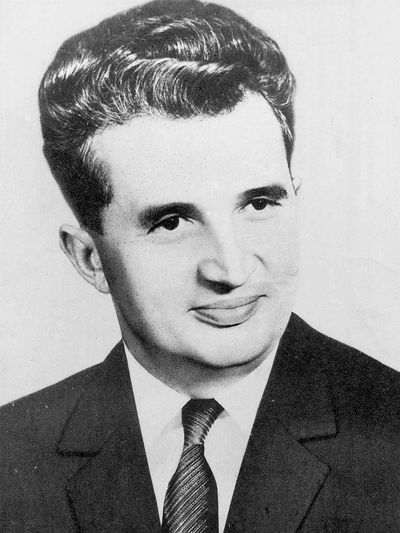
Nicolae Ceausescu
ModernPoliticianRomania1918 — 1989
Communist dictator of Romania executed after the 1989 revolution.
Compare Nicolae Ceausescu with another historical figure:
Quick Facts
Born
1918
Died
1989
Country
Romania
Era
Modern
Occupation
Politician
Score Overview
Military (10%)37
Political (20%)26
Influence (20%)49
Legacy (20%)40
Leadership (15%)74
Strategy (15%)53
Total Score46.4
Nicolae Ceausescu — Complete Timeline
1965 AD
Elected General Secretary of Romanian Communist PartyPolitical Action◆ Major
Ceausescu became General Secretary of the Romanian Communist Party after the death of Gheorghe Gheorghiu-Dej. He consolidated power by purging rivals and promoting family members to key positions, establishing a personal dictatorship.
CommunismDictatorshipCold War
Impact: nationaldestructive
1968 AD
Ceausescu's independent foreign policyPolitical Action◆ Major
Ceausescu publicly condemned the Warsaw Pact invasion of Czechoslovakia in 1968, refusing to send Romanian troops. This stance won him Western praise and loans, but also allowed him to pursue an independent nationalist line within the Eastern Bloc.
Foreign PolicyCold WarNationalism
Impact: regional
1974 AD
Systematization programReform◆ Major
Ceausescu launched a massive urban and rural systematization program aimed at demolishing traditional villages and replacing them with standardized agro-industrial centers. The plan destroyed thousands of historic buildings and displaced hundreds of thousands of people.
Urban PlanningHuman RightsDestruction
Impact: nationaldestructive
1989 AD
Romanian Revolution and executionPolitical Action
After a week of mass protests in Timisoara and Bucharest, Ceausescu and his wife Elena fled the capital. They were captured, tried by a military tribunal, and executed by firing squad on December 25, 1989, ending his 24-year rule.
RevolutionExecutionCold War
Impact: globaltragic
Detailed Scores
▶View all detailed scores
Military
Strategy
6
Tactics
5
Battles
6
Army Scale
5
War Impact
6
Political
Governance
7
Reform
7
Stability
7
Policy
7
Power
8
Influence
History
9
Global
8
Culture
8
Ideology
9
Legacy
8
People often compare with
See how Nicolae Ceausescu stacks up against other historical figures
Popular Comparisons
Nicolae Ceausescu vs Ngozi Okonjo-Iweala
vs Ngozi Okonjo-Iweala63
Nicolae Ceausescu vs Nguyen Phu Trong
vs Nguyen Phu Trong54
Nicolae Ceausescu vs Tabare Vazquez
vs Tabare Vazquez54
Nicolae Ceausescu vs Nicolas Sarkozy
vs Nicolas Sarkozy51
Nicolae Ceausescu vs Horloogiyn Choibalsan
vs Horloogiyn Choibalsan50
Nicolae Ceausescu vs Natsagiin Bagabandi
vs Natsagiin Bagabandi48