Loading...
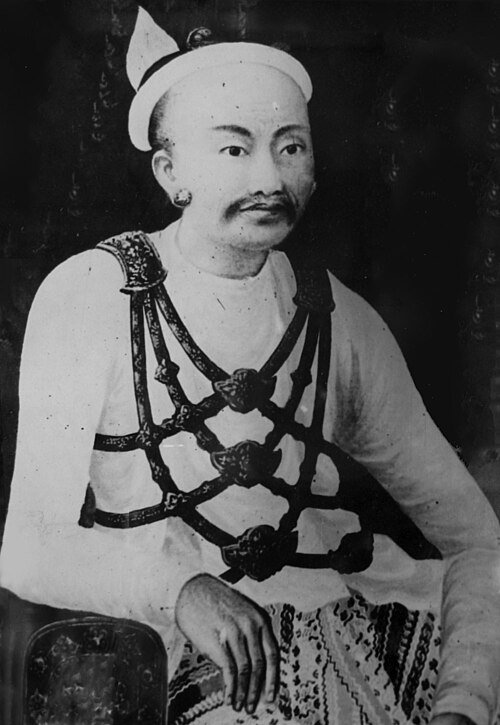
Mindon Min
ModernEmperorMyanmar1808 — 1878
Reformist Konbaung king who held the Fifth Buddhist Council.
Compare Mindon Min with another historical figure:
Quick Facts
Born
1808
Died
1878
Country
Myanmar
Era
Modern
Occupation
Emperor
Score Overview
Military (10%)50
Political (20%)72
Influence (20%)61
Legacy (20%)49
Leadership (15%)72
Strategy (15%)43
Total Score58.5
Mindon Min — Complete Timeline
1853 AD
Modernization ReformsReform◆ Major
Mindon Min initiated a series of modernization reforms, including the establishment of a modern mint, the introduction of telegraph and postal systems, the construction of roads and canals, and the reorganization of the army along Western lines. He also invited European advisors to the court.
ModernizationReformBurma
Impact: nationalconstructive
Accession to the ThronePolitical Action◆ Major
Mindon Min ascended the throne after overthrowing his half-brother Pagan Min in a palace coup. He immediately sought peace with the British, ending the Second Anglo-Burmese War (which had started in 1852) and accepting the loss of Lower Burma.
CoupSuccessionBurma
Impact: nationalconstructive
1857 AD
Construction of Mandalay PalaceCultural◆ Major
Mindon Min founded the new royal capital of Mandalay and constructed the Mandalay Palace, a vast walled complex. The move from Amarapura to Mandalay was part of his efforts to create a modern capital and assert royal authority.
MandalayCapitalArchitecture
Impact: nationalconstructive
1867 AD
Treaty of 1867 with BritainPolitical Action◆ Major
Mindon Min signed a commercial treaty with the British, opening Burma to trade and allowing a British resident in Mandalay. The treaty recognized British control of Lower Burma and established a framework for diplomatic relations, but also increased British influence.
TreatyBritish RelationsTrade
Impact: regional
1871 AD
Holding of the Fifth Buddhist CouncilCultural
Mindon Min convened the Fifth Buddhist Council in Mandalay, a major religious event attended by thousands of monks. The council aimed to purify and standardize the Pali canon. The text was inscribed on 729 marble slabs at the Kuthodaw Pagoda, the world's largest book.
Buddhist CouncilReligionBurma
Impact: globalconstructive
Detailed Scores
▶View all detailed scores
Military
Strategy
7
Tactics
7
Battles
7
Army Scale
6
War Impact
7
Political
Governance
7
Reform
7
Stability
7
Policy
8
Power
8
Influence
History
8
Global
8
Culture
8
Ideology
9
Legacy
8
People often compare with
See how Mindon Min stacks up against other historical figures
Popular Comparisons
Mindon Min vs Peter the Great
vs Peter the Great73
Mindon Min vs Joseph II
vs Joseph II57
Mindon Min vs Sultan bin Muhammad Al Qasimi
vs Sultan bin Muhammad Al Qasimi56
Mindon Min vs Rajasinha I
vs Rajasinha I55
Mindon Min vs Sabah Al-Ahmad Al-Jaber Al-Sabah
vs Sabah Al-Ahmad Al-Jaber Al-Sabah51
Mindon Min vs William II of Wurttemberg
vs William II of Wurttemberg42