Loading...
This comparison has not been analyzed yet.
One-time AI generation (~1 minute). Scores and timeline are already available below.
Mindon Min vs Sabah Al-Ahmad Al-Jaber Al-Sabah
Mindon Min leads by 7.9 pts · 2 figures compared
…
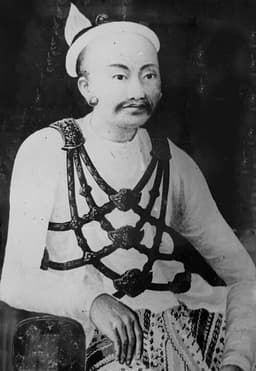
Mindon Min
Emperor · Modern
58.5Total

Sabah Al-Ahmad Al-Jaber Al-Sabah
Emperor · Modern
50.6Total
Basic Information
Born
1808
1929
Died
1878
—
Era
Modern
Modern
Nationality
Myanmar
Kuwait
Occupation
Emperor
Emperor
Civilization
Eastern
Middle Eastern
Score Comparison
Military (10%)
50.0
10.4
Political (20%)
72.0
59.3
Influence (20%)
61.0
54.9
Legacy (20%)
49.2
43.3
Leadership (15%)
72.0
80.0
Strategy (15%)
43.3
40.7
TOTAL
58.5
50.6
Mindon Min — Complete Timeline
1853 AD
Modernization ReformsReform◆ Major
Mindon Min initiated a series of modernization reforms, including the establishment of a modern mint, the introduction of telegraph and postal systems, the construction of roads and canals, and the reorganization of the army along Western lines. He also invited European advisors to the court.
ModernizationReformBurma
Impact: nationalconstructive
Accession to the ThronePolitical Action◆ Major
Mindon Min ascended the throne after overthrowing his half-brother Pagan Min in a palace coup. He immediately sought peace with the British, ending the Second Anglo-Burmese War (which had started in 1852) and accepting the loss of Lower Burma.
CoupSuccessionBurma
Impact: nationalconstructive
1857 AD
Construction of Mandalay PalaceCultural◆ Major
Mindon Min founded the new royal capital of Mandalay and constructed the Mandalay Palace, a vast walled complex. The move from Amarapura to Mandalay was part of his efforts to create a modern capital and assert royal authority.
MandalayCapitalArchitecture
Impact: nationalconstructive
1867 AD
Treaty of 1867 with BritainPolitical Action◆ Major
Mindon Min signed a commercial treaty with the British, opening Burma to trade and allowing a British resident in Mandalay. The treaty recognized British control of Lower Burma and established a framework for diplomatic relations, but also increased British influence.
TreatyBritish RelationsTrade
Impact: regional
1871 AD
Holding of the Fifth Buddhist CouncilCultural
Mindon Min convened the Fifth Buddhist Council in Mandalay, a major religious event attended by thousands of monks. The council aimed to purify and standardize the Pali canon. The text was inscribed on 729 marble slabs at the Kuthodaw Pagoda, the world's largest book.
Buddhist CouncilReligionBurma
Impact: globalconstructive
Sabah Al-Ahmad Al-Jaber Al-Sabah — Complete Timeline
1991 AD
Led Kuwait's reconstruction after the Gulf WarOther◆ Major
As Crown Prince and Prime Minister, Sabah oversaw the reconstruction of Kuwait after the 1990-1991 Iraqi invasion and Gulf War. He managed the restoration of oil fields, infrastructure, and the return of the Kuwaiti government from exile.
ReconstructionGulf WarPost-war
Impact: nationalconstructive
2003 AD
Hosted international conferences for Iraq reconstructionPolitical Action
Emir Sabah hosted several international donor conferences for the reconstruction of Iraq after the 2003 U.S.-led invasion. Kuwait contributed billions of dollars in aid and hosted meetings of the International Reconstruction Fund Facility for Iraq.
IraqReconstructionDiplomacy
Impact: regionalconstructive
2006 AD
Became Emir of KuwaitPolitical Action◆ Major
Sabah Al-Ahmad Al-Jaber Al-Sabah became the Emir of Kuwait on January 29, 2006, after the death of Emir Jaber Al-Ahmad Al-Sabah. His accession was confirmed by the National Assembly, ending a succession crisis.
SuccessionMonarchyEmir
Impact: national
Expanded Kuwait's foreign aid and humanitarian rolePolitical Action
Under Emir Sabah's rule, Kuwait increased its foreign aid and humanitarian contributions, becoming one of the largest donors per capita. He established the Kuwait Fund for Arab Economic Development and supported UN humanitarian efforts.
Foreign AidHumanitarianDevelopment
Impact: globalconstructive
2017 AD
Mediated Gulf diplomatic crisis (2017-2021)Political Action◆ Major
Emir Sabah attempted to mediate the diplomatic crisis between Qatar and a Saudi-led bloc that began in 2017. Kuwait maintained neutrality and hosted negotiations, though the crisis was not resolved during his lifetime.
MediationGulf CrisisDiplomacy
Impact: regionalconstructive
This comparison has not been analyzed yet.
One-time AI generation (~1 minute). Scores and timeline are already available below.
Rankings
🥇
Mindon MinLeader
Mil: 50.0Pol: 72.0Inf: 61.0
58.5
🥈
Sabah Al-Ahmad Al-Jaber Al-Sabah
Mil: 10.4Pol: 59.3Inf: 54.9
50.6
+7.9 behind
How This Comparison Works
Algorithm
Each figure is scored on 6 dimensions (0—100 scale) based on structured historical data: Military (10%), Political (20%), Influence (20%), Legacy (20%), Leadership (15%), Strategy (15%). The weighted total produces the final ranking.
Data Sources
Scores are computed from structured sub-indicators in the database. Scale factors adjust for era (Ancient ×0.85, Modern ×1.0) and civilization size (Eastern ×1.05, Other ×0.80) to account for differences in population and military scale.
Maximum 3 Figures
Comparisons are limited to 2—3 figures to ensure readability and statistical meaningfulness.
Error Margins
±5 points per dimension — Sub-scores are derived from historical records with inherent uncertainty. Two figures within 5 points on a dimension should be considered roughly equivalent in that area.
Total Score Accuracy
±3 points overall — The weighted combination of 6 dimensions produces a total score with approximately ±3 points of uncertainty. Differences of less than 3 points are not statistically significant— the figures are effectively tied.
Known Limitations
- Historical records are incomplete and uneven across civilizations
- Figures from oral-tradition societies may be underrepresented
- Occupation labels can misclassify multi-role figures
- Scores measure capability and impact, not moral character
- Quantitative scoring is a comparison tool, not absolute truth
Capability Radar
Military (10%) — Battles & Warfare
Battles
20
4
Win Rate
20
9
Expansion
10
12
Political (20%) — Governance & Reform
Reform
75
60
Diplomacy
55
70
Economy
60
65
Influence (20%) — Cultural & Global Reach
Cultural
65
30
Global
40
40
Legacy (20%) — Historical Impact
Historical
60
40
Longevity
45
30
Leadership (15%) — Power & Stability
Tenure
60
75
Stability
50
60
Strategy (15%) — Tactics & Innovation
Strategy
25
14
Tactics
25
15
Reform
30
20
Similar Comparisons
Mindon Min vs Napoleon BonaparteJames II of England vs Sabah Al-Ahmad Al-Jaber Al-SabahKarim Khan Zand vs Sabah Al-Ahmad Al-Jaber Al-SabahJivaji Rao Scindia vs Sabah Al-Ahmad Al-Jaber Al-SabahKarl I of Austria vs Sabah Al-Ahmad Al-Jaber Al-SabahSabah Al-Ahmad Al-Jaber Al-Sabah vs Vijayaraji of Kutch
Comments & Discussion
No comments yet. Be the first to share your thoughts!