Loading...
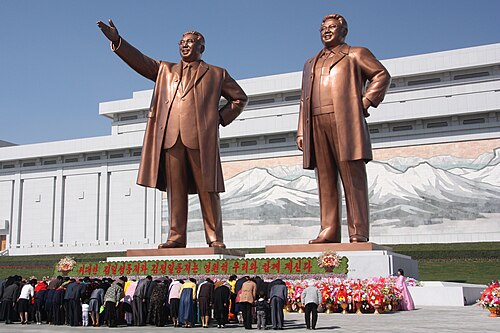
Kim Jong-il
ModernPoliticianNorth Korea1941 — ?
Second supreme leader of North Korea.
Compare Kim Jong-il with another historical figure:
Quick Facts
Born
1941
Country
North Korea
Era
Modern
Occupation
Politician
Score Overview
Military (10%)37
Political (20%)26
Influence (20%)56
Legacy (20%)45
Leadership (15%)72
Strategy (15%)54
Total Score49.1
Kim Jong-il — Complete Timeline
1994 AD
Assumption of Leadership after Kim Il-sung's DeathPolitical Action◆ Major
Kim Jong-il officially assumed supreme leadership of North Korea following the death of his father Kim Il-sung. He inherited a totalitarian state with a struggling economy and a nuclear weapons program.
SuccessionNorth KoreaLeadership
Impact: global
1995 AD
Arduous March FamineOther◆ Major
North Korea suffered a severe famine, known as the Arduous March, caused by floods, economic mismanagement, and the collapse of Soviet aid. Hundreds of thousands died, while the regime prioritized military spending over relief.
FamineHumanitarian CrisisNorth Korea
Impact: nationaltragic
2000 AD
Sunshine Policy Engagement with South KoreaPolitical Action◆ Major
Kim Jong-il participated in the first inter-Korean summit with South Korean President Kim Dae-jung in Pyongyang. The summit led to the June 15th Joint Declaration, promoting reconciliation and economic cooperation.
SummitReconciliationSouth Korea
Impact: regionalconstructive
2006 AD
First North Korean Nuclear TestWar
Under Kim Jong-il's leadership, North Korea conducted its first underground nuclear test, claiming success. This event escalated international tensions and led to UN sanctions, marking North Korea's entry as a nuclear-armed state.
Nuclear TestProliferationSanctions
Impact: globaldestructive
2011 AD
Death and Succession by Kim Jong-unPolitical Action◆ Major
Kim Jong-il died of a heart attack, and his youngest son Kim Jong-un was quickly declared the successor. This continued the Kim dynasty's hereditary rule, with Kim Jong-un assuming leadership of the Workers' Party and military.
DeathSuccessionKim Dynasty
Impact: global
Detailed Scores
▶View all detailed scores
Military
Strategy
6
Tactics
5
Battles
6
Army Scale
5
War Impact
6
Political
Governance
7
Reform
7
Stability
7
Policy
7
Power
8
Influence
History
9
Global
8
Culture
9
Ideology
9
Legacy
8
People often compare with
See how Kim Jong-il stacks up against other historical figures
Popular Comparisons
Kim Jong-il vs Sarvepalli Radhakrishnan
vs Sarvepalli Radhakrishnan60
Kim Jong-il vs Matsudaira Sadanobu
vs Matsudaira Sadanobu51
Kim Jong-il vs Tom Thabane
vs Tom Thabane45
Kim Jong-il vs John Stuart of Bute
vs John Stuart of Bute41
Kim Jong-il vs Napoleon Bonaparte
vs Napoleon Bonaparte71