Loading...
Kim Jong-il vs Sarvepalli Radhakrishnan
Sarvepalli Radhakrishnan leads by 10.6 pts · 2 figures compared
…
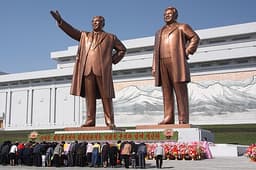
Kim Jong-il
Politician · Modern
49.1Total

Sarvepalli Radhakrishnan
Politician · Modern
59.7Total
Basic Information
Born
1941
1888
Died
—
1975
Era
Modern
Modern
Nationality
North Korea
India
Occupation
Politician
Politician
Civilization
Eastern
Indian
Score Comparison
Military (10%)
36.6
48.4
Political (20%)
26.4
53.8
Influence (20%)
56.4
65.0
Legacy (20%)
45.0
55.0
Leadership (15%)
72.0
72.0
Strategy (15%)
53.8
60.0
TOTAL
49.1
59.7
Kim Jong-il — Complete Timeline
1994 AD
Assumption of Leadership after Kim Il-sung's DeathPolitical Action◆ Major
Kim Jong-il officially assumed supreme leadership of North Korea following the death of his father Kim Il-sung. He inherited a totalitarian state with a struggling economy and a nuclear weapons program.
SuccessionNorth KoreaLeadership
Impact: global
1995 AD
Arduous March FamineOther◆ Major
North Korea suffered a severe famine, known as the Arduous March, caused by floods, economic mismanagement, and the collapse of Soviet aid. Hundreds of thousands died, while the regime prioritized military spending over relief.
FamineHumanitarian CrisisNorth Korea
Impact: nationaltragic
2000 AD
Sunshine Policy Engagement with South KoreaPolitical Action◆ Major
Kim Jong-il participated in the first inter-Korean summit with South Korean President Kim Dae-jung in Pyongyang. The summit led to the June 15th Joint Declaration, promoting reconciliation and economic cooperation.
SummitReconciliationSouth Korea
Impact: regionalconstructive
2006 AD
First North Korean Nuclear TestWar
Under Kim Jong-il's leadership, North Korea conducted its first underground nuclear test, claiming success. This event escalated international tensions and led to UN sanctions, marking North Korea's entry as a nuclear-armed state.
Nuclear TestProliferationSanctions
Impact: globaldestructive
2011 AD
Death and Succession by Kim Jong-unPolitical Action◆ Major
Kim Jong-il died of a heart attack, and his youngest son Kim Jong-un was quickly declared the successor. This continued the Kim dynasty's hereditary rule, with Kim Jong-un assuming leadership of the Workers' Party and military.
DeathSuccessionKim Dynasty
Impact: global
Sarvepalli Radhakrishnan — Complete Timeline
1949 AD
Appointed Ambassador to the Soviet UnionPolitical Action◆ Major
Sarvepalli Radhakrishnan was appointed as India's Ambassador to the Soviet Union, serving from 1949 to 1952. He played a key role in establishing diplomatic relations and promoting cultural exchange.
DiplomacyAmbassadorUSSR
Impact: nationalconstructive
1952 AD
Elected Vice President of IndiaPolitical Action◆ Major
Sarvepalli Radhakrishnan was elected as the first Vice President of India, serving from 1952 to 1962. He also served as Chairman of the Rajya Sabha, presiding over the upper house.
Vice PresidentRajya SabhaConstitutional
Impact: nationalconstructive
1954 AD
Awarded Bharat RatnaCultural◆ Major
Sarvepalli Radhakrishnan was awarded the Bharat Ratna, India's highest civilian award, in 1954. He was one of the first recipients, honored for his contributions to philosophy and public life.
AwardHonorCivilian
Impact: nationalconstructive
1962 AD
Elected President of IndiaPolitical Action◆ Major
Sarvepalli Radhakrishnan was elected as the 2nd President of India, serving from 1962 to 1967. He was a renowned philosopher and scholar, and his presidency was marked by intellectual leadership.
PresidencyPhilosopherElection
Impact: nationalconstructive
Teachers' Day established in his honorCultural◆ Major
India's Teachers' Day is celebrated on September 5, the birthday of Sarvepalli Radhakrishnan, in recognition of his contributions to education and philosophy. The tradition began during his presidency.
Teachers' DayEducationHonor
Impact: nationalconstructive
Expert Analysis
Origins
Kim Jong-il was born on February 16, 1941, in the Soviet Union, though official records claim 1942 in a secret military camp on Mount Paektu. He was the son of Kim Il-sung, North Korea's founding leader. His early life was shaped by the Korean War and his father's cult of personality. He studied at Kim Il-sung University and later at the University of Malta, focusing on political economy.
Sarvepalli Radhakrishnan was born on September 5, 1888, in Tiruttani, Madras Presidency, British India. He came from a humble Telugu Brahmin family. His father was a subordinate revenue official. Radhakrishnan excelled academically, earning a master's degree in philosophy from Madras Christian College. He began his career as a professor at Mysore University and later at Calcutta University.
Rise to Power
Kim Jong-il's rise was orchestrated by his father. He was appointed to key party positions in the 1970s, becoming secretary of the Workers' Party of Korea in 1973. In 1980, he was officially designated as heir apparent. After Kim Il-sung's death in 1994, Kim Jong-il assumed leadership, though he had effectively ruled since 1991. His power rested on the military and the cult of personality.
Radhakrishnan's rise was through intellectual and diplomatic achievements. He gained international recognition as a philosopher, publishing works like 'Indian Philosophy' (1923) and 'The Hindu View of Life' (1926). He was appointed as India's Ambassador to the Soviet Union from 1949 to 1952, strengthening ties. In 1952, he became the first Vice President of India, and in 1962, he was elected as the second President of India.
Leadership & Governance
Kim Jong-il's leadership was totalitarian and isolationist. He prioritized the military-first policy (Songun), allocating 25% of GDP to defense. Under him, North Korea developed nuclear weapons, conducting its first test in 2006. Economic mismanagement and natural disasters led to the Arduous March famine (1994-1998), causing 240,000 to 3.5 million deaths. He maintained power through a personality cult and suppression.
Radhakrishnan's governance was symbolic and intellectual as President. He focused on education and philosophy, using his position to promote Indian culture. He was not involved in day-to-day politics but influenced policy through moral authority. He represented India's soft power, advocating for peace and non-alignment during the Cold War. His leadership style was democratic and respectful.
Triumph & Tragedy
Kim Jong-il's greatest success was maintaining his regime despite economic collapse and international pressure. He oversaw the first inter-Korean summit in 2000, briefly improving relations. However, his greatest failure was the Arduous March famine, a humanitarian catastrophe. His nuclear ambitions isolated North Korea and impoverished its people.
Radhakrishnan's triumphs include being a leading philosopher of comparative religion, with his works translated into multiple languages. As President, he enhanced India's global standing. His tragedy was that his philosophical ideals had limited impact on India's domestic problems like poverty and inequality. He also faced criticism for not opposing the Emergency more forcefully.
Character & Destiny
Kim Jong-il was reclusive, paranoid, and ruthless. He micromanaged propaganda and enjoyed luxury while his people starved. His character led to a hermit kingdom with a failing economy. His destiny was to die of a heart attack in 2011, passing power to his son Kim Jong-un.
Radhakrishnan was scholarly, humble, and principled. He believed in dialogue and education. His character earned him respect globally. His destiny was to be remembered as a philosopher-president, with his birthday celebrated as Teachers' Day in India.
Legacy
Kim Jong-il's legacy is a nuclear-armed North Korea, a severe human rights record, and a hereditary dictatorship that continues. His scores: Military 36.6, Political 26.4, Influence 56.4, Legacy 45.0, Leadership 72.0, Strategy 53.8, Total 49.1.
Radhakrishnan's legacy is in education and philosophy. He revived interest in Indian philosophy globally. Teachers' Day honors him. His scores: Military 48.4, Political 53.8, Influence 65.0, Legacy 55.0, Leadership 72.0, Strategy 60.0, Total 59.7.
Conclusion
Sarvepalli Radhakrishnan had a greater positive impact. His total score of 59.7 exceeds Kim Jong-il's 49.1 by 10.6 points. While Kim left a legacy of suffering and nuclear threats, Radhakrishnan inspired education and cross-cultural understanding. Radhakrishnan's influence is more enduring and constructive.
Rankings
🥇
Sarvepalli RadhakrishnanLeader
Mil: 48.4Pol: 53.8Inf: 65.0
59.7
🥈
Kim Jong-il
Mil: 36.6Pol: 26.4Inf: 56.4
49.1
+10.6 behind
How This Comparison Works
Algorithm
Each figure is scored on 6 dimensions (0—100 scale) based on structured historical data: Military (10%), Political (20%), Influence (20%), Legacy (20%), Leadership (15%), Strategy (15%). The weighted total produces the final ranking.
Data Sources
Scores are computed from structured sub-indicators in the database. Scale factors adjust for era (Ancient ×0.85, Modern ×1.0) and civilization size (Eastern ×1.05, Other ×0.80) to account for differences in population and military scale.
Maximum 3 Figures
Comparisons are limited to 2—3 figures to ensure readability and statistical meaningfulness.
Error Margins
±5 points per dimension — Sub-scores are derived from historical records with inherent uncertainty. Two figures within 5 points on a dimension should be considered roughly equivalent in that area.
Total Score Accuracy
±3 points overall — The weighted combination of 6 dimensions produces a total score with approximately ±3 points of uncertainty. Differences of less than 3 points are not statistically significant— the figures are effectively tied.
Known Limitations
- Historical records are incomplete and uneven across civilizations
- Figures from oral-tradition societies may be underrepresented
- Occupation labels can misclassify multi-role figures
- Scores measure capability and impact, not moral character
- Quantitative scoring is a comparison tool, not absolute truth
Capability Radar
Military (10%) — Battles & Warfare
Battles
5
41
Win Rate
5
49
Expansion
5
48
Political (20%) — Governance & Reform
Reform
10
55
Diplomacy
20
70
Economy
5
50
Influence (20%) — Cultural & Global Reach
Cultural
30
75
Global
40
70
Legacy (20%) — Historical Impact
Historical
40
70
Longevity
30
65
Leadership (15%) — Power & Stability
Tenure
85
60
Stability
40
65
Strategy (15%) — Tactics & Innovation
Strategy
10
55
Tactics
10
56
Reform
15
58
Similar Comparisons
Comments & Discussion
No comments yet. Be the first to share your thoughts!