Loading...
Kim Jong-il vs Tom Thabane
Kim Jong-il leads by 3.7 pts · 2 figures compared
…
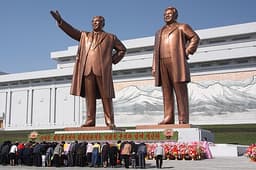
Kim Jong-il
Politician · Modern
49.1Total

Tom Thabane
Politician · Modern
45.4Total
Basic Information
Born
1941
1939
Died
—
—
Era
Modern
Modern
Nationality
North Korea
Lesotho
Occupation
Politician
Politician
Civilization
Eastern
Other
Score Comparison
Military (10%)
36.6
34.6
Political (20%)
26.4
39.4
Influence (20%)
56.4
48.6
Legacy (20%)
45.0
39.2
Leadership (15%)
72.0
67.0
Strategy (15%)
53.8
40.4
TOTAL
49.1
45.4
Kim Jong-il — Complete Timeline
1994 AD
Assumption of Leadership after Kim Il-sung's DeathPolitical Action◆ Major
Kim Jong-il officially assumed supreme leadership of North Korea following the death of his father Kim Il-sung. He inherited a totalitarian state with a struggling economy and a nuclear weapons program.
SuccessionNorth KoreaLeadership
Impact: global
1995 AD
Arduous March FamineOther◆ Major
North Korea suffered a severe famine, known as the Arduous March, caused by floods, economic mismanagement, and the collapse of Soviet aid. Hundreds of thousands died, while the regime prioritized military spending over relief.
FamineHumanitarian CrisisNorth Korea
Impact: nationaltragic
2000 AD
Sunshine Policy Engagement with South KoreaPolitical Action◆ Major
Kim Jong-il participated in the first inter-Korean summit with South Korean President Kim Dae-jung in Pyongyang. The summit led to the June 15th Joint Declaration, promoting reconciliation and economic cooperation.
SummitReconciliationSouth Korea
Impact: regionalconstructive
2006 AD
First North Korean Nuclear TestWar
Under Kim Jong-il's leadership, North Korea conducted its first underground nuclear test, claiming success. This event escalated international tensions and led to UN sanctions, marking North Korea's entry as a nuclear-armed state.
Nuclear TestProliferationSanctions
Impact: globaldestructive
2011 AD
Death and Succession by Kim Jong-unPolitical Action◆ Major
Kim Jong-il died of a heart attack, and his youngest son Kim Jong-un was quickly declared the successor. This continued the Kim dynasty's hereditary rule, with Kim Jong-un assuming leadership of the Workers' Party and military.
DeathSuccessionKim Dynasty
Impact: global
Tom Thabane — Complete Timeline
2012 AD
Elected Prime Minister of LesothoPolitical Action◆ Major
Thabane became Prime Minister after leading a coalition government following the 2012 general election, ending Pakalitha Mosisili's 14-year rule. His All Basotho Convention party won the most seats but required coalition partners to form a government.
ElectionCoalitionPolitical Change
Impact: national
2014 AD
Fled to South Africa during alleged coupPolitical Action◆ Major
Thabane fled to South Africa claiming a coup attempt by the military. He returned after Southern African Development Community mediation, but the incident highlighted deep political instability and civil-military tensions in Lesotho.
CoupExileSADC Mediation
Impact: regionaldestructive
2015 AD
Lost 2015 snap electionPolitical Action◆ Major
Thabane's government collapsed after a no-confidence vote, leading to a snap election which he lost to Pakalitha Mosisili. His brief tenure was marked by political turmoil and coalition instability.
Election LossGovernment CollapsePolitical Instability
Impact: nationaldestructive
2017 AD
Returned to power in 2017 electionPolitical Action◆ Major
Thabane won the 2017 snap election, returning as Prime Minister after Mosisili's government fell. His coalition government again faced challenges, including internal party disputes and corruption allegations.
ElectionReturn to PowerCoalition
Impact: national
2020 AD
Resigned amid murder allegationsPolitical Action◆ Major
Thabane resigned as Prime Minister after being implicated in the murder of his ex-wife. He faced mounting pressure from his party and the public, leading to his resignation and replacement by Moeketsi Majoro.
Murder AllegationsResignationScandal
Impact: nationaltragic
Expert Analysis
Origins
Kim Jong-il was born on February 16, 1941, in the Soviet Union, though official North Korean sources claim 1942 at Mount Paektu. He was the son of Kim Il-sung, the founding leader of North Korea. His early life was shrouded in propaganda; he studied at Kim Il-sung University and later at the University of Malta. He was groomed for leadership from a young age, working in the Korean Workers' Party Propaganda and Agitation Department.
Tom Thabane was born on May 28, 1939, in Mafeteng, Lesotho. He studied at the University of South Africa, earning a degree in political science. His early career included work as a civil servant and later as a private secretary to Prime Minister Leabua Jonathan. Thabane was a member of the Basotho National Party before founding the All Basotho Convention in 2006.
Rise to Power
Kim Jong-il's rise was orchestrated by his father. He was officially designated as successor in 1980, taking on key party roles. After Kim Il-sung's death in 1994, Kim Jong-il assumed leadership, though he did not take the title of president. His power was consolidated through the military-first policy (Songun). By 1998, he was formally re-elected as chairman of the National Defense Commission.
Tom Thabane rose to prominence as a critic of long-serving Prime Minister Pakalitha Mosisili. In the 2012 general election, Thabane's All Basotho Convention formed a coalition government, ending Mosisili's 14-year rule. Thabane became Prime Minister on June 8, 2012, after a period of political instability.
Leadership & Governance
Kim Jong-il ruled through a totalitarian system, relying on personality cult, military control, and suppression of dissent. He prioritized the military, diverting resources to nuclear weapons while the population suffered. His governance scored 72.0 in leadership but only 26.4 in political effectiveness due to economic mismanagement and isolation.
Tom Thabane's leadership was marked by coalition politics and instability. He struggled to maintain a majority, facing no-confidence votes. His governance was reactive; he fled to South Africa in 2014 claiming a coup, returning after SADC mediation. His political score of 39.4 reflects his inability to consolidate power.
Triumph & Tragedy
Kim Jong-il's greatest triumph was the development of nuclear weapons. North Korea conducted its first nuclear test in 2006, elevating its international standing. However, his rule saw the Arduous March famine (1994-1998), which killed an estimated 240,000 to 3.5 million people. His legacy is marred by human rights abuses and economic failure.
Tom Thabane's triumph was returning to power in the 2017 election after losing in 2015. This demonstrated his political resilience. However, his tragedy was his resignation in 2020 amid allegations of involvement in the murder of his ex-wife. His legacy is overshadowed by scandal.
Character & Destiny
Kim Jong-il was reclusive but strategic, using brinkmanship to extract concessions. His character shaped a regime that survived despite sanctions. He died in 2011 of a heart attack, passing power to his son Kim Jong-un, ensuring dynastic continuity.
Tom Thabane was described as charming but indecisive. His tendency to flee during crises (2014) and involvement in a murder scandal defined his destiny. He was forced to resign in 2020, a weak end for a three-time prime minister.
Legacy
Kim Jong-il's legacy is the institutionalization of the Kim dynasty and nuclear program. He scored 56.4 in influence and 45.0 in legacy. North Korea remains a nuclear state, and his policies continue under his son.
Tom Thabane's legacy is limited. He broke Mosisili's dominance but failed to establish stable governance. His influence score of 48.6 reflects regional impact, but his legacy of 39.2 is tarnished. Lesotho's politics remain volatile.
Conclusion
Kim Jong-il had greater impact than Tom Thabane. Despite lower political and military scores (26.4 vs 39.4; 36.6 vs 34.6), his total score of 49.1 exceeds Thabane's 45.4. More importantly, Kim Jong-il shaped global security through nuclear proliferation, while Thabane's influence was confined to a small African state. Kim's leadership score of 72.0 and strategy of 53.8 underscore his effectiveness in maintaining power. Thabane, with leadership 67.0 and strategy 40.4, was less strategic. The score gap of 3.7 points understates the chasm in historical weight. Kim Jong-il's regime continues to affect millions, while Thabane's tenure is a footnote.
Rankings
🥇
Kim Jong-ilLeader
Mil: 36.6Pol: 26.4Inf: 56.4
49.1
🥈
Tom Thabane
Mil: 34.6Pol: 39.4Inf: 48.6
45.4
+3.7 behind
How This Comparison Works
Algorithm
Each figure is scored on 6 dimensions (0—100 scale) based on structured historical data: Military (10%), Political (20%), Influence (20%), Legacy (20%), Leadership (15%), Strategy (15%). The weighted total produces the final ranking.
Data Sources
Scores are computed from structured sub-indicators in the database. Scale factors adjust for era (Ancient ×0.85, Modern ×1.0) and civilization size (Eastern ×1.05, Other ×0.80) to account for differences in population and military scale.
Maximum 3 Figures
Comparisons are limited to 2—3 figures to ensure readability and statistical meaningfulness.
Error Margins
±5 points per dimension — Sub-scores are derived from historical records with inherent uncertainty. Two figures within 5 points on a dimension should be considered roughly equivalent in that area.
Total Score Accuracy
±3 points overall — The weighted combination of 6 dimensions produces a total score with approximately ±3 points of uncertainty. Differences of less than 3 points are not statistically significant— the figures are effectively tied.
Known Limitations
- Historical records are incomplete and uneven across civilizations
- Figures from oral-tradition societies may be underrepresented
- Occupation labels can misclassify multi-role figures
- Scores measure capability and impact, not moral character
- Quantitative scoring is a comparison tool, not absolute truth
Capability Radar
Military (10%) — Battles & Warfare
Battles
5
24
Win Rate
5
22
Expansion
5
26
Political (20%) — Governance & Reform
Reform
10
30
Diplomacy
20
35
Economy
5
25
Influence (20%) — Cultural & Global Reach
Cultural
30
10
Global
40
10
Legacy (20%) — Historical Impact
Historical
40
15
Longevity
30
10
Leadership (15%) — Power & Stability
Tenure
85
55
Stability
40
15
Strategy (15%) — Tactics & Innovation
Strategy
10
28
Tactics
10
32
Reform
15
35
Similar Comparisons
Comments & Discussion
No comments yet. Be the first to share your thoughts!