Loading...
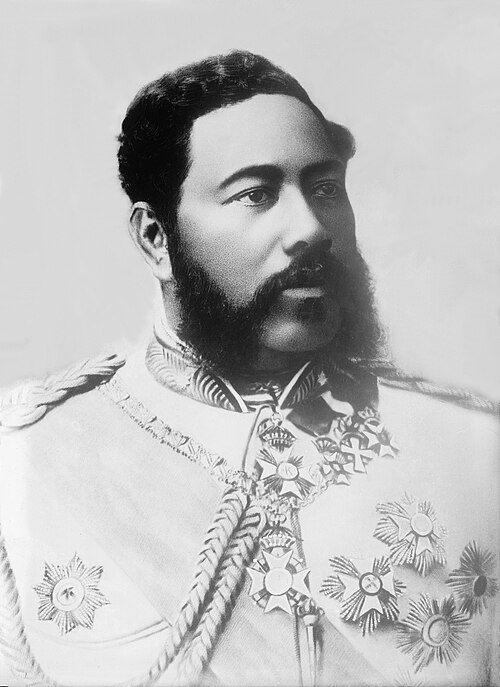
Kalakaua
ModernEmperorHawaii1836 — 1891
Merrie Monarch who tried to preserve Hawaiian sovereignty.
Compare Kalakaua with another historical figure:
Quick Facts
Born
1836
Died
1891
Country
Hawaii
Era
Modern
Occupation
Emperor
Score Overview
Military (10%)13
Political (20%)72
Influence (20%)61
Legacy (20%)49
Leadership (15%)53
Strategy (15%)42
Total Score51.8
Kalakaua — Complete Timeline
1874 AD
Elected King of HawaiiPolitical Action◆ Major
David Kalākaua was elected king by the Hawaiian legislature after the death of King Lunalilo. His election sparked a riot by supporters of Queen Emma, which was suppressed by American and British troops.
ElectionMonarchy
Impact: national
1875 AD
Signed the Reciprocity Treaty of 1875Political Action◆ Major
Kalākaua signed a reciprocity treaty with the United States that eliminated tariffs on Hawaiian sugar and other products. In exchange, the US gained exclusive rights to use Pearl Harbor as a naval base, increasing American influence.
TradePearl Harbor
Impact: national
1881 AD
Circumnavigated the GlobeOther◆ Major
Kalākaua became the first monarch to circumnavigate the globe, traveling to the United States, Europe, and Asia. He sought to strengthen diplomatic ties, promote Hawaiian culture, and recruit immigrants to work on sugar plantations.
DiplomacyTravel
Impact: globalconstructive
1882 AD
Built ʻIolani PalaceCultural◆ Major
Kalākaua completed the construction of ʻIolani Palace in Honolulu, the only royal palace in the United States. The palace was equipped with modern amenities like electricity and telephones, symbolizing Hawaiian modernization.
ArchitectureRoyal palace
Impact: nationalconstructive
1887 AD
Forced to Sign the Bayonet ConstitutionPolitical Action◆ Major
Kalākaua was forced by a group of American and European businessmen, backed by the Honolulu Rifles militia, to sign a new constitution. The Bayonet Constitution stripped the monarchy of power, gave voting rights only to wealthy landowners, and favored foreign interests.
ConstitutionCoup
Impact: nationaldestructive
1891 AD
Died in San FranciscoOther◆ Major
Kalākaua died in San Francisco while on a diplomatic trip to the United States. His death was attributed to Bright's disease (kidney failure). He was the last reigning king of Hawaii.
DeathDiplomacy
Impact: nationaltragic
Detailed Scores
▶View all detailed scores
Military
Strategy
7
Tactics
7
Battles
7
Army Scale
6
War Impact
7
Political
Governance
7
Reform
7
Stability
7
Policy
8
Power
8
Influence
History
8
Global
8
Culture
8
Ideology
9
Legacy
8
People often compare with
See how Kalakaua stacks up against other historical figures
Popular Comparisons
Kalakaua vs Chulalongkorn
vs Chulalongkorn64
Kalakaua vs Ahmed Shah Abdali
vs Ahmed Shah Abdali62
Kalakaua vs Mubarak al-Sabah
vs Mubarak al-Sabah57
Kalakaua vs Vajiravudh
vs Vajiravudh57
Kalakaua vs Sadasiva Raya
vs Sadasiva Raya56
Kalakaua vs Louis Philippe I
vs Louis Philippe I50