Loading...
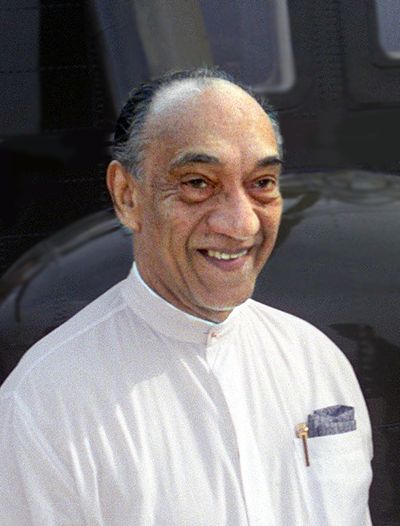
Junius Richard Jayewardene
ModernPoliticianSri Lanka1906 — 1996
Introduced executive presidency, open economy.
Compare Junius Richard Jayewardene with another historical figure:
Quick Facts
Born
1906
Died
1996
Country
Sri Lanka
Era
Modern
Occupation
Politician
Score Overview
Military (10%)43
Political (20%)72
Influence (20%)59
Legacy (20%)54
Leadership (15%)78
Strategy (15%)60
Total Score61.0
Junius Richard Jayewardene — Complete Timeline
1971 AD
Suppressed the 1971 JVP InsurrectionWar◆ Major
As Prime Minister, Jayewardene oversaw the military response to the Janatha Vimukthi Peramuna (JVP) uprising. The government declared a state of emergency, deployed the army, and crushed the insurrection within months, resulting in thousands of deaths and mass arrests.
JVP UprisingState RepressionEmergency Rule
Impact: nationaldestructive
1977 AD
Opened the Economy to Free Market ReformsReform◆ Major
After winning the 1977 general election, Jayewardene's UNP government implemented sweeping economic liberalization. They removed import controls, devalued the rupee, promoted foreign investment, and established the Greater Colombo Economic Commission to create export processing zones.
Economic LiberalizationOpen EconomyFree Market
Impact: nationalprogressive
1978 AD
Introduced Executive PresidencyReform
Jayewardene's government passed the 1978 Constitution, replacing the Westminster-style parliamentary system with an executive presidency. He became the first Executive President of Sri Lanka, concentrating significant power in the presidency, including control over the cabinet and judiciary.
Constitutional ReformExecutive PresidencyPower Centralization
Impact: national
1983 AD
Declared the 1983 Black July PogromPolitical Action
Following the LTTE ambush that killed 13 soldiers, Jayewardene's government did not deploy the military to stop anti-Tamil riots. Over several days, Sinhalese mobs killed thousands of Tamils in Colombo and elsewhere, destroying property. The pogrom radicalized the Tamil separatist movement.
Black JulyAnti-Tamil RiotsCivil War Escalation
Impact: nationaltragic
1987 AD
Signed the Indo-Sri Lanka AccordPolitical Action◆ Major
Jayewardene signed the Indo-Sri Lanka Peace Accord with Indian Prime Minister Rajiv Gandhi. The accord aimed to end the Sri Lankan Civil War by devolving power to Tamil provinces and deploying the Indian Peace Keeping Force (IPKF) to disarm the LTTE.
Peace AccordIndian InterventionCivil War
Impact: regional
Detailed Scores
▶View all detailed scores
Military
Strategy
6
Tactics
5
Battles
6
Army Scale
5
War Impact
6
Political
Governance
7
Reform
7
Stability
7
Policy
7
Power
8
Influence
History
9
Global
8
Culture
8
Ideology
9
Legacy
8
People often compare with
See how Junius Richard Jayewardene stacks up against other historical figures
Popular Comparisons
Junius Richard Jayewardene vs Patrice Lumumba
vs Patrice Lumumba61
Junius Richard Jayewardene vs Mehmed Emin Ali Pasha
vs Mehmed Emin Ali Pasha60
Junius Richard Jayewardene vs Lal Krishna Advani
vs Lal Krishna Advani58
Junius Richard Jayewardene vs Mwai Kibaki
vs Mwai Kibaki53
Junius Richard Jayewardene vs Thomas Klestil
vs Thomas Klestil52
Junius Richard Jayewardene vs Yousaf Raza Gillani
vs Yousaf Raza Gillani50