Loading...
Junius Richard Jayewardene vs Mwai Kibaki
Junius Richard Jayewardene leads by 7.9 pts · 2 figures compared
…
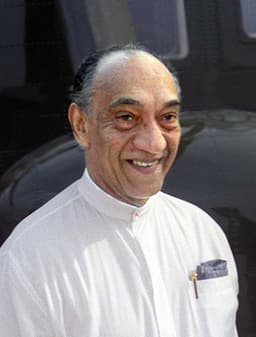
Junius Richard Jayewardene
Politician · Modern
61.0Total

Mwai Kibaki
Politician · Modern
53.1Total
Basic Information
Born
1906
1931
Died
1996
—
Era
Modern
Modern
Nationality
Sri Lanka
Kenya
Occupation
Politician
Politician
Civilization
Indian
Other
Score Comparison
Military (10%)
43.0
42.8
Political (20%)
72.0
60.0
Influence (20%)
59.0
54.1
Legacy (20%)
54.0
45.0
Leadership (15%)
78.0
72.0
Strategy (15%)
60.0
42.7
TOTAL
61.0
53.1
Junius Richard Jayewardene — Complete Timeline
1971 AD
Suppressed the 1971 JVP InsurrectionWar◆ Major
As Prime Minister, Jayewardene oversaw the military response to the Janatha Vimukthi Peramuna (JVP) uprising. The government declared a state of emergency, deployed the army, and crushed the insurrection within months, resulting in thousands of deaths and mass arrests.
JVP UprisingState RepressionEmergency Rule
Impact: nationaldestructive
1977 AD
Opened the Economy to Free Market ReformsReform◆ Major
After winning the 1977 general election, Jayewardene's UNP government implemented sweeping economic liberalization. They removed import controls, devalued the rupee, promoted foreign investment, and established the Greater Colombo Economic Commission to create export processing zones.
Economic LiberalizationOpen EconomyFree Market
Impact: nationalprogressive
1978 AD
Introduced Executive PresidencyReform
Jayewardene's government passed the 1978 Constitution, replacing the Westminster-style parliamentary system with an executive presidency. He became the first Executive President of Sri Lanka, concentrating significant power in the presidency, including control over the cabinet and judiciary.
Constitutional ReformExecutive PresidencyPower Centralization
Impact: national
1983 AD
Declared the 1983 Black July PogromPolitical Action
Following the LTTE ambush that killed 13 soldiers, Jayewardene's government did not deploy the military to stop anti-Tamil riots. Over several days, Sinhalese mobs killed thousands of Tamils in Colombo and elsewhere, destroying property. The pogrom radicalized the Tamil separatist movement.
Black JulyAnti-Tamil RiotsCivil War Escalation
Impact: nationaltragic
1987 AD
Signed the Indo-Sri Lanka AccordPolitical Action◆ Major
Jayewardene signed the Indo-Sri Lanka Peace Accord with Indian Prime Minister Rajiv Gandhi. The accord aimed to end the Sri Lankan Civil War by devolving power to Tamil provinces and deploying the Indian Peace Keeping Force (IPKF) to disarm the LTTE.
Peace AccordIndian InterventionCivil War
Impact: regional
Mwai Kibaki — Complete Timeline
2002 AD
2002 Kenyan general electionPolitical Action◆ Major
Mwai Kibaki, as candidate of the National Rainbow Coalition (NARC), won the presidential election, defeating Uhuru Kenyatta of the Kenya African National Union (KANU). This ended KANU's 39-year rule and marked Kenya's first peaceful transfer of power since independence.
ElectionDemocratic TransitionNARC
Impact: nationalprogressive
2003 AD
Free primary education policyReform◆ Major
Kibaki's government introduced free primary education, abolishing tuition fees for public primary schools. This policy led to a surge in enrollment from 5.9 million to 7.2 million children within a year, significantly improving access to education across Kenya.
Education ReformSocial PolicyAccess
Impact: nationalprogressive
Economic recovery strategyReform◆ Major
Kibaki implemented the Economic Recovery Strategy for Wealth and Employment Creation (ERS), focusing on macroeconomic stability, infrastructure investment, and privatization. Kenya's GDP growth averaged over 5% annually from 2004 to 2007, reversing a decade of stagnation.
Economic ReformGrowthInfrastructure
Impact: nationalconstructive
2007 AD
2007-2008 Kenyan post-election violencePolitical Action◆ Major
After Kibaki was declared winner of the disputed 2007 presidential election, opposition supporters protested, leading to ethnic violence that killed over 1,100 people and displaced 600,000. The crisis ended with a power-sharing agreement that created a coalition government with Raila Odinga as Prime Minister.
Election DisputeEthnic ViolencePower-Sharing
Impact: nationaltragic
2010 AD
Promulgation of the 2010 ConstitutionReform◆ Major
Kibaki oversaw the passage of a new constitution in a national referendum, which devolved power to 47 counties, introduced a bill of rights, and limited presidential powers. The constitution was a key outcome of the 2008 peace agreement and reshaped Kenya's governance structure.
Constitutional ReformDevolutionGovernance
Impact: nationalprogressive
Expert Analysis
Origins
Junius Richard Jayewardene was born on September 17, 1906, in Colombo, Ceylon (now Sri Lanka), into a wealthy and politically connected Sinhalese family. His father, Justice Eugene Wilfred Jayewardene, was a Supreme Court judge. Jayewardene studied at Royal College, Colombo, and later at Ceylon Law College, becoming a lawyer. He entered politics in 1943 when he was elected to the State Council.
Mwai Kibaki was born on November 15, 1931, in Gatuyaini, Nyeri, Kenya, into a Kikuyu family. His father was a farmer. Kibaki attended Mangu High School and later Makerere University in Uganda, graduating in economics. He then studied at the London School of Economics, earning a B.Sc. in public finance. He returned to Kenya and taught economics at Makerere before entering politics.
Rise to Power
Jayewardene rose through the ranks of the United National Party (UNP). He served as Minister of Finance (1960-1965) and later as Leader of the Opposition. In 1977, the UNP won a landslide victory, and Jayewardene became Prime Minister. He quickly moved to consolidate power, passing a new constitution in 1978 that made him executive president, a position he assumed on February 4, 1978.
Kibaki's rise began in the 1960s. He was elected to Parliament in 1963 and served in various ministerial posts under Jomo Kenyatta, including Minister of Finance (1969-1981). After Kenyatta's death, Kibaki became Vice President under Daniel arap Moi (1978-1988). He later broke with Moi and formed the Democratic Party. After two unsuccessful presidential bids, Kibaki won the 2002 election as the candidate of the National Rainbow Coalition, ending Moi's 24-year rule.
Leadership & Governance
Jayewardene centralized power through the executive presidency, concentrating authority in his hands. He introduced economic liberalization in 1977, removing import controls, devaluing the currency, and promoting foreign investment. GDP growth averaged 6% annually from 1978 to 1982. However, his governance was authoritarian: he used draconian laws like the Prevention of Terrorism Act to suppress dissent. His handling of the 1983 Black July riots, where over 3,000 Tamils were killed, showed a failure to protect minority communities.
Kibaki's leadership focused on economic recovery. He implemented the Economic Recovery Strategy (ERS) in 2003, which stabilized the economy, reduced inflation from 30% to single digits, and achieved GDP growth averaging 5% per year. He introduced free primary education, boosting enrollment from 5.9 million to 7.2 million. However, his government was marred by corruption scandals, such as the Anglo-Leasing affair. Kibaki's response to the 2007-2008 post-election violence was criticized as slow and ineffective.
Triumph & Tragedy
Jayewardene's greatest triumph was the economic transformation of Sri Lanka, opening it to global trade and investment. However, his tragedy was the escalation of the civil war. The 1983 Black July pogrom alienated Tamils and strengthened the LTTE. The Indo-Sri Lanka Accord of 1987, aimed at devolving power, failed to end the conflict and led to Indian military intervention. Jayewardene's political score of 72.0 reflects his ability to dominate politics, but his legacy score of 54.0 is weighed down by the civil war.
Kibaki's triumph was the economic recovery and the new constitution in 2010, which devolved power and limited presidential authority. His free primary education policy was a major success. However, the 2007-2008 election violence, which killed over 1,100 people, was a tragic failure. Kibaki's leadership score of 72.0 is high, but his influence score of 54.1 and legacy score of 45.0 are lower due to the violence and corruption.
Character & Destiny
Jayewardene was a shrewd and calculating politician, willing to use authoritarian means to achieve his goals. He believed in a strong executive and was intolerant of dissent. His decision to not intervene in the 1983 riots was a critical error that shaped Sri Lanka's destiny. Historians note that his centralization of power contributed to the instability that followed.
Kibaki was seen as a quiet, technocratic leader, more comfortable with economic policy than with politics. He was often criticized for being aloof and indecisive during crises. His delay in addressing the 2007 election dispute led to widespread violence. However, his commitment to institutional reform, like the 2010 constitution, shows a legacy of strengthening democracy.
Legacy
Jayewardene's legacy is mixed. He transformed Sri Lanka's economy but also entrenched an executive presidency that later leaders used to consolidate power. The civil war that intensified under his watch ended only in 2009. His score of 61.0 overall reflects his significant but controversial impact.
Kibaki's legacy is more positive but less transformative. He restored economic growth and passed a progressive constitution. However, the 2007-2008 violence and persistent corruption tarnish his record. His overall score of 53.1 indicates a competent but flawed leader.
Conclusion
Junius Richard Jayewardene had a greater impact on his country than Mwai Kibaki, though much of that impact was negative. Jayewardene's political skill (72.0) and leadership (78.0) allowed him to reshape Sri Lanka's institutions and economy, but his failures in ethnic relations and civil war management led to decades of conflict. Kibaki, with a lower total score of 53.1, achieved economic recovery and constitutional reform but failed to prevent ethnic violence. Jayewardene's legacy is more consequential, for better and worse, making him the more significant figure in history.
Rankings
🥇
Junius Richard JayewardeneLeader
Mil: 43.0Pol: 72.0Inf: 59.0
61.0
🥈
Mwai Kibaki
Mil: 42.8Pol: 60.0Inf: 54.1
53.1
+7.9 behind
How This Comparison Works
Algorithm
Each figure is scored on 6 dimensions (0—100 scale) based on structured historical data: Military (10%), Political (20%), Influence (20%), Legacy (20%), Leadership (15%), Strategy (15%). The weighted total produces the final ranking.
Data Sources
Scores are computed from structured sub-indicators in the database. Scale factors adjust for era (Ancient ×0.85, Modern ×1.0) and civilization size (Eastern ×1.05, Other ×0.80) to account for differences in population and military scale.
Maximum 3 Figures
Comparisons are limited to 2—3 figures to ensure readability and statistical meaningfulness.
Error Margins
±5 points per dimension — Sub-scores are derived from historical records with inherent uncertainty. Two figures within 5 points on a dimension should be considered roughly equivalent in that area.
Total Score Accuracy
±3 points overall — The weighted combination of 6 dimensions produces a total score with approximately ±3 points of uncertainty. Differences of less than 3 points are not statistically significant— the figures are effectively tied.
Known Limitations
- Historical records are incomplete and uneven across civilizations
- Figures from oral-tradition societies may be underrepresented
- Occupation labels can misclassify multi-role figures
- Scores measure capability and impact, not moral character
- Quantitative scoring is a comparison tool, not absolute truth
Capability Radar
Military (10%) — Battles & Warfare
Battles
42
21
Win Rate
47
24
Expansion
50
28
Political (20%) — Governance & Reform
Reform
80
65
Diplomacy
70
55
Economy
75
75
Influence (20%) — Cultural & Global Reach
Cultural
40
30
Global
55
35
Legacy (20%) — Historical Impact
Historical
65
40
Longevity
50
30
Leadership (15%) — Power & Stability
Tenure
85
60
Stability
60
50
Strategy (15%) — Tactics & Innovation
Strategy
54
29
Tactics
53
34
Reform
57
38
Similar Comparisons
Comments & Discussion
No comments yet. Be the first to share your thoughts!