Loading...
This comparison has not been analyzed yet.
One-time AI generation (~1 minute). Scores and timeline are already available below.
Junius Richard Jayewardene vs Lal Krishna Advani
Junius Richard Jayewardene leads by 2.6 pts · 2 figures compared
…
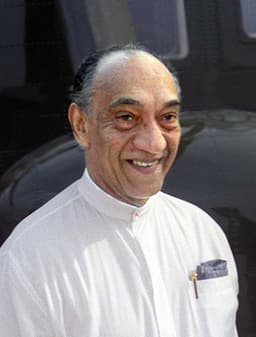
Junius Richard Jayewardene
Politician · Modern
61.0Total

Lal Krishna Advani
Politician · Modern
58.4Total
Basic Information
Born
1906
1927
Died
1996
—
Era
Modern
Modern
Nationality
Sri Lanka
India
Occupation
Politician
Politician
Civilization
Indian
Indian
Score Comparison
Military (10%)
43.0
38.8
Political (20%)
72.0
65.0
Influence (20%)
59.0
56.7
Legacy (20%)
54.0
55.0
Leadership (15%)
78.0
72.0
Strategy (15%)
60.0
60.0
TOTAL
61.0
58.4
Junius Richard Jayewardene — Complete Timeline
1971 AD
Suppressed the 1971 JVP InsurrectionWar◆ Major
As Prime Minister, Jayewardene oversaw the military response to the Janatha Vimukthi Peramuna (JVP) uprising. The government declared a state of emergency, deployed the army, and crushed the insurrection within months, resulting in thousands of deaths and mass arrests.
JVP UprisingState RepressionEmergency Rule
Impact: nationaldestructive
1977 AD
Opened the Economy to Free Market ReformsReform◆ Major
After winning the 1977 general election, Jayewardene's UNP government implemented sweeping economic liberalization. They removed import controls, devalued the rupee, promoted foreign investment, and established the Greater Colombo Economic Commission to create export processing zones.
Economic LiberalizationOpen EconomyFree Market
Impact: nationalprogressive
1978 AD
Introduced Executive PresidencyReform
Jayewardene's government passed the 1978 Constitution, replacing the Westminster-style parliamentary system with an executive presidency. He became the first Executive President of Sri Lanka, concentrating significant power in the presidency, including control over the cabinet and judiciary.
Constitutional ReformExecutive PresidencyPower Centralization
Impact: national
1983 AD
Declared the 1983 Black July PogromPolitical Action
Following the LTTE ambush that killed 13 soldiers, Jayewardene's government did not deploy the military to stop anti-Tamil riots. Over several days, Sinhalese mobs killed thousands of Tamils in Colombo and elsewhere, destroying property. The pogrom radicalized the Tamil separatist movement.
Black JulyAnti-Tamil RiotsCivil War Escalation
Impact: nationaltragic
1987 AD
Signed the Indo-Sri Lanka AccordPolitical Action◆ Major
Jayewardene signed the Indo-Sri Lanka Peace Accord with Indian Prime Minister Rajiv Gandhi. The accord aimed to end the Sri Lankan Civil War by devolving power to Tamil provinces and deploying the Indian Peace Keeping Force (IPKF) to disarm the LTTE.
Peace AccordIndian InterventionCivil War
Impact: regional
Lal Krishna Advani — Complete Timeline
1990 AD
Leadership of the Ram Rath YatraPolitical Action
Lal Krishna Advani led the Ram Rath Yatra, a political-religious procession from Somnath to Ayodhya, to mobilize support for building a Ram temple at the disputed Babri Masjid site. The yatra sparked communal tensions and was stopped by the Bihar government.
AyodhyaRam TempleCommunal Politics
Impact: nationaldestructive
1998 AD
Appointment as Minister of Home AffairsPolitical Action◆ Major
Lal Krishna Advani was appointed Union Minister of Home Affairs in the Vajpayee government, serving until 2004. He oversaw internal security, including the Kargil War (1999) and the 2001 Indian Parliament attack.
Home MinisterInternal SecurityKargil
Impact: national
2002 AD
Appointment as Deputy Prime Minister of IndiaPolitical Action◆ Major
Lal Krishna Advani was appointed Deputy Prime Minister of India in the Vajpayee government, serving until 2004. He also held the Home Ministry portfolio, overseeing internal security during a period of communal violence.
Deputy Prime MinisterHome MinisterSecurity
Impact: national
2004 AD
Appointment as Leader of the Opposition in Lok SabhaPolitical Action◆ Major
Lal Krishna Advani was appointed Leader of the Opposition in the Lok Sabha after the BJP's defeat in the 2004 general election. He served in this role until 2009, leading the opposition against the UPA government.
Leader of OppositionLok SabhaBJP
Impact: national
2009 AD
Resignation as BJP President After 2009 Election DefeatPolitical Action
Lal Krishna Advani resigned as President of the Bharatiya Janata Party after the party's defeat in the 2009 general election. He took responsibility for the electoral loss, though he remained a senior leader.
ResignationBJPElection Defeat
Impact: national
This comparison has not been analyzed yet.
One-time AI generation (~1 minute). Scores and timeline are already available below.
Rankings
🥇
Junius Richard JayewardeneLeader
Mil: 43.0Pol: 72.0Inf: 59.0
61.0
🥈
Lal Krishna Advani
Mil: 38.8Pol: 65.0Inf: 56.7
58.4
+2.6 behind
How This Comparison Works
Algorithm
Each figure is scored on 6 dimensions (0—100 scale) based on structured historical data: Military (10%), Political (20%), Influence (20%), Legacy (20%), Leadership (15%), Strategy (15%). The weighted total produces the final ranking.
Data Sources
Scores are computed from structured sub-indicators in the database. Scale factors adjust for era (Ancient ×0.85, Modern ×1.0) and civilization size (Eastern ×1.05, Other ×0.80) to account for differences in population and military scale.
Maximum 3 Figures
Comparisons are limited to 2—3 figures to ensure readability and statistical meaningfulness.
Error Margins
±5 points per dimension — Sub-scores are derived from historical records with inherent uncertainty. Two figures within 5 points on a dimension should be considered roughly equivalent in that area.
Total Score Accuracy
±3 points overall — The weighted combination of 6 dimensions produces a total score with approximately ±3 points of uncertainty. Differences of less than 3 points are not statistically significant— the figures are effectively tied.
Known Limitations
- Historical records are incomplete and uneven across civilizations
- Figures from oral-tradition societies may be underrepresented
- Occupation labels can misclassify multi-role figures
- Scores measure capability and impact, not moral character
- Quantitative scoring is a comparison tool, not absolute truth
Capability Radar
Military (10%) — Battles & Warfare
Battles
42
41
Win Rate
47
49
Expansion
50
51
Political (20%) — Governance & Reform
Reform
80
75
Diplomacy
70
70
Economy
75
60
Influence (20%) — Cultural & Global Reach
Cultural
40
70
Global
55
55
Legacy (20%) — Historical Impact
Historical
65
75
Longevity
50
65
Leadership (15%) — Power & Stability
Tenure
85
85
Stability
60
65
Strategy (15%) — Tactics & Innovation
Strategy
54
50
Tactics
53
58
Reform
57
59
Similar Comparisons
Comments & Discussion
No comments yet. Be the first to share your thoughts!