Loading...
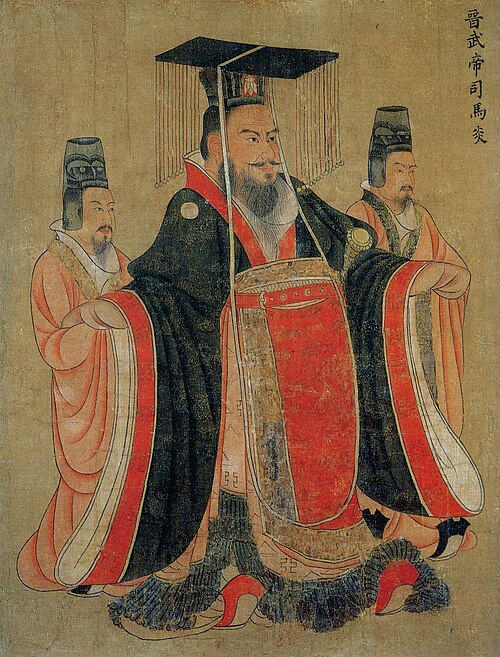
Emperor Wu of Jin
AncientEmperorChina236 — 290
Sima Yan, unified the Three Kingdoms under Western Jin.
Compare Emperor Wu of Jin with another historical figure:
Quick Facts
Born
236
Died
290
Country
China
Era
Ancient
Occupation
Emperor
Score Overview
Military (10%)75
Political (20%)68
Influence (20%)53
Legacy (20%)44
Leadership (15%)49
Strategy (15%)58
Total Score54.9
Emperor Wu of Jin — Complete Timeline
265 AD
Enfeoffment of Imperial PrincesPolitical Action◆ Major
Emperor Wu enfeoffed 27 of his sons as princes with military commands and territories, hoping to strengthen the imperial family. This policy backfired, as the princes later rebelled in the War of the Eight Princes, leading to the dynasty's collapse.
EnfeoffmentFeudal PolicyWar of the Eight Princes
Impact: nationaldestructive
266 AD
Establishment of the Western Jin DynastyPolitical Action
Sima Yan forced the abdication of Cao Huan, the last emperor of Cao Wei, and proclaimed himself Emperor Wu of Jin. He established the Western Jin dynasty with Luoyang as its capital. This ended the Cao Wei dynasty and began a new imperial line.
Dynasty FoundingAbdicationCao Wei
Impact: national
280 AD
Conquest of Eastern WuWar
Emperor Wu of Jin launched a six-pronged invasion of Eastern Wu, the last of the Three Kingdoms. Wu's capital Jianye fell, and its emperor Sun Hao surrendered. This conquest unified China under the Western Jin dynasty, ending the Three Kingdoms period after 60 years.
ConquestUnificationThree Kingdoms End
Impact: national
Abolition of Military ColoniesReform◆ Major
After unifying China, Emperor Wu abolished the military agricultural colonies (tuntian) that had sustained the Three Kingdoms' armies. He demobilized many soldiers and returned them to civilian farming. This reduced military spending but weakened the dynasty's defensive capacity.
DemobilizationAgricultural ReformTuntian
Impact: nationalconstructive
Extravagance and DeclineCultural◆ Major
After unification, Emperor Wu indulged in luxury, building palaces and accumulating concubines. He neglected governance, leading to corruption and factionalism at court. This decadence contributed to the dynasty's instability and the later War of the Eight Princes.
DecadenceGovernance FailureWestern Jin Decline
Impact: nationaldestructive
Detailed Scores
▶View all detailed scores
Military
Strategy
7
Tactics
7
Battles
7
Army Scale
7
War Impact
7
Political
Governance
7
Reform
7
Stability
7
Policy
7
Power
7
Influence
History
8
Global
7
Culture
8
Ideology
8
Legacy
7
People often compare with
See how Emperor Wu of Jin stacks up against other historical figures
Popular Comparisons
Emperor Wu of Jin vs Augustus
vs Augustus86
Emperor Wu of Jin vs Qin Shi Huang
vs Qin Shi Huang85
Emperor Wu of Jin vs Cyrus the Great
vs Cyrus the Great84
Emperor Wu of Jin vs Fu Jian
vs Fu Jian64
Emperor Wu of Jin vs Theodoric the Great
vs Theodoric the Great62
Emperor Wu of Jin vs Shi Le
vs Shi Le59