Loading...
Emperor Wu of Jin vs Theodoric the Great
Theodoric the Great leads by 6.6 pts · 2 figures compared
…
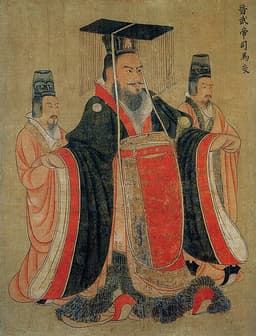
Emperor Wu of Jin
Emperor · Ancient
54.9Total

Theodoric the Great
Emperor · Ancient
61.5Total
Basic Information
Born
236
454
Died
290
526
Era
Ancient
Ancient
Nationality
China
Ostrogothic Kingdom
Occupation
Emperor
Emperor
Civilization
Eastern
Western
Score Comparison
Military (10%)
74.7
74.7
Political (20%)
68.0
59.3
Influence (20%)
52.5
62.0
Legacy (20%)
44.2
52.0
Leadership (15%)
48.8
72.0
Strategy (15%)
57.5
58.0
TOTAL
54.9
61.5
Emperor Wu of Jin — Complete Timeline
265 AD
Enfeoffment of Imperial PrincesPolitical Action◆ Major
Emperor Wu enfeoffed 27 of his sons as princes with military commands and territories, hoping to strengthen the imperial family. This policy backfired, as the princes later rebelled in the War of the Eight Princes, leading to the dynasty's collapse.
EnfeoffmentFeudal PolicyWar of the Eight Princes
Impact: nationaldestructive
266 AD
Establishment of the Western Jin DynastyPolitical Action
Sima Yan forced the abdication of Cao Huan, the last emperor of Cao Wei, and proclaimed himself Emperor Wu of Jin. He established the Western Jin dynasty with Luoyang as its capital. This ended the Cao Wei dynasty and began a new imperial line.
Dynasty FoundingAbdicationCao Wei
Impact: national
280 AD
Conquest of Eastern WuWar
Emperor Wu of Jin launched a six-pronged invasion of Eastern Wu, the last of the Three Kingdoms. Wu's capital Jianye fell, and its emperor Sun Hao surrendered. This conquest unified China under the Western Jin dynasty, ending the Three Kingdoms period after 60 years.
ConquestUnificationThree Kingdoms End
Impact: national
Abolition of Military ColoniesReform◆ Major
After unifying China, Emperor Wu abolished the military agricultural colonies (tuntian) that had sustained the Three Kingdoms' armies. He demobilized many soldiers and returned them to civilian farming. This reduced military spending but weakened the dynasty's defensive capacity.
DemobilizationAgricultural ReformTuntian
Impact: nationalconstructive
Extravagance and DeclineCultural◆ Major
After unification, Emperor Wu indulged in luxury, building palaces and accumulating concubines. He neglected governance, leading to corruption and factionalism at court. This decadence contributed to the dynasty's instability and the later War of the Eight Princes.
DecadenceGovernance FailureWestern Jin Decline
Impact: nationaldestructive
Theodoric the Great — Complete Timeline
493 AD
Conquest of ItalyWar◆ Major
Theodoric the Great led the Ostrogoths in conquering Italy from Odoacer. He defeated Odoacer in several battles and eventually besieged Ravenna. Theodoric tricked Odoacer into a truce and then murdered him, establishing the Ostrogothic Kingdom of Italy.
ConquestOstrogothsItaly
Impact: regional
Establishment of the Ostrogothic KingdomPolitical Action◆ Major
Theodoric established the Ostrogothic Kingdom in Italy with its capital at Ravenna. He maintained Roman administrative structures and laws while ruling as a Gothic king. His reign brought stability and prosperity to Italy, blending Roman and Gothic cultures.
KingdomItalyGothic Rule
Impact: regionalconstructive
500 AD
Promotion of Roman-Gothic CoexistenceReform◆ Major
Theodoric promoted coexistence between Romans and Goths, allowing Romans to keep their laws and institutions. He appointed Romans to high offices and supported the Roman Senate. This policy maintained stability and preserved Roman culture in Italy.
CoexistenceRomanGothic
Impact: regionalconstructive
524 AD
Execution of BoethiusPolitical Action◆ Major
Theodoric ordered the execution of the philosopher Boethius on charges of treason. Boethius had been a high-ranking official and was suspected of conspiring with the Byzantine Empire. This event tarnished Theodoric's reputation as a just ruler and highlighted tensions between Romans and Goths.
ExecutionBoethiusTreason
Impact: regionaltragic
Expert Analysis
Origins
Emperor Wu of Jin, born Sima Yan in 236 CE, was the grandson of Sima Yi, the de facto founder of the Jin dynasty. He grew up in a powerful aristocratic family that had gradually usurped control of Cao Wei. His father, Sima Zhao, was a regent who had already conquered Shu Han. Sima Yan received a traditional Confucian education and was groomed for leadership from an early age. He became the heir after his elder brother died, and ascended to the throne of Wei in 265 CE.
Theodoric the Great was born around 454 CE into the Amal dynasty of the Ostrogoths. As a child, he was sent as a hostage to Constantinople, where he received a Roman education and learned about Roman administration and military tactics. This experience shaped his later policies of coexistence. He returned to the Goths at age 18 and became king in 474 CE, leading his people through a series of migrations and alliances.
Rise to Power
Emperor Wu's rise was swift: in 265 CE, he forced the abdication of Cao Huan, the last Wei emperor, and proclaimed the Jin dynasty. He then focused on conquering Eastern Wu, the last of the Three Kingdoms. In 279 CE, he launched a massive six-pronged invasion with 200,000 troops. The campaign succeeded in 280 CE when Wu's capital Jianye fell and Emperor Sun Hao surrendered. This unified China after nearly a century of division.
Theodoric rose by leading the Ostrogoths as a foederati of the Eastern Roman Empire. In 488 CE, Emperor Zeno sent him to Italy to overthrow Odoacer, who had deposed the Western Roman emperor. Theodoric defeated Odoacer in several battles and besieged Ravenna. In 493 CE, they agreed to a power-sharing treaty, but Theodoric killed Odoacer at a banquet and became sole ruler. He established the Ostrogothic Kingdom with its capital at Ravenna.
Leadership & Governance
Emperor Wu governed a unified China but made critical errors. He enfeoffed 27 imperial princes with military commands and territories, hoping to strengthen the dynasty. This decentralization weakened central authority. He also abolished the military agricultural colonies (tuntian) that had sustained the Three Kingdoms' armies, demobilizing soldiers. After unification, he indulged in luxury, building palaces and accumulating thousands of concubines. He neglected governance, leading to corruption and factionalism. His political score of 68.0 reflects initial success but subsequent decline.
Theodoric ruled Italy as a Roman-style king. He maintained Roman laws and administrative structures, appointing Romans to high offices. He promoted coexistence: Goths served in the military, Romans in civil administration. He undertook public works, restored buildings, and maintained peace. However, in his later years, he grew paranoid and executed the philosopher Boethius on suspicion of treason. His leadership score of 72.0 reflects effective governance despite this flaw.
Triumph & Tragedy
Emperor Wu's greatest triumph was unifying China in 280 CE, ending the Three Kingdoms period. This achievement earned him a military score of 74.7. However, his greatest tragedy was the collapse of the Western Jin shortly after his death. His policy of enfeoffing princes led to the War of the Eight Princes (291-306 CE), a devastating civil war that weakened the dynasty and led to the loss of northern China to nomadic invasions. His legacy score of 44.2 reflects this failure.
Theodoric's triumph was establishing a stable kingdom in Italy that lasted for 33 years. He achieved a balance between Romans and Goths, with a political score of 59.3. His tragedy was the execution of Boethius in 524 CE, which tarnished his reputation and exposed tensions. After his death in 526 CE, the kingdom declined and was eventually reconquered by Byzantium. His legacy score of 52.0 reflects a moderate but enduring impact.
Character & Destiny
Emperor Wu was ambitious and capable in war but lacked discipline in peace. His decision to enfeoff princes stemmed from distrust of non-royal officials, but it backfired catastrophically. He was also prone to extravagance, which drained resources. His character—overconfident and hedonistic after success—led to the dynasty's rapid decline. Historical assessments note his short-sightedness.
Theodoric was pragmatic and culturally astute, blending Roman and Gothic traditions. His education in Constantinople gave him a unique perspective. However, his later paranoia, possibly exacerbated by religious conflicts (he was Arian while Romans were Catholic), led to the execution of Boethius. His character—a balance of Roman sophistication and Gothic warrior values—shaped a stable but fragile kingdom.
Legacy
Emperor Wu's unification was short-lived. The Western Jin collapsed within decades, and China fragmented again until the Sui dynasty. His policies are often cited as a cautionary tale of poor governance after military success. He is remembered primarily as the unifier of the Three Kingdoms, but his dynasty's failure overshadows his achievement. His influence score of 52.5 reflects this mixed legacy.
Theodoric's legacy is more positive. He is remembered as a wise ruler who preserved Roman civilization during the early Middle Ages. The Ostrogothic Kingdom served as a model of barbarian-Roman coexistence. His rule influenced later Germanic kingdoms. He is a figure of the so-called "Theodoric Renaissance." His influence score of 62.0 is higher than Emperor Wu's.
Conclusion
Theodoric the Great had a greater impact than Emperor Wu of Jin. While Emperor Wu united China militarily (military score 74.7 vs. Theodoric's 74.7, tied), his governance failures led to rapid collapse. Theodoric's total score of 61.5 surpasses Emperor Wu's 54.9 by 6.6 points. Theodoric's model of coexistence and preservation of Roman institutions had lasting influence in Europe, whereas Emperor Wu's unification was ephemeral. Theodoric's leadership score of 72.0 versus Emperor Wu's 48.8 underscores his superior governance. Therefore, Theodoric the Great is the more impactful figure.
Rankings
🥇
Theodoric the GreatLeader
Mil: 74.7Pol: 59.3Inf: 62.0
61.5
🥈
Emperor Wu of Jin
Mil: 74.7Pol: 68.0Inf: 52.5
54.9
+6.6 behind
How This Comparison Works
Algorithm
Each figure is scored on 6 dimensions (0—100 scale) based on structured historical data: Military (10%), Political (20%), Influence (20%), Legacy (20%), Leadership (15%), Strategy (15%). The weighted total produces the final ranking.
Data Sources
Scores are computed from structured sub-indicators in the database. Scale factors adjust for era (Ancient ×0.85, Modern ×1.0) and civilization size (Eastern ×1.05, Other ×0.80) to account for differences in population and military scale.
Maximum 3 Figures
Comparisons are limited to 2—3 figures to ensure readability and statistical meaningfulness.
Error Margins
±5 points per dimension — Sub-scores are derived from historical records with inherent uncertainty. Two figures within 5 points on a dimension should be considered roughly equivalent in that area.
Total Score Accuracy
±3 points overall — The weighted combination of 6 dimensions produces a total score with approximately ±3 points of uncertainty. Differences of less than 3 points are not statistically significant— the figures are effectively tied.
Known Limitations
- Historical records are incomplete and uneven across civilizations
- Figures from oral-tradition societies may be underrepresented
- Occupation labels can misclassify multi-role figures
- Scores measure capability and impact, not moral character
- Quantitative scoring is a comparison tool, not absolute truth
Capability Radar
Military (10%) — Battles & Warfare
Battles
65
70
Win Rate
70
75
Expansion
75
65
Political (20%) — Governance & Reform
Reform
40
75
Diplomacy
55
80
Economy
50
70
Influence (20%) — Cultural & Global Reach
Cultural
40
60
Global
35
50
Legacy (20%) — Historical Impact
Historical
55
65
Longevity
30
55
Leadership (15%) — Power & Stability
Tenure
60
80
Stability
45
65
Strategy (15%) — Tactics & Innovation
Strategy
60
70
Tactics
55
65
Reform
30
60
Similar Comparisons
Comments & Discussion
No comments yet. Be the first to share your thoughts!