Loading...
Ali Abdullah Saleh
ModernPoliticianYemen1947 — ?
President of Yemen for over three decades.
Compare Ali Abdullah Saleh with another historical figure:
Quick Facts
Born
1947
Country
Yemen
Era
Modern
Occupation
Politician
Score Overview
Military (10%)50
Political (20%)35
Influence (20%)51
Legacy (20%)42
Leadership (15%)74
Strategy (15%)30
Total Score47.6
Ali Abdullah Saleh — Complete Timeline
1990 AD
Unification of North and South YemenPolitical Action
Ali Abdullah Saleh, as president of North Yemen, negotiated the unification with South Yemen on May 22, 1990. He became president of the unified Republic of Yemen, a major achievement in Arab unity.
UnificationYemenArab Unity
Impact: regionalconstructive
Support for Saddam Hussein in Gulf WarPolitical Action◆ Major
Saleh initially supported Iraq's invasion of Kuwait, straining relations with Saudi Arabia and the West. This led to the expulsion of nearly a million Yemeni workers from Saudi Arabia and economic hardship.
Gulf WarDiplomacyEconomic Crisis
Impact: regionaldestructive
1994 AD
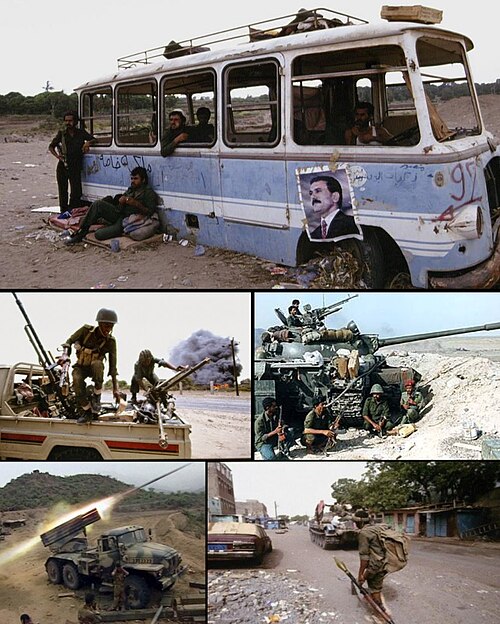
Yemeni Civil War of 1994War◆ Major
After southern leaders attempted secession, Saleh's forces crushed the rebellion in a brief civil war. This solidified his control over a unified Yemen but deepened regional divisions.
Civil WarSecessionConflict
Impact: nationaldestructive
2011 AD
Arab Spring Protests and ResignationPolitical Action
Mass protests erupted against Saleh's 33-year rule. After months of violence and a failed assassination attempt, he agreed to a Gulf Cooperation Council-brokered deal to step down in exchange for immunity.
Arab SpringProtestsResignation
Impact: nationaltragic
2017 AD
Killing by Houthi ForcesWar◆ Major
After switching sides in the Yemeni Civil War to ally with the Houthis, Saleh was killed by Houthi forces on December 4, 2017, while trying to flee Sanaa. His death ended a complex political career.
DeathCivil WarHouthis
Impact: nationaltragic
Detailed Scores
▶View all detailed scores
Military
Strategy
6
Tactics
5
Battles
6
Army Scale
5
War Impact
6
Political
Governance
7
Reform
7
Stability
7
Policy
7
Power
8
Influence
History
9
Global
8
Culture
8
Ideology
9
Legacy
8
People often compare with
See how Ali Abdullah Saleh stacks up against other historical figures
Popular Comparisons
Ali Abdullah Saleh vs Alexei Kosygin
vs Alexei Kosygin58
Ali Abdullah Saleh vs M. G. Ramachandran
vs M. G. Ramachandran57
Ali Abdullah Saleh vs Imran Khan
vs Imran Khan55
Ali Abdullah Saleh vs Seni Pramoj
vs Seni Pramoj51
Ali Abdullah Saleh vs Lord Elgin
vs Lord Elgin50
Ali Abdullah Saleh vs Napoleon Bonaparte
vs Napoleon Bonaparte71