Loading...
Ali Abdullah Saleh vs Seni Pramoj
Seni Pramoj leads by 3.6 pts · 2 figures compared
…
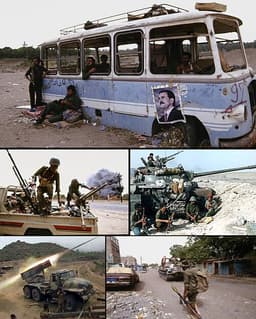
Ali Abdullah Saleh
Politician · Modern
47.6Total

Seni Pramoj
Politician · Modern
51.2Total
Basic Information
Born
1947
1905
Died
—
1997
Era
Modern
Modern
Nationality
Yemen
Thailand
Occupation
Politician
Politician
Civilization
Middle Eastern
Eastern
Score Comparison
Military (10%)
50.0
13.7
Political (20%)
35.1
68.0
Influence (20%)
51.0
54.9
Legacy (20%)
41.7
45.8
Leadership (15%)
74.0
72.0
Strategy (15%)
30.3
36.6
TOTAL
47.6
51.2
Ali Abdullah Saleh — Complete Timeline
1990 AD
Unification of North and South YemenPolitical Action
Ali Abdullah Saleh, as president of North Yemen, negotiated the unification with South Yemen on May 22, 1990. He became president of the unified Republic of Yemen, a major achievement in Arab unity.
UnificationYemenArab Unity
Impact: regionalconstructive
Support for Saddam Hussein in Gulf WarPolitical Action◆ Major
Saleh initially supported Iraq's invasion of Kuwait, straining relations with Saudi Arabia and the West. This led to the expulsion of nearly a million Yemeni workers from Saudi Arabia and economic hardship.
Gulf WarDiplomacyEconomic Crisis
Impact: regionaldestructive
1994 AD
Yemeni Civil War of 1994War◆ Major
After southern leaders attempted secession, Saleh's forces crushed the rebellion in a brief civil war. This solidified his control over a unified Yemen but deepened regional divisions.
Civil WarSecessionConflict
Impact: nationaldestructive
2011 AD
Arab Spring Protests and ResignationPolitical Action
Mass protests erupted against Saleh's 33-year rule. After months of violence and a failed assassination attempt, he agreed to a Gulf Cooperation Council-brokered deal to step down in exchange for immunity.
Arab SpringProtestsResignation
Impact: nationaltragic
2017 AD
Killing by Houthi ForcesWar◆ Major
After switching sides in the Yemeni Civil War to ally with the Houthis, Saleh was killed by Houthi forces on December 4, 2017, while trying to flee Sanaa. His death ended a complex political career.
DeathCivil WarHouthis
Impact: nationaltragic
Seni Pramoj — Complete Timeline
1942 AD
Founded the Free Thai MovementPolitical Action◆ Major
As Thai ambassador to the US, Seni Pramoj refused to deliver Phibunsongkhram's declaration of war against the Allies. He organized the Free Thai Movement, a resistance network that cooperated with the OSS to oppose Japanese occupation and support the Allies.
Free Thai MovementResistanceWorld War IIOSS
Impact: regionalconstructive
1945 AD
Became Prime Minister of ThailandPolitical Action◆ Major
After the end of World War II, Seni Pramoj was appointed Prime Minister, leading the government that negotiated with the Allies. His administration worked to restore Thailand's sovereignty and avoid punishment for its wartime alliance with Japan.
Prime MinisterPost-WarDiplomacy
Impact: nationalconstructive
1975 AD
Served as Prime Minister for a second termPolitical Action
Seni Pramoj returned to power as Prime Minister after a democratic election, leading a coalition government. His tenure was marked by political instability, student protests, and the rise of communist insurgency, lasting only a few months.
Prime MinisterDemocracyCoalition
Impact: national
1976 AD
Resigned after the Thammasat University massacrePolitical Action◆ Major
Seni Pramoj resigned as Prime Minister following the violent crackdown on student protesters at Thammasat University. The massacre led to a military coup, ending his democratic government and ushering in a period of right-wing military rule.
ResignationThammasat MassacreCoupPolitical Violence
Impact: nationaltragic
Expert Analysis
Origins
Ali Abdullah Saleh was born on March 21, 1942, in the village of Beit al-Ahmar in North Yemen, into a poor family of the Hashid tribe. He had little formal education and joined the military at age 16, attending a non-commissioned officer school. His early career was shaped by the Yemen Arab Republic (North Yemen) after the 1962 coup that overthrew the monarchy. Seni Pramoj, born on May 26, 1905, in Nakhon Si Thammarat, Thailand, came from a prominent aristocratic family. He studied law at Oxford University and became a barrister, later serving as a judge and diplomat. His background was elite and intellectual, contrasting sharply with Saleh's tribal and military roots.
Rise to Power
Saleh rose through the military ranks, becoming a key figure in the regime of President Abdul Rahman al-Iryani. In 1978, after the assassination of President Ahmad al-Ghashmi, Saleh was elected president by the parliament, a position he held for over three decades. He consolidated power through tribal alliances and patronage, particularly with the Hashid tribe. Seni Pramoj's rise came during World War II. As Thai ambassador to the United States in 1942, he refused to deliver Prime Minister Phibunsongkhram's declaration of war against the Allies. Instead, he organized the Free Thai Movement, an underground resistance that cooperated with the OSS. After the war, Seni briefly served as prime minister from 1945 to 1946, leading the government that negotiated Thailand's return to pre-war status. His political career was marked by multiple short stints in power, reflecting Thailand's volatile democratic politics.
Leadership & Governance
Saleh ruled Yemen with a strategy of divide and rule, balancing tribal, military, and political factions. He centralized power by rotating governors and military commanders to prevent rivals from building independent bases. His governance was authoritarian, with limited political freedom and widespread corruption. In contrast, Seni Pramoj was a democrat who championed parliamentary rule and human rights. His first term focused on restoring Thailand's international standing after the war. However, his second term in 1975-1976 was plagued by factionalism and student unrest. Seni's leadership style was conciliatory but indecisive, unable to control the military or far-right groups. Where Saleh scored 74.0 in leadership, Seni scored 72.0, reflecting different contexts: Saleh's authoritarian stability vs. Seni's democratic fragility.
Triumph & Tragedy
Saleh's greatest triumph was the unification of North and South Yemen in 1990, a historic achievement that made him president of a unified country. He also crushed a southern secessionist rebellion in 1994, demonstrating military capability. However, his support for Saddam Hussein in the 1990 Gulf War led to the expulsion of nearly a million Yemeni workers from Saudi Arabia, devastating the economy. His tragedy was the Arab Spring in 2011, when mass protests forced him to resign after 33 years. Even then, he retained influence and later allied with the Houthis, only to be killed by them in 2017 after switching sides again. Seni's triumph was founding the Free Thai Movement, which saved Thailand from Allied occupation and preserved its sovereignty. He also served as prime minister multiple times, a rare feat in Thai politics. His tragedy was the Thammasat University massacre in 1976, when student protesters were violently suppressed by state forces. Seni resigned in protest, but his resignation failed to prevent the subsequent military coup. His political career ended in disappointment.
Character & Destiny
Saleh was a shrewd survivor, known for his ability to switch allegiances and manipulate factions. He was pragmatic but ruthless, willing to use violence to maintain power. His character ultimately led to his downfall: after losing the presidency, he could not resist meddling, leading to his death. Seni was principled and intellectual, but indecisive and overly cautious. His commitment to democracy was genuine, but he lacked the iron will to confront the military. Historians note that Seni's aristocratic background made him aloof from the masses, while Saleh's tribal roots gave him deep connections. In terms of strategy, Saleh scored 30.3, reflecting his short-term maneuvering, while Seni scored 36.6, showing more foresight in international affairs.
Legacy
Saleh's legacy is mixed: he unified Yemen but left a fractured state. His rule entrenched corruption and tribalism, contributing to the current civil war. He is remembered as a cunning strongman who outlasted many rivals but ultimately failed to build a stable nation. Seni Pramoj is honored as a hero of democracy and resistance. The Free Thai Movement is celebrated in Thailand, and his role in preserving Thai independence is recognized. However, his political legacy is overshadowed by the military's dominance. In terms of influence, Saleh scored 51.0 and Seni 54.9; legacy scores were 41.7 and 45.8 respectively. Overall, Seni's total score of 51.2 edges Saleh's 47.6 by 3.6 points.
Conclusion
While both figures had significant impacts, Seni Pramoj's legacy as a democratic leader and anti-war activist has greater moral weight and enduring relevance. Saleh's unification of Yemen was a historic achievement, but his authoritarian methods and the subsequent collapse of Yemen undermine his legacy. Seni's principled stance during WWII saved Thailand from Allied retribution, and his commitment to democracy, though flawed, sets a higher standard. Therefore, Seni Pramoj had a greater positive impact on his nation's trajectory.
Rankings
🥇
Seni PramojLeader
Mil: 13.7Pol: 68.0Inf: 54.9
51.2
🥈
Ali Abdullah Saleh
Mil: 50.0Pol: 35.1Inf: 51.0
47.6
+3.6 behind
How This Comparison Works
Algorithm
Each figure is scored on 6 dimensions (0—100 scale) based on structured historical data: Military (10%), Political (20%), Influence (20%), Legacy (20%), Leadership (15%), Strategy (15%). The weighted total produces the final ranking.
Data Sources
Scores are computed from structured sub-indicators in the database. Scale factors adjust for era (Ancient ×0.85, Modern ×1.0) and civilization size (Eastern ×1.05, Other ×0.80) to account for differences in population and military scale.
Maximum 3 Figures
Comparisons are limited to 2—3 figures to ensure readability and statistical meaningfulness.
Error Margins
±5 points per dimension — Sub-scores are derived from historical records with inherent uncertainty. Two figures within 5 points on a dimension should be considered roughly equivalent in that area.
Total Score Accuracy
±3 points overall — The weighted combination of 6 dimensions produces a total score with approximately ±3 points of uncertainty. Differences of less than 3 points are not statistically significant— the figures are effectively tied.
Known Limitations
- Historical records are incomplete and uneven across civilizations
- Figures from oral-tradition societies may be underrepresented
- Occupation labels can misclassify multi-role figures
- Scores measure capability and impact, not moral character
- Quantitative scoring is a comparison tool, not absolute truth
Capability Radar
Military (10%) — Battles & Warfare
Battles
30
16
Win Rate
25
15
Expansion
25
20
Political (20%) — Governance & Reform
Reform
20
55
Diplomacy
40
70
Economy
15
40
Influence (20%) — Cultural & Global Reach
Cultural
20
30
Global
25
40
Legacy (20%) — Historical Impact
Historical
30
45
Longevity
20
30
Leadership (15%) — Power & Stability
Tenure
75
60
Stability
10
50
Strategy (15%) — Tactics & Innovation
Strategy
30
20
Tactics
35
24
Reform
20
31
Similar Comparisons
Comments & Discussion
No comments yet. Be the first to share your thoughts!