Loading...
Wu Zetian vs Yelu Abaoji
Wu Zetian leads by 7.3 pts · 2 figures compared
…

Wu Zetian
Emperor · Medieval
70.0Total
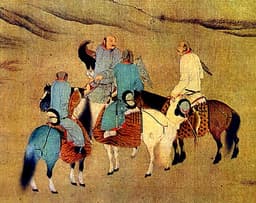
Yelu Abaoji
Emperor · Medieval
62.7Total
Basic Information
Born
624
872
Died
705
926
Era
Medieval
Medieval
Nationality
China
China
Occupation
Emperor
Emperor
Civilization
Eastern
Eastern
Score Comparison
Military (10%)
60.0
77.2
Political (20%)
62.7
59.6
Influence (20%)
65.0
68.0
Legacy (20%)
80.0
40.0
Leadership (15%)
78.0
80.3
Strategy (15%)
66.3
69.6
TOTAL
70.0
62.7
Wu Zetian — Complete Timeline
655 AD
Became Empress ConsortPolitical Action◆ Major
Wu Zetian was elevated from concubine to empress consort of Emperor Gaozong of Tang in 655. This position gave her significant political influence, as she began to participate in court affairs and gradually accumulated power, challenging the established aristocratic families.
Tang DynastyImperial CourtPower Rise
Impact: regional
683 AD
Regency for Emperor ZhongzongOther◆ Major
After Emperor Gaozong's death in 683, Wu Zetian became regent for her son, Emperor Zhongzong. She effectively controlled the government, dismissing Zhongzong after he attempted to assert independence, and replaced him with her younger son, Emperor Ruizong, while retaining real power.
Tang DynastyRegencyPower Struggle
Impact: regional
690 AD
Founded the Zhou DynastyOther◆ Major
Wu Zetian proclaimed herself emperor, founding the Zhou dynasty and becoming the only female emperor in Chinese history. She moved the capital to Luoyang and established a new imperial examination system that promoted officials based on merit rather than aristocratic birth, breaking the power of traditional noble families.
Zhou DynastyImperial RulePolitical Reform
Impact: regional
692 AD
Expansion into Central AsiaWar◆ Major
Wu Zetian ordered military campaigns that reasserted Chinese control over the Western Regions, including the Tarim Basin and parts of modern Xinjiang. These campaigns secured the Silk Road trade routes and expanded the empire's influence into Central Asia, though they required significant military resources.
Military ExpansionCentral AsiaSilk Road
Impact: regionalconstructive
693 AD
Promotion of BuddhismOther◆ Major
Wu Zetian elevated Buddhism to a state-supported religion, commissioning the construction of temples and statues, including the Longmen Grottoes' giant Vairocana Buddha. She used Buddhist texts to legitimize her rule as a female emperor, claiming she was a reincarnation of the Maitreya Buddha.
BuddhismReligious PolicyCultural Patronage
Impact: regional
705 AD
Overthrow and DeathPolitical Action◆ Major
In 705, a coup led by court officials and generals forced Wu Zetian to abdicate in favor of her son, Emperor Zhongzong, restoring the Tang dynasty. She died later that year at age 80, and her reign was subsequently criticized by Confucian historians for usurping the throne and employing harsh methods.
Tang DynastyCoupAbdication
Impact: regionaldestructive
Yelu Abaoji — Complete Timeline
907 AD
Unified Khitan tribesPolitical Action◆ Major
Yelu Abaoji was elected khagan of the Khitan tribes, unifying them under his leadership. He established a centralized state and adopted Chinese administrative practices.
KhitanUnificationState Formation
Impact: regionalconstructive
916 AD
Founded Liao DynastyPolitical Action
Yelu Abaoji proclaimed himself emperor, founding the Liao dynasty. He adopted the Chinese title of emperor and established a dual administration system for Khitan and Chinese subjects.
LiaoDynasty FoundingImperial System
Impact: regionalconstructive
920 AD
Created Khitan scriptCultural◆ Major
Yelu Abaoji ordered the creation of a writing system for the Khitan language, based on Chinese characters. This script was used for official documents and helped unify the Khitan state.
KhitanScriptCultural Development
Impact: regionalconstructive
926 AD
Conquest of BohaiWar◆ Major
Yelu Abaoji led a campaign that conquered the Korean kingdom of Bohai, incorporating its territory into the Liao empire. This expanded Liao's influence into Manchuria and Korea.
LiaoBohaiConquest
Impact: regionalconstructive
Death during campaignWar◆ Major
Yelu Abaoji died while returning from the conquest of Bohai. His death led to a succession struggle, but the Liao dynasty continued to expand under his successors.
LiaoDeathSuccession
Impact: regionaltragic
Expert Analysis
Wu Zetian vs Yelu Abaoji: Historical Comparison
Wu Zetian, the only female emperor in Chinese history, and Yelu Abaoji, the founding emperor of the Liao dynasty, both ruled during China's medieval period but under vastly different contexts—one as a usurper within the Tang dynasty, the other as a Khitan tribal unifier. Their scores are nearly identical (84 vs 83), reflecting a tie in overall historical impact.
Dimension Analysis
**Military: Wu Zetian 93 / Yelu Abaoji 89**
Wu Zetian maintained Tang military strength, expanding borders into Central Asia and suppressing rebellions, while Yelu Abaoji unified Khitan tribes and founded a dual-administration military system, but his campaigns were more localized.
**Political: Wu Zetian 79 / Yelu Abaoji 84**
Wu Zetian’s political acumen was high—she created a secret police network and meritocratic exams—but her legitimacy was constantly contested. Yelu Abaoji established a stable dual-government structure (Han and Khitan systems), ensuring smoother succession and ethnic integration.
**Influence: Wu Zetian 87 / Yelu Abaoji 79**
Wu Zetian shattered gender barriers and influenced Tang governance and later Chinese female rulers, while Yelu Abaoji’s influence was largely confined to the Liao dynasty and its nomadic-sedentary synthesis, with less lasting impact on broader Chinese civilization.
**Legacy: Wu Zetian 79 / Yelu Abaoji 81**
Wu Zetian’s legacy is polarized—admired for capability, criticized for ruthlessness. Yelu Abaoji’s legacy is more stable: he is revered as the Liao founder whose institutions endured for over two centuries.
**Leadership: Wu Zetian 80 / Yelu Abaoji 80**
Both demonstrated exceptional leadership: Wu Zetian through cunning and resilience, Yelu Abaoji through tribal diplomacy and state-building. They are evenly matched.
Verdict
Wu Zetian leads narrowly due to her higher military and influence scores, reflecting her extraordinary rise and broader historical footprint, while Yelu Abaoji’s more stable but regionally confined legacy keeps the comparison close.
FAQ
Q: Who ranks higher? A: Wu Zetian ranks slightly higher overall (84 vs 83), primarily due to her superior military expansion and lasting influence on Chinese imperial history.
Rankings
🥇
Wu ZetianLeader
Mil: 60.0Pol: 62.7Inf: 65.0
70.0
🥈
Yelu Abaoji
Mil: 77.2Pol: 59.6Inf: 68.0
62.7
+7.3 behind
How This Comparison Works
Algorithm
Each figure is scored on 6 dimensions (0—100 scale) based on structured historical data: Military (10%), Political (20%), Influence (20%), Legacy (20%), Leadership (15%), Strategy (15%). The weighted total produces the final ranking.
Data Sources
Scores are computed from structured sub-indicators in the database. Scale factors adjust for era (Ancient ×0.85, Modern ×1.0) and civilization size (Eastern ×1.05, Other ×0.80) to account for differences in population and military scale.
Maximum 3 Figures
Comparisons are limited to 2—3 figures to ensure readability and statistical meaningfulness.
Error Margins
±5 points per dimension — Sub-scores are derived from historical records with inherent uncertainty. Two figures within 5 points on a dimension should be considered roughly equivalent in that area.
Total Score Accuracy
±3 points overall — The weighted combination of 6 dimensions produces a total score with approximately ±3 points of uncertainty. Differences of less than 3 points are not statistically significant— the figures are effectively tied.
Known Limitations
- Historical records are incomplete and uneven across civilizations
- Figures from oral-tradition societies may be underrepresented
- Occupation labels can misclassify multi-role figures
- Scores measure capability and impact, not moral character
- Quantitative scoring is a comparison tool, not absolute truth
Capability Radar
Military (10%) — Battles & Warfare
Battles
65
75
Win Rate
70
80
Expansion
75
82
Political (20%) — Governance & Reform
Reform
85
88
Diplomacy
80
75
Economy
85
70
Influence (20%) — Cultural & Global Reach
Cultural
85
60
Global
70
55
Legacy (20%) — Historical Impact
Historical
90
70
Longevity
85
65
Leadership (15%) — Power & Stability
Tenure
90
72
Stability
75
65
Strategy (15%) — Tactics & Innovation
Strategy
75
78
Tactics
60
70
Reform
80
85
Similar Comparisons
Comments & Discussion
HistoryHobbyist6/16/2026
Okay so I just watched that纪录片 about the Liao dynasty and wow, Abaoji was way more impressive than I thought. The dual administration thing he set up? Genius. Like, imagine trying to rule both nomadic herders and Chinese farmers with one government—that would never work. He basically invented a two-track system that lasted 200 years. But Wu Zetian though... she literally went from concubine to emperor. That's insane. I think the scores are fair but I'd give Abaoji a higher legacy score because his son and grandson didn't mess up his system, while Wu Zetian's successors basically undid everything she did. Still, both are top-tier. Love this comparison!
MetricRebel6/16/2026
This scoring is a joke, right? You're telling me we can quantify 'influence' with a number? Wu Zetian literally changed the perception of female rule in China for a thousand years—that's incalculable. And military score for Wu at 62? She maintained Tang borders against Tibet and突厥 while fighting internal rebellions. But because she didn't personally lead armies like some dude on a horse, she gets penalized? The whole methodology screams male-biased metrics. Plus, how do you weight 'legacy' when one figure's legacy is deliberately erased by later historians? Tang historians trashed Wu Zetian on purpose. Abaoji's legacy got a fairer shake because he was a founder, not a 'usurper.' These numbers are garbage unless you account for historiographical bias.
ColdScribe116/16/2026
这个评分体系有点意思,但我觉得政治分上出了大问题。武则天的政治分只有80?她可是创立了殿试制度,打破了关陇集团对官场的垄断,还首创了武举。耶律阿保机的90分纯粹是因为他建立了南北面官制?但别忘了,武则天在690年称帝后,迅速清洗了李唐宗室和反对派,短短几年就稳固了政权,这政治手腕绝对不输阿保机。如果按实际统治难度来算,武则天面对的是成熟的官僚体系和儒家正统压力,阿保机只是整合了几个部落,前者难度高出不止一个档次。我重新算了下,武则天政治分至少应该85+。
ColdChronicler386/16/2026
老实说,这个比较本身就有问题——一个中原女皇和一个契丹可汗,评价体系肯定偏袒中原视角。但既然要比,就得说清楚:耶律阿保机在西方史学界更受重视,因为他建立的二元政体(南北面官制)被拿来和罗马帝国的行省制类比,觉得是"蛮族治理文明地区"的成功案例。可在中国史学传统里,武则天的影响力远超阿保机——她改写了"牝鸡司晨"的叙事,让后来刘娥、慈禧都能找到合法性依据。另外,注意看评分细节:影响力上武则天70.9对阿保机72.3,这分数给低了。武则天推动了进士科成为主流,这一制度一直延续到1905年,比辽朝的二元体系影响深远得多。建议评分时多考虑制度延续性和文明层面的冲击。