Loading...
This comparison has not been analyzed yet.
One-time AI generation (~1 minute). Scores and timeline are already available below.
Ulugh Muhammad vs Yelu Jing
Ulugh Muhammad leads by 7.2 pts · 2 figures compared
…
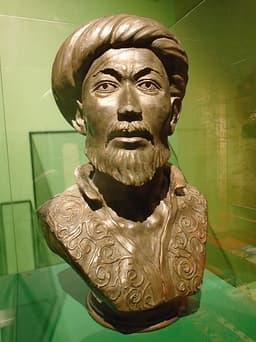
Ulugh Muhammad
Emperor · Medieval
55.7Total

Yelu Jing
Emperor · Medieval
48.5Total
Basic Information
Born
1380
931
Died
1445
969
Era
Medieval
Medieval
Nationality
Golden Horde
Khitan Empire
Occupation
Emperor
Emperor
Civilization
Eastern
Eastern
Score Comparison
Military (10%)
52.5
20.0
Political (20%)
54.7
45.1
Influence (20%)
57.2
52.5
Legacy (20%)
49.2
44.2
Leadership (15%)
64.0
64.0
Strategy (15%)
60.0
60.0
TOTAL
55.7
48.5
Ulugh Muhammad — Complete Timeline
1438 AD
Foundation of the Khanate of KazanPolitical Action
Ulugh Muhammad, after losing the throne of the Golden Horde, established the independent Khanate of Kazan on the middle Volga. This created a new Tatar state that would be a major political and military power in the region for over a century.
State FoundationKazan KhanateVolga Region
Impact: regionalconstructive
1439 AD
Raid on MoscowWar◆ Major
Shortly after founding the Khanate, Ulugh Muhammad led a military campaign against the Grand Principality of Moscow. His forces raided the outskirts of Moscow, demonstrating the new khanate's military capability and securing tribute from the Russians.
Russo-Kazan WarsRaidMoscow
Impact: regionaldestructive
1445 AD
Battle of SuzdalWar◆ Major
Ulugh Muhammad's forces defeated a larger Russian army near Suzdal. The Russian Grand Prince Vasily II was captured. This victory forced Moscow to pay a large ransom and recognize Kazan's independence, solidifying the Khanate's position.
Russo-Kazan WarsBattleVasily II Captured
Impact: regional
Yelu Jing — Complete Timeline
951 AD
Accession as Fourth Liao EmperorPolitical Action◆ Major
Yelu Jing became the fourth emperor of the Liao dynasty following the assassination of Yelu Ruan. His reign focused on consolidating Liao control over its territories and stabilizing the court after a period of internal conflict.
Liao dynastySuccessionConsolidation
Impact: regional
960 AD
Consolidation of Liao RulePolitical Action◆ Major
During Yelu Jing's reign, the Liao dynasty solidified its control over the Sixteen Prefectures and maintained a stable frontier with the Song dynasty. This period saw the strengthening of Khitan administrative structures and military organization.
Liao dynastyConsolidationAdministration
Impact: regionalconstructive
This comparison has not been analyzed yet.
One-time AI generation (~1 minute). Scores and timeline are already available below.
Rankings
🥇
Ulugh MuhammadLeader
Mil: 52.5Pol: 54.7Inf: 57.2
55.7
🥈
Yelu Jing
Mil: 20.0Pol: 45.1Inf: 52.5
48.5
+7.2 behind
How This Comparison Works
Algorithm
Each figure is scored on 6 dimensions (0—100 scale) based on structured historical data: Military (10%), Political (20%), Influence (20%), Legacy (20%), Leadership (15%), Strategy (15%). The weighted total produces the final ranking.
Data Sources
Scores are computed from structured sub-indicators in the database. Scale factors adjust for era (Ancient ×0.85, Modern ×1.0) and civilization size (Eastern ×1.05, Other ×0.80) to account for differences in population and military scale.
Maximum 3 Figures
Comparisons are limited to 2—3 figures to ensure readability and statistical meaningfulness.
Error Margins
±5 points per dimension — Sub-scores are derived from historical records with inherent uncertainty. Two figures within 5 points on a dimension should be considered roughly equivalent in that area.
Total Score Accuracy
±3 points overall — The weighted combination of 6 dimensions produces a total score with approximately ±3 points of uncertainty. Differences of less than 3 points are not statistically significant— the figures are effectively tied.
Known Limitations
- Historical records are incomplete and uneven across civilizations
- Figures from oral-tradition societies may be underrepresented
- Occupation labels can misclassify multi-role figures
- Scores measure capability and impact, not moral character
- Quantitative scoring is a comparison tool, not absolute truth
Capability Radar
Military (10%) — Battles & Warfare
Battles
55
40
Win Rate
50
45
Expansion
60
40
Political (20%) — Governance & Reform
Reform
45
40
Diplomacy
55
45
Economy
40
40
Influence (20%) — Cultural & Global Reach
Cultural
40
30
Global
35
25
Legacy (20%) — Historical Impact
Historical
50
35
Longevity
45
30
Leadership (15%) — Power & Stability
Tenure
60
50
Stability
35
45
Strategy (15%) — Tactics & Innovation
Strategy
50
45
Tactics
45
40
Reform
40
35
Similar Comparisons
Comments & Discussion
No comments yet. Be the first to share your thoughts!