Loading...
Stephen of Blois vs Yelu Jing
Yelu Jing leads by 6.6 pts · 2 figures compared
…
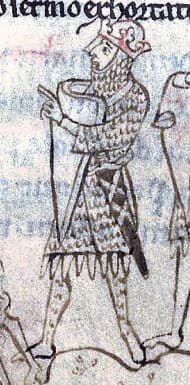
Stephen of Blois
Emperor · Medieval
41.9Total

Yelu Jing
Emperor · Medieval
48.5Total
Basic Information
Born
1096
931
Died
1154
969
Era
Medieval
Medieval
Nationality
England
Khitan Empire
Occupation
Emperor
Emperor
Civilization
Western
Eastern
Score Comparison
Military (10%)
50.0
20.0
Political (20%)
26.4
45.1
Influence (20%)
51.0
52.5
Legacy (20%)
41.7
44.2
Leadership (15%)
41.5
64.0
Strategy (15%)
35.7
60.0
TOTAL
41.9
48.5
Stephen of Blois — Complete Timeline
1135 AD
Coronation of StephenPolitical Action◆ Major
Stephen was crowned king of England on December 22, 1135, after the death of Henry I. He seized the throne despite Henry's designation of his daughter Matilda as heir.
CoronationUsurpationSuccession Crisis
Impact: national
1141 AD
Battle of LincolnWar◆ Major
Stephen was captured by forces loyal to Matilda at the Battle of Lincoln on February 2, 1141. He was imprisoned, and Matilda briefly ruled as Lady of the English.
BattleCaptureCivil War
Impact: nationaldestructive
Release and RestorationPolitical Action◆ Major
Stephen was released in exchange for Matilda's half-brother Robert of Gloucester, who had been captured. Stephen was restored as king, and the civil war continued.
ReleaseRestorationCivil War
Impact: national
1153 AD
Treaty of WallingfordPolitical Action◆ Major
Stephen and Matilda's son Henry Plantagenet signed the Treaty of Wallingford. Stephen recognized Henry as his heir, ending the Anarchy civil war.
TreatyPeaceSuccession
Impact: nationalconstructive
1154 AD
Death of StephenPolitical Action◆ Major
Stephen died on October 25, 1154, at Dover. His death allowed Henry Plantagenet to become king as Henry II, founding the Plantagenet dynasty.
DeathEnd of AnarchyPlantagenet
Impact: nationaltragic
Yelu Jing — Complete Timeline
951 AD
Accession as Fourth Liao EmperorPolitical Action◆ Major
Yelu Jing became the fourth emperor of the Liao dynasty following the assassination of Yelu Ruan. His reign focused on consolidating Liao control over its territories and stabilizing the court after a period of internal conflict.
Liao dynastySuccessionConsolidation
Impact: regional
960 AD
Consolidation of Liao RulePolitical Action◆ Major
During Yelu Jing's reign, the Liao dynasty solidified its control over the Sixteen Prefectures and maintained a stable frontier with the Song dynasty. This period saw the strengthening of Khitan administrative structures and military organization.
Liao dynastyConsolidationAdministration
Impact: regionalconstructive
Expert Analysis
Origins
Stephen of Blois was born around 1096 as the son of Stephen II, Count of Blois, and Adela of Normandy, daughter of William the Conqueror. His family connections gave him vast estates in England and France. He was raised in the Anglo-Norman court and became Count of Boulogne through marriage. Yelu Jing, born in 948, was a member of the Khitan Yelu clan, the imperial family of the Liao dynasty. He ascended the throne in 969 after the assassination of his cousin Yelu Ruan. His early life was shaped by the nomadic traditions of the Khitan and the bureaucratic structures of the Liao state.
Rise to Power
Stephen rose to prominence by capitalizing on the death of King Henry I in 1135. Despite Henry's designation of his daughter Matilda as heir, Stephen rushed to England, secured the support of the church and barons, and was crowned on December 22, 1135. His seizure of power was swift but fragile. Yelu Jing became emperor in 969 after a palace coup that killed his predecessor. He was the fourth emperor of the Liao dynasty and faced the challenge of stabilizing a realm that had expanded rapidly under previous rulers. His rise was not through battlefield prowess but through political maneuvering within the Khitan aristocracy.
Leadership & Governance
Stephen's leadership was characterized by indecisiveness and a reliance on personal relationships. He granted concessions to barons and the church to secure loyalty, but this eroded royal authority. During the Anarchy (1135–1154), England descended into civil war as Matilda contested his rule. Stephen's military score of 50.0 reflects his mixed record; he won battles but failed to crush his opponents. His political score of 26.4 highlights his inability to maintain control. Yelu Jing ruled with a firmer hand, focusing on consolidating Liao control over the Sixteen Prefectures. He maintained a stable frontier with the Song dynasty through diplomacy and limited military action. His political score of 45.1 and leadership score of 64.0 indicate a more effective administrator. Yelu Jing's governance emphasized continuity and legal codification, strengthening the Liao state.
Triumph & Tragedy
Stephen's greatest success was surviving the Anarchy and securing the Treaty of Wallingford in 1153, which recognized Henry Plantagenet as his heir, ending the civil war. His tragedy was the devastation of England: widespread famine, lawlessness, and the collapse of royal authority. The Battle of Lincoln in 1141, where he was captured, epitomized his failures. Yelu Jing's triumph was the peaceful consolidation of Liao territory, avoiding major wars while maintaining stability. His tragedy was the lack of significant expansion or reform; his reign is often seen as a pause rather than a dynamic period. The Liao dynasty reached its peak under his successors, but Yelu Jing's caution prevented both great victories and great defeats.
Character & Destiny
Stephen was a courageous but impulsive leader. He often made decisions based on immediate circumstances rather than long-term strategy. His capture at Lincoln showed his willingness to lead from the front, but also his poor tactical judgment. His character led to a reign of chaos. Yelu Jing was more cautious and bureaucratic. He relied on advisors and sought to preserve the status quo. His strategy score of 60.0 reflects a methodical approach, but his military score of 20.0 indicates a lack of aggressive ambition. His destiny was to be a transitional figure, overshadowed by more dynamic rulers.
Legacy
Stephen's legacy is defined by the Anarchy, a period of civil war that weakened the crown and led to the rise of Henry II and the Plantagenet dynasty. His reign is a cautionary tale of weak leadership. Yelu Jing's legacy is more subtle: he stabilized the Liao dynasty and maintained its territorial integrity. The Liao continued to dominate East Asia for decades after his death. His influence score of 52.5 and legacy score of 44.2 reflect a solid but unspectacular impact. In comparative terms, Stephen's total score of 41.9 is lower than Yelu Jing's 48.5, but Stephen's impact on English history was more profound due to the dramatic consequences of his rule.
Conclusion
Yelu Jing scores higher overall (48.5 vs 41.9), but Stephen's reign had a greater direct impact on the course of English history. The Anarchy reshaped English governance, leading to the Plantagenet reforms. Yelu Jing's consolidation was important for the Liao but did not alter the broader trajectory of Chinese history. Therefore, while Yelu Jing was a more competent ruler by the metrics, Stephen's tumultuous reign had a more significant legacy. The clear position is that Stephen, despite his lower score, had greater historical impact due to the transformative nature of the Anarchy.
Rankings
🥇
Yelu JingLeader
Mil: 20.0Pol: 45.1Inf: 52.5
48.5
🥈
Stephen of Blois
Mil: 50.0Pol: 26.4Inf: 51.0
41.9
+6.6 behind
How This Comparison Works
Algorithm
Each figure is scored on 6 dimensions (0—100 scale) based on structured historical data: Military (10%), Political (20%), Influence (20%), Legacy (20%), Leadership (15%), Strategy (15%). The weighted total produces the final ranking.
Data Sources
Scores are computed from structured sub-indicators in the database. Scale factors adjust for era (Ancient ×0.85, Modern ×1.0) and civilization size (Eastern ×1.05, Other ×0.80) to account for differences in population and military scale.
Maximum 3 Figures
Comparisons are limited to 2—3 figures to ensure readability and statistical meaningfulness.
Error Margins
±5 points per dimension — Sub-scores are derived from historical records with inherent uncertainty. Two figures within 5 points on a dimension should be considered roughly equivalent in that area.
Total Score Accuracy
±3 points overall — The weighted combination of 6 dimensions produces a total score with approximately ±3 points of uncertainty. Differences of less than 3 points are not statistically significant— the figures are effectively tied.
Known Limitations
- Historical records are incomplete and uneven across civilizations
- Figures from oral-tradition societies may be underrepresented
- Occupation labels can misclassify multi-role figures
- Scores measure capability and impact, not moral character
- Quantitative scoring is a comparison tool, not absolute truth
Capability Radar
Military (10%) — Battles & Warfare
Battles
30
40
Win Rate
25
45
Expansion
10
40
Political (20%) — Governance & Reform
Reform
20
40
Diplomacy
25
45
Economy
15
40
Influence (20%) — Cultural & Global Reach
Cultural
20
30
Global
15
25
Legacy (20%) — Historical Impact
Historical
30
35
Longevity
20
30
Leadership (15%) — Power & Stability
Tenure
40
50
Stability
10
45
Strategy (15%) — Tactics & Innovation
Strategy
15
45
Tactics
20
40
Reform
10
35
Similar Comparisons
Comments & Discussion
No comments yet. Be the first to share your thoughts!