Loading...
Timur vs Wu Zetian
Wu Zetian leads by 4.4 pts · 2 figures compared
…
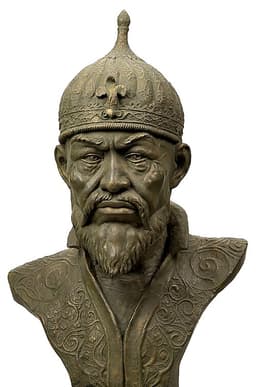
Timur
Emperor · Medieval
65.6Total

Wu Zetian
Emperor · Medieval
70.0Total
Basic Information
Born
1336
624
Died
1405
705
Era
Medieval
Medieval
Nationality
Timurid Empire
China
Occupation
Emperor
Emperor
Civilization
Middle Eastern
Eastern
Score Comparison
Military (10%)
79.0
60.0
Political (20%)
70.0
62.7
Influence (20%)
70.0
65.0
Legacy (20%)
40.0
80.0
Leadership (15%)
79.8
78.0
Strategy (15%)
77.6
66.3
TOTAL
65.6
70.0
Timur — Complete Timeline
1362 AD
Battle of the Terek RiverWar
Timur defeated the Mongol ruler of the Chagatai Khanate, establishing his control over Transoxiana. This victory marked the beginning of his rise to power, as he captured Samarkand and declared himself emir.
Rise to PowerBattleCentral Asia
Impact: regional
1387 AD
Conquest of PersiaWar◆ Major
Timur launched a campaign into Persia, capturing Isfahan and Shiraz. He suppressed a revolt in Isfahan by massacring tens of thousands of inhabitants, establishing his reputation for extreme brutality and consolidating control over the region.
ConquestMassacrePersia
Impact: regionaldestructive
1395 AD
Campaign against the Golden HordeWar◆ Major
Timur defeated the Golden Horde under Tokhtamysh at the Battle of the Terek River. He sacked Sarai, the Horde's capital, and destroyed its trade networks, permanently weakening the Mongol state and securing his northern frontier.
ConquestGolden HordeBattle
Impact: regionaldestructive
1398 AD
Sack of DelhiWar◆ Major
Timur invaded the Delhi Sultanate, defeating Sultan Nasir-ud-Din Mahmud Shah Tughluq. His army sacked Delhi, massacring tens of thousands of civilians and destroying the city's infrastructure, then withdrew with immense plunder.
ConquestMassacreIndia
Impact: regionaldestructive
1402 AD
Battle of AnkaraWar
Timur defeated the Ottoman Sultan Bayezid I at Ankara, capturing him. The victory shattered Ottoman power, leading to a civil war among Bayezid's sons and delaying Ottoman expansion into Europe for a decade.
BattleOttoman EmpireDecisive Victory
Impact: global
1404 AD
Construction of SamarkandCultural◆ Major
Timur invested heavily in transforming Samarkand into a cultural and architectural center. He brought artisans from conquered lands to build mosques, madrasas, and the Bibi-Khanym Mosque, making the city a showcase of Timurid art and learning.
ArchitecturePatronageCultural Center
Impact: regionalconstructive
1405 AD
Death during campaign against Ming ChinaWar◆ Major
Timur died of illness while leading a massive army toward the Ming dynasty's borders. His death ended the planned invasion of China and led to the fragmentation of his empire among his sons and grandsons.
DeathCampaignMing Dynasty
Impact: regional
Wu Zetian — Complete Timeline
655 AD
Became Empress ConsortPolitical Action◆ Major
Wu Zetian was elevated from concubine to empress consort of Emperor Gaozong of Tang in 655. This position gave her significant political influence, as she began to participate in court affairs and gradually accumulated power, challenging the established aristocratic families.
Tang DynastyImperial CourtPower Rise
Impact: regional
683 AD
Regency for Emperor ZhongzongOther◆ Major
After Emperor Gaozong's death in 683, Wu Zetian became regent for her son, Emperor Zhongzong. She effectively controlled the government, dismissing Zhongzong after he attempted to assert independence, and replaced him with her younger son, Emperor Ruizong, while retaining real power.
Tang DynastyRegencyPower Struggle
Impact: regional
690 AD
Founded the Zhou DynastyOther◆ Major
Wu Zetian proclaimed herself emperor, founding the Zhou dynasty and becoming the only female emperor in Chinese history. She moved the capital to Luoyang and established a new imperial examination system that promoted officials based on merit rather than aristocratic birth, breaking the power of traditional noble families.
Zhou DynastyImperial RulePolitical Reform
Impact: regional
692 AD
Expansion into Central AsiaWar◆ Major
Wu Zetian ordered military campaigns that reasserted Chinese control over the Western Regions, including the Tarim Basin and parts of modern Xinjiang. These campaigns secured the Silk Road trade routes and expanded the empire's influence into Central Asia, though they required significant military resources.
Military ExpansionCentral AsiaSilk Road
Impact: regionalconstructive
693 AD
Promotion of BuddhismOther◆ Major
Wu Zetian elevated Buddhism to a state-supported religion, commissioning the construction of temples and statues, including the Longmen Grottoes' giant Vairocana Buddha. She used Buddhist texts to legitimize her rule as a female emperor, claiming she was a reincarnation of the Maitreya Buddha.
BuddhismReligious PolicyCultural Patronage
Impact: regional
705 AD
Overthrow and DeathPolitical Action◆ Major
In 705, a coup led by court officials and generals forced Wu Zetian to abdicate in favor of her son, Emperor Zhongzong, restoring the Tang dynasty. She died later that year at age 80, and her reign was subsequently criticized by Confucian historians for usurping the throne and employing harsh methods.
Tang DynastyCoupAbdication
Impact: regionaldestructive
Expert Analysis
Wu Zetian vs Timur
# The Throne and the Saddle: Wu Zetian and Timur, Two Paths to Power
On a winter morning in 705, an elderly woman lay dying in a cold palace chamber, stripped of the crown she had worn for fifteen years. Half a world away and six centuries later, a lame conqueror shivered in his tent on the frozen steppes of Central Asia, his vast army stalled by illness and the approaching Chinese border. Wu Zetian and Timur never met, yet their lives pose a question that haunts history: What drives one ruler to build through cunning and another through carnage?
Origins
Wu Zetian was born in 624 into a wealthy but politically marginal family in Tang China. Her father was a timber merchant who had risen through military service, but in a society that valued aristocratic lineage above all, the Wus were parvenus. When she entered the imperial palace at age fourteen as a low-ranking concubine, she carried nothing but her intelligence and an unyielding will. The Tang dynasty was at its zenith—cosmopolitan, prosperous, and deeply Confucian, a world that assigned women to the shadows.
Timur, born in 1336 near Samarkand, emerged from a different crucible. The son of a minor Turco-Mongol chieftain, he grew up in the chaos following the collapse of the Mongol Empire. His world was one of constant warfare, shifting alliances, and brutal survival. A shepherd's son who became a bandit, Timur suffered an arrow wound to his right leg and hand in his youth, leaving him lame—hence his Persian nickname, *Timur-e Lang*, or Timur the Lame. Where Wu Zetian learned to navigate the treacherous corridors of a palace, Timur learned to ride, raid, and kill.
Rise to Power
Wu Zetian's ascent was a masterclass in patience and psychological warfare. After Emperor Taizong's death, she was sent to a convent, but she had already caught the eye of his son, Gaozong. When she returned to court as his concubine, she systematically eliminated rivals—including her own infant daughter, according to historical accounts, to frame the empress. By 655, she had become Gaozong's empress. For decades, she ruled from behind the throne, managing the empire while her husband's health declined. Her power was built not on armies but on alliances, espionage, and an iron grip on the bureaucracy.
Timur's rise was more direct. In 1362, at the Battle of the Terek River, he defeated the Mongol ruler of the Chagatai Khanate, seizing control of Transoxiana. He did not conquer alone; he married into the lineage of Genghis Khan, installed puppet khans, and built a coalition of nomadic warriors. His legitimacy came from the sword, not the court. By 1370, he had made Samarkand his capital and began a career of conquest that would span three decades.
Leadership & Governance
As sole ruler after Gaozong's death, Wu Zetian founded her own Zhou dynasty in 690, becoming the only female emperor in Chinese history. She transformed governance. She created a secret police network to root out aristocratic opposition, but she also expanded the civil service examination system, promoting talented commoners over hereditary nobles. She reduced taxes during famines, patronized Buddhism to legitimize her rule, and extended Chinese influence into Central Asia. Her political score of 80.0 reflects a ruler who understood that power flows from institutions, not just armies.
Timur governed differently. His military score of 90.0 and strategy of 85.0 tell of a conqueror who devastated everything in his path. In 1387, he suppressed a revolt in Isfahan by building towers of 70,000 skulls. In 1398, he sacked Delhi, massacring tens of thousands. In 1402, he defeated the Ottoman Sultan Bayezid I at Ankara, shattering Ottoman power for a generation. Yet Timur was not merely a destroyer. He invested heavily in Samarkand, bringing artisans from conquered cities to build mosques, libraries, and gardens. His political score of 65.0 reveals a ruler who could inspire loyalty but could not build lasting institutions.
Triumph & Tragedy
Wu Zetian's greatest triumph was survival itself. She ruled for fifty years, died in her bed, and saw her dynasty continue under her son. Her tragedy was the loneliness of absolute power: she executed her own children, exiled her heirs, and died knowing that history would judge her harshly for her gender.
Timur's triumph was the Battle of Ankara, where he captured the Ottoman sultan and reshaped the map of the Middle East. His tragedy came in 1405, when he died of illness while marching against the Ming dynasty—the one conquest that eluded him. His empire, held together by fear and charisma, fragmented within a generation.
Character & Destiny
Wu Zetian ruled through the mind. She was ruthless but calculating, cruel but strategic. She understood that in a Confucian world, a female emperor needed more than force—she needed legitimacy, ideology, and an unassailable bureaucracy. Timur ruled through the will. He was a nomad who never sat still, a builder who destroyed, a man who could quote Persian poetry while ordering massacres. His lameness was a constant reminder of physical vulnerability, which he compensated for with relentless ambition.
Legacy
Wu Zetian's legacy score of 85.0 reflects her profound impact. She remains a figure of fascination—the only woman to claim the title of emperor in China, a symbol of female power in a patriarchal system. Her reforms outlasted her dynasty, and her tomb at Qianling still stands, a silent monument to her audacity.
Timur's legacy is more ambiguous. He is remembered as a monster in Persia and India, a national hero in Uzbekistan. His empire was ephemeral, but his cultural patronage made Samarkand a jewel of Islamic civilization. His descendants, the Mughals, would later conquer India, carrying his name into a new era.
Conclusion
Wu Zetian and Timur represent two poles of leadership: the palace and the saddle, the examination hall and the battlefield. One built through persuasion, the other through terror. One expanded the state, the other shattered it. Their lives remind us that power is never a single thing—it is a choice, made again and again, between the throne and the sword.
Rankings
🥇
Wu ZetianLeader
Mil: 60.0Pol: 62.7Inf: 65.0
70.0
🥈
Timur
Mil: 79.0Pol: 70.0Inf: 70.0
65.6
+4.4 behind
How This Comparison Works
Algorithm
Each figure is scored on 6 dimensions (0—100 scale) based on structured historical data: Military (10%), Political (20%), Influence (20%), Legacy (20%), Leadership (15%), Strategy (15%). The weighted total produces the final ranking.
Data Sources
Scores are computed from structured sub-indicators in the database. Scale factors adjust for era (Ancient ×0.85, Modern ×1.0) and civilization size (Eastern ×1.05, Other ×0.80) to account for differences in population and military scale.
Maximum 3 Figures
Comparisons are limited to 2—3 figures to ensure readability and statistical meaningfulness.
Error Margins
±5 points per dimension — Sub-scores are derived from historical records with inherent uncertainty. Two figures within 5 points on a dimension should be considered roughly equivalent in that area.
Total Score Accuracy
±3 points overall — The weighted combination of 6 dimensions produces a total score with approximately ±3 points of uncertainty. Differences of less than 3 points are not statistically significant— the figures are effectively tied.
Known Limitations
- Historical records are incomplete and uneven across civilizations
- Figures from oral-tradition societies may be underrepresented
- Occupation labels can misclassify multi-role figures
- Scores measure capability and impact, not moral character
- Quantitative scoring is a comparison tool, not absolute truth
Capability Radar
Military (10%) — Battles & Warfare
Battles
95
65
Win Rate
92
70
Expansion
96
75
Political (20%) — Governance & Reform
Reform
78
85
Diplomacy
70
80
Economy
82
85
Influence (20%) — Cultural & Global Reach
Cultural
88
85
Global
85
70
Legacy (20%) — Historical Impact
Historical
90
90
Longevity
75
85
Leadership (15%) — Power & Stability
Tenure
85
90
Stability
65
75
Strategy (15%) — Tactics & Innovation
Strategy
93
75
Tactics
94
60
Reform
80
80
Similar Comparisons
Comments & Discussion
武则天与铁木儿6/16/2026
作为古典学者,我必须说武则天的统治更令人敬畏。她以智谋和文字治国,在长安宫廷中操纵儒家官僚体系,而非靠骑兵和屠杀。公元690年她称帝时,中国人口和财富远超帖木儿的草原帝国。智慧胜过蛮力。
Historian1866/16/2026
As a military historian, I see Timur as the superior strategist—his campaigns from Delhi to Ankara show a genius for logistics and terror that Wu Zetian couldn't match. She played palace games; he conquered continents. A lame shepherd who defeated the Ottoman sultan Bayezid. That's raw power.