Loading...
Stilicho vs Yuwen Tai
Yuwen Tai leads by 0.4 pts · 2 figures compared
…
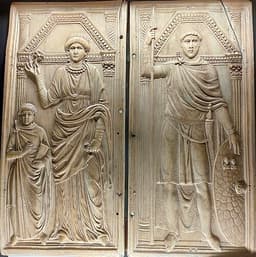
Stilicho
General · Ancient
61.1Total

Yuwen Tai
General · Ancient
61.5Total
Basic Information
Born
359
-507
Died
408
—
Era
Ancient
Ancient
Nationality
Roman Empire
China
Occupation
General
General
Civilization
Western
Eastern
Score Comparison
Military (10%)
74.0
85.0
Political (20%)
52.0
62.7
Influence (20%)
58.3
61.0
Legacy (20%)
55.6
52.0
Leadership (15%)
68.0
48.8
Strategy (15%)
72.0
80.0
TOTAL
61.1
61.5
Stilicho — Complete Timeline
401 AD
Withdrawal of Legions from BritainPolitical Action◆ Major
Stilicho withdrew Roman legions from Britain to defend Italy against barbarian invasions. This withdrawal weakened Roman control over Britain and contributed to the eventual abandonment of the province by the Roman Empire.
BritainWithdrawalLegions
Impact: regionaldestructive
402 AD
Battle of PollentiaWar◆ Major
Stilicho defeated the Visigoths under Alaric I at the Battle of Pollentia (modern Pollenzo). The victory forced Alaric to retreat from Italy, temporarily saving the Western Roman Empire from Gothic invasion.
BattleVisigothsAlaric
Impact: regional
403 AD
Battle of VeronaWar◆ Major
Stilicho again defeated Alaric at the Battle of Verona, forcing the Visigoths to withdraw from Italy. Stilicho negotiated a treaty with Alaric, allowing the Visigoths to settle in Illyricum, a decision that later proved controversial.
BattleTreatyVisigoths
Impact: regional
406 AD
Defense of Italy against RadagaisusWar◆ Major
Stilicho defeated a large invasion force of Goths under Radagaisus at Fiesole (modern Florence). Radagaisus was captured and executed, and his followers were enslaved or recruited into the Roman army.
InvasionGothsDefense
Impact: regional
408 AD
Execution of StilichoPolitical Action
Stilicho was executed on the orders of Emperor Honorius, following accusations of treason and conspiracy with the barbarians. His death removed the Western Empire's most capable general and led to a breakdown of Roman defenses.
ExecutionTreasonHonorius
Impact: globaltragic
Yuwen Tai — Complete Timeline
535 AD
Founded the Western Wei dynastyPolitical Action◆ Major
Yuwen Tai established the Western Wei dynasty after the split of the Northern Wei. He served as regent and de facto ruler, with the Yuan clan as figurehead emperors, and implemented military and administrative reforms.
Dynasty FoundingReformNorthern China
Impact: regionalconstructive
537 AD
Defeated the Eastern Wei at the Battle of ShaxianWar◆ Major
Yuwen Tai led Western Wei forces to victory against the larger Eastern Wei army at Shaxian. This battle secured the survival of Western Wei and established Yuwen Tai's military reputation.
BattleVictoryEastern Wei
Impact: regionalconstructive
540 AD
Implemented the Fubing systemReform◆ Major
Yuwen Tai introduced the Fubing militia system, which organized farmer-soldiers into garrisons. This system provided a stable military force and became the basis for the Sui and Tang military systems.
Military ReformFubingInstitution
Impact: regionalconstructive
556 AD
Death and succession by Yuwen HuOther◆ Major
Yuwen Tai died of illness. His nephew Yuwen Hu took over as regent, later forcing the abdication of the Western Wei emperor and founding the Northern Zhou dynasty, fulfilling Yuwen Tai's legacy.
DeathSuccessionNorthern Zhou
Impact: regional
Expert Analysis
Origins
Stilicho was born around 359 AD, likely in the Roman province of Dacia, to a Vandal father and Roman mother. He rose through the military ranks under Emperor Theodosius I, who appointed him guardian of his son Honorius. Yuwen Tai was born in 507 AD in the Xianbei-dominated Northern Wei dynasty. His family served as military commanders; he began his career as a low-ranking officer but gained experience in the rebellions that plagued the late Northern Wei.
Rise to Power
Stilicho became the effective ruler of the Western Roman Empire after Theodosius I died in 395 AD, serving as regent for the young Honorius. He claimed to have been entrusted with the care of both Honorius and Arcadius (the Eastern emperor), though this was disputed. His authority depended on military success and manipulation of the court. Yuwen Tai rose during the disintegration of Northern Wei. After the court split, he supported the claimant who became Emperor Xiaowu of Western Wei. When Xiaowu fled to Yuwen's domain, Yuwen Tai took control, later installing a puppet emperor and ruling as regent. By 535 AD, he had consolidated power, founding the Western Wei dynasty.
Leadership & Governance
Stilicho's leadership focused on defending Italy from barbarian invasions. He used diplomatic and military means, negotiating with Alaric while also defeating him at Pollentia (402 AD) and Verona (403 AD). He integrated barbarian troops into the Roman army, a controversial policy that alienated traditionalists. His governance was constrained by infighting and the weak emperor Honorius. Yuwen Tai implemented the Fubing system, a militia-based army that balanced central control with local autonomy. He reformed the bureaucracy, adopting Chinese administrative practices while maintaining Xianbei military elite. His political score of 62.7 reflects his skill in consolidating power without taking the throne himself.
Triumph & Tragedy
Stilicho's greatest triumph was defending Italy from Radagaisus (406 AD), crushing a large Gothic invasion. His tragedy was his execution in 408 AD on trumped-up charges of treason, orchestrated by Honorius's court. His death led to the sack of Rome by Alaric in 410 AD. Stilicho's military score of 74.0 reflects his defensive successes but also his failure to secure his position. Yuwen Tai's triumph was the victory at Shaxian (537 AD) against a larger Eastern Wei army, securing Western Wei's survival. His tragedy was his early death in 556 AD, leaving his son too young to rule, leading to a regency that eventually overthrew the dynasty. His military score of 85.0 highlights his battlefield prowess.
Character & Destiny
Stilicho was a capable general but a poor politician. He trusted Honorius and failed to neutralize his enemies at court. His Vandal heritage made him suspect among Romans. Yuwen Tai was more astute politically, building a stable regime through reforms. He was a cautious strategist, avoiding risky battles. His leadership score of 48.8 may reflect his reliance on clan ties rather than personal charisma. Both men died before achieving their goals: Stilicho by betrayal, Yuwen Tai by illness.
Legacy
Stilicho's legacy is mixed: he is remembered as the last great Roman general in the West, but his policies of barbarian integration arguably weakened Rome. His score of 55.6 for legacy reflects this ambiguity. Yuwen Tai's Fubing system influenced later Chinese dynasties, including the Sui and Tang. The Northern Zhou, which he founded, unified northern China. His legacy score of 52.0 is lower, perhaps because his dynasty was short-lived. However, his military and administrative reforms had lasting impact.
Conclusion
While Stilicho scored 61.1 overall and Yuwen Tai 61.5, the gap is marginal. Yuwen Tai had a higher military score (85.0 vs 74.0) and his political reforms were more enduring. Stilicho's defensive victories were crucial but temporary; his death triggered Rome's decline. Yuwen Tai's foundation of Western Wei led to the reunification of China. Therefore, Yuwen Tai had greater long-term impact. His strategic innovations and state-building outweigh Stilicho's last-ditch defense of a dying empire.
Rankings
🥇
Yuwen TaiLeader
Mil: 85.0Pol: 62.7Inf: 61.0
61.5
🥈
Stilicho
Mil: 74.0Pol: 52.0Inf: 58.3
61.1
+0.4 behind
How This Comparison Works
Algorithm
Each figure is scored on 6 dimensions (0—100 scale) based on structured historical data: Military (10%), Political (20%), Influence (20%), Legacy (20%), Leadership (15%), Strategy (15%). The weighted total produces the final ranking.
Data Sources
Scores are computed from structured sub-indicators in the database. Scale factors adjust for era (Ancient ×0.85, Modern ×1.0) and civilization size (Eastern ×1.05, Other ×0.80) to account for differences in population and military scale.
Maximum 3 Figures
Comparisons are limited to 2—3 figures to ensure readability and statistical meaningfulness.
Error Margins
±5 points per dimension — Sub-scores are derived from historical records with inherent uncertainty. Two figures within 5 points on a dimension should be considered roughly equivalent in that area.
Total Score Accuracy
±3 points overall — The weighted combination of 6 dimensions produces a total score with approximately ±3 points of uncertainty. Differences of less than 3 points are not statistically significant— the figures are effectively tied.
Known Limitations
- Historical records are incomplete and uneven across civilizations
- Figures from oral-tradition societies may be underrepresented
- Occupation labels can misclassify multi-role figures
- Scores measure capability and impact, not moral character
- Quantitative scoring is a comparison tool, not absolute truth
Capability Radar
Military (10%) — Battles & Warfare
Battles
78
65
Win Rate
72
70
Expansion
55
70
Political (20%) — Governance & Reform
Reform
60
85
Diplomacy
68
70
Economy
55
75
Influence (20%) — Cultural & Global Reach
Cultural
60
60
Global
60
55
Legacy (20%) — Historical Impact
Historical
72
75
Longevity
65
70
Leadership (15%) — Power & Stability
Tenure
70
75
Stability
45
70
Strategy (15%) — Tactics & Innovation
Strategy
82
80
Tactics
80
75
Reform
65
85
Similar Comparisons
Comments & Discussion
No comments yet. Be the first to share your thoughts!