Loading...
Stilicho vs Yeon Gaesomun
Yeon Gaesomun leads by 2.6 pts · 2 figures compared
…
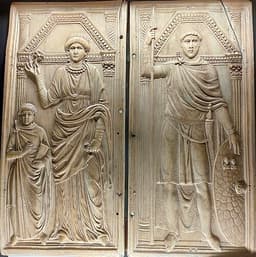
Stilicho
General · Ancient
61.1Total

Yeon Gaesomun
General · Ancient
63.7Total
Basic Information
Born
359
-603
Died
408
—
Era
Ancient
Ancient
Nationality
Roman Empire
Korea
Occupation
General
General
Civilization
Western
Eastern
Score Comparison
Military (10%)
74.0
90.0
Political (20%)
52.0
68.0
Influence (20%)
58.3
56.7
Legacy (20%)
55.6
52.0
Leadership (15%)
68.0
62.0
Strategy (15%)
72.0
80.3
TOTAL
61.1
63.7
Stilicho — Complete Timeline
401 AD
Withdrawal of Legions from BritainPolitical Action◆ Major
Stilicho withdrew Roman legions from Britain to defend Italy against barbarian invasions. This withdrawal weakened Roman control over Britain and contributed to the eventual abandonment of the province by the Roman Empire.
BritainWithdrawalLegions
Impact: regionaldestructive
402 AD
Battle of PollentiaWar◆ Major
Stilicho defeated the Visigoths under Alaric I at the Battle of Pollentia (modern Pollenzo). The victory forced Alaric to retreat from Italy, temporarily saving the Western Roman Empire from Gothic invasion.
BattleVisigothsAlaric
Impact: regional
403 AD
Battle of VeronaWar◆ Major
Stilicho again defeated Alaric at the Battle of Verona, forcing the Visigoths to withdraw from Italy. Stilicho negotiated a treaty with Alaric, allowing the Visigoths to settle in Illyricum, a decision that later proved controversial.
BattleTreatyVisigoths
Impact: regional
406 AD
Defense of Italy against RadagaisusWar◆ Major
Stilicho defeated a large invasion force of Goths under Radagaisus at Fiesole (modern Florence). Radagaisus was captured and executed, and his followers were enslaved or recruited into the Roman army.
InvasionGothsDefense
Impact: regional
408 AD
Execution of StilichoPolitical Action
Stilicho was executed on the orders of Emperor Honorius, following accusations of treason and conspiracy with the barbarians. His death removed the Western Empire's most capable general and led to a breakdown of Roman defenses.
ExecutionTreasonHonorius
Impact: globaltragic
Yeon Gaesomun — Complete Timeline
642 AD
Coup d'État and Seizure of PowerPolitical Action
Yeon Gaesomun led a military coup, killing King Yeongnyu and hundreds of nobles. He installed King Bojang as a puppet ruler and assumed the position of Dae Mangniji (Supreme Commander), establishing a military dictatorship over Goguryeo.
CoupMilitary DictatorshipPower Seizure
Impact: nationaldestructive
Defiance of Tang ChinaPolitical Action◆ Major
Yeon Gaesomun refused to submit to Tang Chinese demands for tribute and recognition, asserting Goguryeo's sovereignty. His aggressive stance led to multiple Tang invasions and a prolonged war that drained both empires.
Tang RelationsSovereigntyConflict
Impact: regional
645 AD
Battle of Ansi FortressWar◆ Major
Yeon Gaesomun led the defense of Ansi Fortress against a massive Tang Chinese invasion led by Emperor Taizong. The Goguryeo forces held out for months, inflicting heavy casualties and forcing the Tang army to retreat, preserving Goguryeo's independence.
Tang-Goguryeo WarSiegeMilitary Victory
Impact: regional
666 AD
Death and Fall of GoguryeoOther
Yeon Gaesomun died, leading to a power struggle among his sons. This internal division weakened Goguryeo, allowing the Tang-Silla alliance to conquer the kingdom in 668, ending its 700-year history.
DeathSuccession CrisisFall of Goguryeo
Impact: regionaltragic
Expert Analysis
Origins
Flavius Stilicho was born around 359 AD, likely in the Roman Empire, to a Vandal father and a Roman mother. He rose through the military ranks, serving under Emperor Theodosius I. His mixed heritage gave him unique insight into both Roman and barbarian worlds, but also fueled later suspicions of treachery. Stilicho received a classical Roman education and was groomed for high command, eventually marrying Serena, Theodosius's niece, which tied him to the imperial family.
Yeon Gaesomun was born in 603 AD in Goguryeo, one of the Three Kingdoms of Korea. He came from the aristocratic Yeon clan, which held significant military power. Details of his early life are sparse, but he was trained in martial arts and military strategy, reflecting Goguryeo's warrior culture. His father, Yeon Taejo, served as a high-ranking official, and Yeon Gaesomun inherited a position as a regional commander, giving him control over troops and resources.
Rise to Power
Stilicho's rise was meteoric under Theodosius I. He became the empire's leading general after victories against the Goths in 382 AD. By 384 AD, he was appointed magister militum (master of soldiers) and later served as regent for the young Emperor Honorius after Theodosius's death in 395 AD. Stilicho claimed Theodosius had entrusted him with guardianship of both Honorius and Arcadius, the eastern emperor, leading to tension with the Eastern court. He solidified his power by marrying his daughter Maria to Honorius in 398 AD, becoming the de facto ruler of the Western Roman Empire.
Yeon Gaesomun seized power through a bloody coup in 642 AD. He killed King Yeongnyu and hundreds of nobles, accusing them of plotting to surrender to Tang China. He then installed King Bojang as a puppet ruler and declared himself Dae Mangniji (Supreme Commander), effectively becoming the military dictator of Goguryeo. This ruthless move eliminated internal opposition and consolidated his authority, allowing him to pursue an aggressive foreign policy against Tang China.
Leadership & Governance
Stilicho governed the Western Roman Empire during a period of collapse. He focused on military defense, using diplomacy and battlefield victories to stem barbarian incursions. He integrated barbarian foederati into Roman armies, a controversial policy that alienated traditionalists. His governance was reactive, struggling to maintain control over a shrinking tax base and rebellious provinces. He attempted to strengthen central authority but faced constant opposition from the Eastern court and Roman senators who distrusted his barbarian origins.
Yeon Gaesomun ruled Goguryeo with an iron fist. He centralized military command, reformed the army, and fortified key strongholds like Ansi Fortress. His governance was autocratic, suppressing dissent through executions and purges. He maintained Goguryeo's independence by rejecting Tang demands for submission, but his dictatorial style alienated other nobles and created instability. His rule prioritized military preparedness over economic development, leading to long-term strain on the kingdom's resources.
Triumph & Tragedy
Stilicho's greatest triumph was the defense of Italy. At the Battle of Pollentia in 402 AD, he defeated the Visigoths under Alaric I, forcing them to retreat. In 405 AD, he crushed a massive invasion by Radagaisus at Fiesole, capturing and executing the Gothic leader. He also negotiated a treaty with Alaric in 407 AD, temporarily securing peace. However, his tragic failure was his execution in 408 AD. Accused of treason by Honorius's court, he was arrested and beheaded on August 22, 408 AD. His death led to the breakdown of Roman defenses; Alaric sacked Rome in 410 AD.
Yeon Gaesomun's greatest triumph was the defense of Ansi Fortress in 645 AD. Emperor Taizong of Tang led a massive invasion force, but Yeon Gaesomun's stubborn defense and strategic use of terrain forced a Tang withdrawal after months of siege. This victory preserved Goguryeo's independence for another two decades. His tragic failure was his death in 666 AD, which triggered a power struggle among his sons. This internal conflict weakened Goguryeo, allowing the Tang-Silla alliance to conquer the kingdom in 668 AD, ending its 700-year history.
Character & Destiny
Stilicho was a capable general but a poor politician. His trusting nature and reliance on Honorius led to his downfall. He failed to secure his position against court intrigues, and his Vandal heritage made him vulnerable to accusations of barbarian sympathy. His death was a direct result of his inability to navigate the treacherous politics of the late Roman court. Historian Edward Gibbon described him as "the last great Roman general," but his fate underscored the empire's decay.
Yeon Gaesomun was ruthless and strategically brilliant, but his authoritarian rule created enemies. His coup and purges eliminated rivals but also bred resentment. His defiance of Tang China earned him a reputation as a national hero, but his failure to establish a stable succession doomed his kingdom. His sons' infighting after his death mirrored his own violent rise, leading to Goguryeo's fall. Korean history remembers him as a symbol of resistance, but his legacy is tempered by the kingdom's collapse.
Legacy
Stilicho's legacy is mixed. He delayed the fall of the Western Roman Empire by a decade but is often blamed for withdrawing legions from Britain, contributing to its abandonment. His execution proved catastrophic, as no capable general remained to defend Italy. In military history, he is remembered for his tactical acumen in battles like Pollentia and Verona. His overall score of 61.1 reflects his strong military skills (74.0) but weaker political and leadership scores (52.0 and 68.0).
Yeon Gaesomun's legacy is central to Korean history. He is celebrated as a heroic defender of Goguryeo's sovereignty against Chinese imperialism. His defiance set a precedent for Korean resistance to foreign domination. However, his dictatorial methods and failure to ensure a smooth succession contributed to Goguryeo's downfall. His military score of 90.0 is among the highest in history, but his legacy score of 52.0 is lower due to the kingdom's collapse. His influence on Korean identity remains strong.
Conclusion
While Stilicho and Yeon Gaesomun both shaped their nations' fates, Yeon Gaesomun had a greater impact on long-term historical outcomes. Stilicho's efforts were ultimately futile; the Western Roman Empire fell within 70 years of his death, and his legacy is one of temporary delay. Yeon Gaesomun's defiance preserved Goguryeo for two decades and solidified Korean resistance to Chinese dominance, influencing Korean nationalism for centuries. His military score (90.0) far exceeds Stilicho's (74.0), and his strategic score (80.3) is also higher. Although his political score (68.0) is higher than Stilicho's (52.0), his total score (63.7 vs 61.1) reflects a greater overall effectiveness. Yeon Gaesomun's actions had enduring consequences for Korean identity, while Stilicho's death marked a turning point in Rome's decline. Therefore, Yeon Gaesomun emerges as the more impactful figure.
Rankings
🥇
Yeon GaesomunLeader
Mil: 90.0Pol: 68.0Inf: 56.7
63.7
🥈
Stilicho
Mil: 74.0Pol: 52.0Inf: 58.3
61.1
+2.6 behind
How This Comparison Works
Algorithm
Each figure is scored on 6 dimensions (0—100 scale) based on structured historical data: Military (10%), Political (20%), Influence (20%), Legacy (20%), Leadership (15%), Strategy (15%). The weighted total produces the final ranking.
Data Sources
Scores are computed from structured sub-indicators in the database. Scale factors adjust for era (Ancient ×0.85, Modern ×1.0) and civilization size (Eastern ×1.05, Other ×0.80) to account for differences in population and military scale.
Maximum 3 Figures
Comparisons are limited to 2—3 figures to ensure readability and statistical meaningfulness.
Error Margins
±5 points per dimension — Sub-scores are derived from historical records with inherent uncertainty. Two figures within 5 points on a dimension should be considered roughly equivalent in that area.
Total Score Accuracy
±3 points overall — The weighted combination of 6 dimensions produces a total score with approximately ±3 points of uncertainty. Differences of less than 3 points are not statistically significant— the figures are effectively tied.
Known Limitations
- Historical records are incomplete and uneven across civilizations
- Figures from oral-tradition societies may be underrepresented
- Occupation labels can misclassify multi-role figures
- Scores measure capability and impact, not moral character
- Quantitative scoring is a comparison tool, not absolute truth
Capability Radar
Military (10%) — Battles & Warfare
Battles
78
85
Win Rate
72
80
Expansion
55
75
Political (20%) — Governance & Reform
Reform
60
70
Diplomacy
68
75
Economy
55
60
Influence (20%) — Cultural & Global Reach
Cultural
60
60
Global
60
65
Legacy (20%) — Historical Impact
Historical
72
75
Longevity
65
70
Leadership (15%) — Power & Stability
Tenure
70
85
Stability
45
65
Strategy (15%) — Tactics & Innovation
Strategy
82
85
Tactics
80
90
Reform
65
70
Similar Comparisons
Comments & Discussion
No comments yet. Be the first to share your thoughts!