Loading...
Amr ibn al-As vs Stilicho
Stilicho leads by 1.4 pts · 2 figures compared
…

Amr ibn al-As
General · Ancient
59.7Total
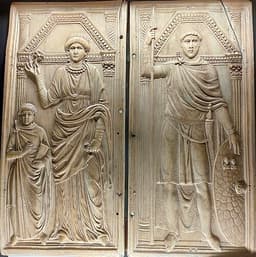
Stilicho
General · Ancient
61.1Total
Basic Information
Born
-573
359
Died
—
408
Era
Ancient
Ancient
Nationality
Rashidun Caliphate
Roman Empire
Occupation
General
General
Civilization
Middle Eastern
Western
Score Comparison
Military (10%)
72.0
74.0
Political (20%)
46.6
52.0
Influence (20%)
56.7
58.3
Legacy (20%)
58.0
55.6
Leadership (15%)
68.0
68.0
Strategy (15%)
66.7
72.0
TOTAL
59.7
61.1
Amr ibn al-As — Complete Timeline
640 AD
Conquest of EgyptWar◆ Major
Amr ibn al-As led the Muslim Arab army into Egypt, then a province of the Byzantine Empire. He defeated the Byzantines at the Battle of Heliopolis and captured the fortress of Babylon, leading to the surrender of Alexandria in 642.
Islamic ConquestEgyptByzantine Empire
Impact: regional
641 AD
Foundation of FustatCultural◆ Major
Amr ibn al-As established the city of Fustat near the Nile Delta as the new capital of Muslim Egypt. The city became a major administrative and commercial center, later evolving into modern Cairo.
City FoundationEgyptIslamic Architecture
Impact: regionalconstructive
642 AD
Governor of EgyptPolitical Action◆ Major
After the conquest, Amr ibn al-As was appointed governor of Egypt by Caliph Umar. He administered the province, implemented tax systems, and oversaw the construction of the Mosque of Amr ibn al-As, the first mosque in Africa.
GovernorshipEgyptAdministration
Impact: regionalconstructive
Stilicho — Complete Timeline
401 AD
Withdrawal of Legions from BritainPolitical Action◆ Major
Stilicho withdrew Roman legions from Britain to defend Italy against barbarian invasions. This withdrawal weakened Roman control over Britain and contributed to the eventual abandonment of the province by the Roman Empire.
BritainWithdrawalLegions
Impact: regionaldestructive
402 AD
Battle of PollentiaWar◆ Major
Stilicho defeated the Visigoths under Alaric I at the Battle of Pollentia (modern Pollenzo). The victory forced Alaric to retreat from Italy, temporarily saving the Western Roman Empire from Gothic invasion.
BattleVisigothsAlaric
Impact: regional
403 AD
Battle of VeronaWar◆ Major
Stilicho again defeated Alaric at the Battle of Verona, forcing the Visigoths to withdraw from Italy. Stilicho negotiated a treaty with Alaric, allowing the Visigoths to settle in Illyricum, a decision that later proved controversial.
BattleTreatyVisigoths
Impact: regional
406 AD
Defense of Italy against RadagaisusWar◆ Major
Stilicho defeated a large invasion force of Goths under Radagaisus at Fiesole (modern Florence). Radagaisus was captured and executed, and his followers were enslaved or recruited into the Roman army.
InvasionGothsDefense
Impact: regional
408 AD
Execution of StilichoPolitical Action
Stilicho was executed on the orders of Emperor Honorius, following accusations of treason and conspiracy with the barbarians. His death removed the Western Empire's most capable general and led to a breakdown of Roman defenses.
ExecutionTreasonHonorius
Impact: globaltragic
Expert Analysis
Origins
**Amr ibn al-As** was born around 573 CE in Mecca, into the powerful Quraysh tribe. His father, al-As ibn Wa'il, was a wealthy merchant. Amr initially opposed Islam but converted in 629 CE, becoming one of the early Muslim leaders. He was known for his eloquence and diplomatic skills, which he honed as a trader.
**Stilicho** was born around 359 CE, likely in a Romanized Germanic family. His father was a Vandal cavalry officer, and his mother was Roman. Stilicho rose through the ranks of the Roman army, serving under Emperor Theodosius I. He married Serena, Theodosius's niece, linking him to the imperial family.
Rise to Power
**Amr ibn al-As** rose to prominence after converting to Islam. He participated in key battles like the Battle of the Trench (627) and later served as a commander under Caliph Abu Bakr during the Ridda Wars (632-633). His major breakthrough came when Caliph Umar appointed him to lead the conquest of Byzantine Syria. In 639 CE, Amr convinced Umar to allow an invasion of Egypt with a small force of 4,000 men. He besieged Pelusium and defeated the Byzantines at the Battle of Heliopolis (640 CE), securing Egypt.
**Stilicho** rose under Emperor Theodosius I, who appointed him magister militum (master of soldiers) for the West in 393 CE. Upon Theodosius's death in 395 CE, Stilicho became regent for the young Emperor Honorius, effectively ruling the Western Roman Empire. He claimed that Theodosius had entrusted him with the guardianship of both his sons, but this was contested by the Eastern court.
Leadership & Governance
**Amr ibn al-As** governed Egypt with a focus on stability and revenue. He implemented a tax system based on the Byzantine model but adjusted rates to encourage conversion to Islam. He founded the city of Fustat (641 CE) as the administrative capital, building a mosque and a palace. Amr maintained religious tolerance, allowing Coptic Christians to practice freely, which contrasted with Byzantine persecution. His leadership style was pragmatic: he negotiated with local leaders and used diplomacy to reduce resistance. He scored 46.6 in political acumen, reflecting his ability to balance local and caliphal interests.
**Stilicho** governed the Western Empire with a focus on military defense. He maintained a policy of integrating barbarians into the Roman army, a controversial move that alienated Roman traditionalists. He also sought to maintain unity between the Eastern and Western empires, often intervening in Eastern affairs, which led to friction with Constantinople. His political score of 52.0 indicates moderate effectiveness, but his inability to secure loyalty from the Roman elite contributed to his downfall. Stilicho's governance was reactive, responding to successive barbarian invasions.
Triumph & Tragedy
**Amr ibn al-As's** greatest triumph was the conquest of Egypt, a wealthy province that became the breadbasket of the Islamic empire. He also founded Fustat, which grew into a major city (modern Cairo). His administration of Egypt was effective, ensuring a steady flow of taxes and grain. However, his tragedy came when Caliph Uthman replaced him as governor in 645 CE, partly due to complaints about his fiscal policies. Amr later regained the governorship under Caliph Muawiyah I, but his influence waned. He died in 664 CE at around age 91.
**Stilicho's** greatest triumphs were his victories over barbarian invaders: at Pollentia (402 CE) against Alaric, at Verona (403 CE), and at Fiesole (406 CE) against Radagaisus. These victories saved Italy from sack. However, his tragedy was his execution in 408 CE on trumped-up charges of treason. After his death, the Western Empire crumbled: Rome was sacked by Alaric in 410 CE, and Britain was lost. Stilicho's military score of 74.0 reflects his tactical prowess, but his political score of 52.0 reveals his failure to secure his position.
Character & Destiny
**Amr ibn al-As** was shrewd and adaptable. He was known for his eloquence and ability to read situations. His decision to invade Egypt with a small force showed ambition and risk-taking. He was also politically astute, maintaining good relations with Caliphs Umar and Muawiyah. His character ensured his survival and continued influence.
**Stilicho** was a capable general but politically naive. He trusted the imperial court and failed to neutralize his enemies, such as Olympius. His partial Vandal heritage was used against him. His decision to withdraw legions from Britain (407 CE) weakened the empire's frontiers. Stilicho's character—loyal to the empire but unable to navigate court intrigue—led to his tragic end. Historians often see him as a figure who could have saved the West if not betrayed.
Legacy
**Amr ibn al-As** left a lasting legacy in Egypt. The city of Fustat became the nucleus of Cairo, and his tax system influenced Islamic administration. He is remembered as a key figure in Islam's expansion. His legacy score is 58.0, reflecting enduring influence in the Islamic world.
**Stilicho's** legacy is mixed. He is remembered as the last great Roman general of the West, but his withdrawal of legions from Britain contributed to the island's abandonment. His integration of barbarians set a precedent for later foederati. His execution marked a turning point leading to the fall of the Western Empire. His legacy score is 55.6.
Conclusion
While Stilicho's military score (74.0) slightly exceeds Amr's (72.0), and his total score (61.1) is higher than Amr's (59.7), Amr ibn al-As had greater long-term impact. Stilicho's victories delayed the collapse of the Western Empire but did not prevent it. In contrast, Amr's conquest of Egypt permanently integrated a rich province into the Islamic world, shaping its culture and religion for centuries. Amr's foundation of Fustat grew into one of the world's great cities. Therefore, Amr ibn al-As had a more enduring and transformative impact on history.
Rankings
🥇
StilichoLeader
Mil: 74.0Pol: 52.0Inf: 58.3
61.1
🥈
Amr ibn al-As
Mil: 72.0Pol: 46.6Inf: 56.7
59.7
+1.4 behind
How This Comparison Works
Algorithm
Each figure is scored on 6 dimensions (0—100 scale) based on structured historical data: Military (10%), Political (20%), Influence (20%), Legacy (20%), Leadership (15%), Strategy (15%). The weighted total produces the final ranking.
Data Sources
Scores are computed from structured sub-indicators in the database. Scale factors adjust for era (Ancient ×0.85, Modern ×1.0) and civilization size (Eastern ×1.05, Other ×0.80) to account for differences in population and military scale.
Maximum 3 Figures
Comparisons are limited to 2—3 figures to ensure readability and statistical meaningfulness.
Error Margins
±5 points per dimension — Sub-scores are derived from historical records with inherent uncertainty. Two figures within 5 points on a dimension should be considered roughly equivalent in that area.
Total Score Accuracy
±3 points overall — The weighted combination of 6 dimensions produces a total score with approximately ±3 points of uncertainty. Differences of less than 3 points are not statistically significant— the figures are effectively tied.
Known Limitations
- Historical records are incomplete and uneven across civilizations
- Figures from oral-tradition societies may be underrepresented
- Occupation labels can misclassify multi-role figures
- Scores measure capability and impact, not moral character
- Quantitative scoring is a comparison tool, not absolute truth
Capability Radar
Military (10%) — Battles & Warfare
Battles
65
78
Win Rate
70
72
Expansion
75
55
Political (20%) — Governance & Reform
Reform
55
60
Diplomacy
70
68
Economy
50
55
Influence (20%) — Cultural & Global Reach
Cultural
55
60
Global
60
60
Legacy (20%) — Historical Impact
Historical
65
72
Longevity
60
65
Leadership (15%) — Power & Stability
Tenure
60
70
Stability
55
45
Strategy (15%) — Tactics & Innovation
Strategy
75
82
Tactics
72
80
Reform
40
65
Similar Comparisons
Comments & Discussion
No comments yet. Be the first to share your thoughts!