Loading...
This comparison has not been analyzed yet.
One-time AI generation (~1 minute). Scores and timeline are already available below.
Shaukat Aziz vs Vicente Fox
Shaukat Aziz leads by 0.3 pts · 2 figures compared
…
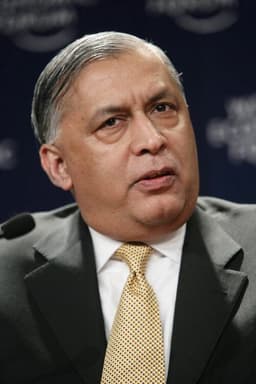
Shaukat Aziz
Politician · Modern
50.7Total

Vicente Fox
Politician · Modern
50.4Total
Basic Information
Born
1949
1942
Died
—
—
Era
Modern
Modern
Nationality
Pakistan
Mexico
Occupation
Politician
Politician
Civilization
Indian
Western
Score Comparison
Military (10%)
35.8
50.0
Political (20%)
62.7
68.0
Influence (20%)
50.2
54.9
Legacy (20%)
38.3
45.0
Leadership (15%)
64.0
40.0
Strategy (15%)
60.0
42.4
TOTAL
50.7
50.4
Shaukat Aziz — Complete Timeline
1999 AD
Economic Reforms as Finance MinisterReform◆ Major
As Finance Minister under President Pervez Musharraf from 1999 to 2004, Shaukat Aziz implemented economic reforms including privatization of state-owned enterprises, banking sector reforms, and tax restructuring. These policies contributed to GDP growth averaging 7% annually.
Economic ReformPrivatizationMusharraf
Impact: nationalconstructive
2004 AD
Appointed Prime Minister of PakistanPolitical Action◆ Major
Shaukat Aziz was appointed as the 17th Prime Minister of Pakistan on August 28, 2004, after serving as Finance Minister. He was a former Citibank executive and his appointment marked a technocratic shift in Pakistani politics.
Prime MinisterTechnocratPakistan
Impact: national
2007 AD
Completion of Five-Year TermPolitical Action◆ Major
Shaukat Aziz completed his five-year term as Prime Minister on November 15, 2007, becoming the first Pakistani Prime Minister to serve a full term since 1977. His tenure saw continued economic growth but also rising political instability.
Term CompletionPolitical StabilityPakistan
Impact: national
Vicente Fox — Complete Timeline
2000 AD
Election as first opposition president in 71 yearsPolitical Action
Vicente Fox of the National Action Party (PAN) won the presidential election, defeating the long-ruling PRI. This marked Mexico's first peaceful transfer of power to an opposition party since 1929, ending one-party rule.
DemocratizationElectionPolitical Change
Impact: nationalconstructive
2001 AD
Creation of the Federal Police forceReform◆ Major
Fox created the Federal Police (Polic
Police ReformSecurityDrug War
Impact: national
Failed attempt to pass indigenous rights legislationPolitical Action◆ Major
Fox sent a constitutional reform on indigenous rights to Congress, but the final version was watered down. The Zapatistas rejected it, and the initiative failed to address key demands for autonomy, leading to continued conflict in Chiapas.
Indigenous RightsLegislationFailure
Impact: national
This comparison has not been analyzed yet.
One-time AI generation (~1 minute). Scores and timeline are already available below.
Rankings
🥇
Shaukat AzizLeader
Mil: 35.8Pol: 62.7Inf: 50.2
50.7
🥈
Vicente Fox
Mil: 50.0Pol: 68.0Inf: 54.9
50.4
+0.3 behind
How This Comparison Works
Algorithm
Each figure is scored on 6 dimensions (0—100 scale) based on structured historical data: Military (10%), Political (20%), Influence (20%), Legacy (20%), Leadership (15%), Strategy (15%). The weighted total produces the final ranking.
Data Sources
Scores are computed from structured sub-indicators in the database. Scale factors adjust for era (Ancient ×0.85, Modern ×1.0) and civilization size (Eastern ×1.05, Other ×0.80) to account for differences in population and military scale.
Maximum 3 Figures
Comparisons are limited to 2—3 figures to ensure readability and statistical meaningfulness.
Error Margins
±5 points per dimension — Sub-scores are derived from historical records with inherent uncertainty. Two figures within 5 points on a dimension should be considered roughly equivalent in that area.
Total Score Accuracy
±3 points overall — The weighted combination of 6 dimensions produces a total score with approximately ±3 points of uncertainty. Differences of less than 3 points are not statistically significant— the figures are effectively tied.
Known Limitations
- Historical records are incomplete and uneven across civilizations
- Figures from oral-tradition societies may be underrepresented
- Occupation labels can misclassify multi-role figures
- Scores measure capability and impact, not moral character
- Quantitative scoring is a comparison tool, not absolute truth
Capability Radar
Military (10%) — Battles & Warfare
Battles
45
27
Win Rate
45
31
Expansion
52
34
Political (20%) — Governance & Reform
Reform
55
45
Diplomacy
50
55
Economy
65
40
Influence (20%) — Cultural & Global Reach
Cultural
10
30
Global
30
40
Legacy (20%) — Historical Impact
Historical
20
50
Longevity
10
20
Leadership (15%) — Power & Stability
Tenure
40
60
Stability
35
35
Strategy (15%) — Tactics & Innovation
Strategy
54
38
Tactics
55
39
Reform
57
46
Similar Comparisons
Comments & Discussion
No comments yet. Be the first to share your thoughts!