Loading...
Romulus vs Vikramaditya
Vikramaditya leads by 7.3 pts · 2 figures compared
…
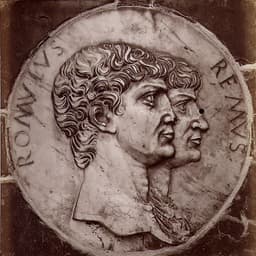
Romulus
Emperor · Ancient
47.7Total

Vikramaditya
Emperor · Ancient
55.0Total
Basic Information
Born
-771
-101
Died
-716
-15
Era
Ancient
Ancient
Nationality
Roman Kingdom
India
Occupation
Emperor
Emperor
Civilization
Western
Indian
Score Comparison
Military (10%)
38.3
25.0
Political (20%)
37.9
42.3
Influence (20%)
55.0
72.0
Legacy (20%)
55.0
55.0
Leadership (15%)
41.5
67.0
Strategy (15%)
45.0
43.3
TOTAL
47.7
55.0
Romulus — Complete Timeline
753 BC
Founding of RomePolitical Action
According to legend, Romulus founded the city of Rome on the Palatine Hill after killing his brother Remus. He established the Roman Kingdom, created the Senate, and organized the early Roman military and religious institutions.
FoundingLegend
Impact: global
Establishment of the Roman SenatePolitical Action◆ Major
Romulus created the Roman Senate, appointing 100 patricians as advisors. This institution became a central element of Roman government, providing counsel to kings and later playing a key role in the Republic.
GovernmentInstitution
Impact: globalconstructive
750 BC
Rape of the Sabine WomenWar◆ Major
Romulus orchestrated the abduction of Sabine women to provide wives for Roman men. This act led to war with the Sabines, but eventually resulted in the unification of Romans and Sabines under a joint rule.
LegendConflict
destructive
716 BC
Apotheosis as QuirinusCultural
After his death, Romulus was said to have been taken up to the heavens and deified as the god Quirinus. This legend reinforced the divine status of Rome's founder and became part of Roman state religion.
ReligionLegend
Vikramaditya — Complete Timeline
60 BC
Defeat of the ShakasWar◆ Major
Vikramaditya is traditionally credited with defeating the Shaka (Scythian) invaders who had occupied parts of western India. This victory is commemorated in the founding of the Vikram Samvat calendar, though historical evidence is limited.
Shaka DefeatVikram SamvatLegendary Victory
Impact: regionalconstructive
57 BC
Establishment of the Vikram Samvat CalendarCultural◆ Major
The Vikram Samvat calendar, traditionally linked to Vikramaditya's victory over the Shakas, began in 57 BCE. It remains widely used in India and Nepal for religious and civil purposes, though its historical connection to a single king is disputed.
CalendarVikram SamvatCultural Legacy
Impact: regionalconstructive
50 BC
Patronage of the Nine GemsCultural◆ Major
Vikramaditya is said to have patronized the 'Nine Gems' (Navaratnas) of his court, including the poet Kalidasa and the astronomer Varahamihira. This legendary assembly symbolizes a golden age of learning and culture in ancient India.
NavaratnasCultural PatronageGolden Age
Impact: regionalconstructive
Expert Analysis
Origins
Romulus, according to Roman mythology, was born in 771 BCE to Rhea Silvia, a Vestal Virgin, and the god Mars. He and his twin brother Remus were abandoned on the Tiber River, rescued by a she-wolf, and later raised by a shepherd. Their lineage was tied to the royal house of Alba Longa. Romulus's early life was marked by conflict with his brother, culminating in the founding of Rome.
Vikramaditya, whose historicity is debated, is traditionally placed in the 1st century BCE. He is said to have been born in Ujjain, the capital of Avanti, into a royal family. His name means "Sun of Valor." Little is known of his early life, but legends portray him as a just and learned prince. He was likely a historical figure who became mythologized over centuries.
Rise to Power
Romulus rose to power by killing his brother Remus after a dispute over the founding of Rome. He then became the first king of Rome, establishing its initial institutions. The founding of Rome is dated to 753 BCE. Romulus's authority came from his military prowess and his role as the city's founder. He consolidated power by creating the Roman Senate, appointing 100 patricians as advisors.
Vikramaditya rose to power by defeating the Shaka (Scythian) invaders who had occupied parts of western India. This victory, traditionally dated to 57 BCE, led to the establishment of the Vikram Samvat calendar. He is also said to have expanded his kingdom and patronized learning. His rise was marked by military success and cultural patronage, rather than fratricide.
Leadership & Governance
Romulus's leadership was autocratic and militaristic. He focused on expanding Rome's population and territory. He established the Senate as an advisory body but retained ultimate authority. His governance included the creation of the Roman legions and the Rape of the Sabine Women to secure wives for his men, which led to war but eventually integration. Romulus scored 41.5 in leadership and 37.9 in political skill, reflecting his authoritarian style.
Vikramaditya's leadership was more consensual and cultural. He is remembered for his patronage of the Nine Gems, scholars and artists who formed his court. This fostered a golden age of literature and science. He likely governed through a feudal system, with local rulers under his suzerainty. His political score of 42.3 and leadership of 67.0 suggest a more collaborative approach than Romulus.
Triumph & Tragedy
Romulus's greatest triumph was founding Rome and creating its early institutions, which became the foundation of a vast empire. His tragedy was the murder of his brother and the violent means of securing wives, which led to war. He also disappeared mysteriously, possibly murdered by the Senate, leading to his deification as Quirinus. His military score of 38.3 reflects limited conquests compared to later Roman leaders.
Vikramaditya's triumph was defeating the Shakas and establishing a calendar that remains in use today. His patronage of the Nine Gems produced lasting cultural achievements. His tragedy is the lack of historical records; much of his story is legend. His military score of 25.0 suggests modest expansion, but his influence score of 72.0 highlights his cultural impact.
Character & Destiny
Romulus was ambitious, ruthless, and pragmatic. His character drove him to found a city through fratricide and abduction. His destiny was to become a god, symbolizing Rome's divine origins. Historical assessments vary; Livy portrays him as a heroic founder, while others note his tyranny.
Vikramaditya was portrayed as wise, generous, and just. His character attracted scholars and poets. His destiny was to become a legendary figure, with his name synonymous with valor. Historians view him as a symbol of Indian resistance to foreign invasion and cultural revival.
Legacy
Romulus's legacy is immense: he founded Rome, which became the center of a civilization that shaped Western law, language, and governance. The Roman Senate, a key institution, endured for centuries. His deification reinforced the imperial cult. His total score is 47.7.
Vikramaditya's legacy includes the Vikram Samvat calendar, still used in India and Nepal. His patronage set a standard for royal support of the arts. The Nine Gems tradition influenced later Indian courts. His total score is 55.0, higher than Romulus due to greater influence and leadership.
Conclusion
Vikramaditya had a greater overall impact than Romulus when considering cultural and enduring influence. While Romulus founded a city that became a world power, Vikramaditya's calendar and cultural patronage have persisted for over two millennia. Romulus's political and military scores are lower, and his legacy is tied to a specific civilization. Vikramaditya's influence transcends India, with his calendar used in diverse regions. Therefore, Vikramaditya's total score of 55.0 surpasses Romulus's 47.7, making him the more impactful figure.
Rankings
🥇
VikramadityaLeader
Mil: 25.0Pol: 42.3Inf: 72.0
55.0
🥈
Romulus
Mil: 38.3Pol: 37.9Inf: 55.0
47.7
+7.3 behind
How This Comparison Works
Algorithm
Each figure is scored on 6 dimensions (0—100 scale) based on structured historical data: Military (10%), Political (20%), Influence (20%), Legacy (20%), Leadership (15%), Strategy (15%). The weighted total produces the final ranking.
Data Sources
Scores are computed from structured sub-indicators in the database. Scale factors adjust for era (Ancient ×0.85, Modern ×1.0) and civilization size (Eastern ×1.05, Other ×0.80) to account for differences in population and military scale.
Maximum 3 Figures
Comparisons are limited to 2—3 figures to ensure readability and statistical meaningfulness.
Error Margins
±5 points per dimension — Sub-scores are derived from historical records with inherent uncertainty. Two figures within 5 points on a dimension should be considered roughly equivalent in that area.
Total Score Accuracy
±3 points overall — The weighted combination of 6 dimensions produces a total score with approximately ±3 points of uncertainty. Differences of less than 3 points are not statistically significant— the figures are effectively tied.
Known Limitations
- Historical records are incomplete and uneven across civilizations
- Figures from oral-tradition societies may be underrepresented
- Occupation labels can misclassify multi-role figures
- Scores measure capability and impact, not moral character
- Quantitative scoring is a comparison tool, not absolute truth
Capability Radar
Military (10%) — Battles & Warfare
Battles
25
30
Win Rate
30
35
Expansion
35
40
Political (20%) — Governance & Reform
Reform
45
40
Diplomacy
25
35
Economy
30
40
Influence (20%) — Cultural & Global Reach
Cultural
70
70
Global
60
65
Legacy (20%) — Historical Impact
Historical
75
75
Longevity
80
80
Leadership (15%) — Power & Stability
Tenure
30
45
Stability
20
45
Strategy (15%) — Tactics & Innovation
Strategy
25
35
Tactics
20
40
Reform
40
30
Similar Comparisons
Comments & Discussion
No comments yet. Be the first to share your thoughts!