Loading...
Qin Shi Huang vs Vikramaditya
Qin Shi Huang leads by 30.2 pts · 2 figures compared
…
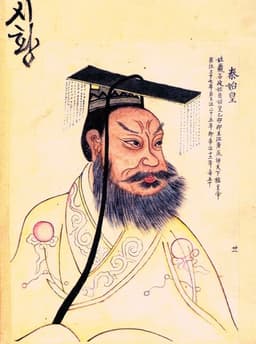
Qin Shi Huang
Emperor · Ancient
85.2Total

Vikramaditya
Emperor · Ancient
55.0Total
Basic Information
Born
-259
-101
Died
-210
-15
Era
Ancient
Ancient
Nationality
China
India
Occupation
Emperor
Emperor
Civilization
Eastern
Indian
Score Comparison
Military (10%)
80.0
25.0
Political (20%)
90.0
42.3
Influence (20%)
85.0
72.0
Legacy (20%)
90.0
55.0
Leadership (15%)
78.0
67.0
Strategy (15%)
82.0
43.3
TOTAL
85.2
55.0
Qin Shi Huang — Complete Timeline
246 BC
Construction of the Mausoleum and Terracotta ArmyOther◆ Major
Qin Shi Huang commissioned a vast mausoleum complex near Xi'an, guarded by thousands of life-sized terracotta soldiers, horses, and chariots. The project employed hundreds of thousands of workers and reflected his obsession with immortality and imperial power.
Impact: global
230 BC
Conquest of the Six Warring StatesWar
From 230 to 221 BCE, Ying Zheng led the Qin state in a series of campaigns that conquered the Han, Zhao, Wei, Chu, Yan, and Qi states. This unified China under a single ruler for the first time, ending the Warring States period.
Impact: global
221 BC
Standardization of Writing, Currency, and MeasurementsReform◆ Major
Qin Shi Huang ordered the standardization of Chinese script, currency, and weights and measures across the unified empire. This facilitated administration, trade, and cultural integration, laying a foundation for future dynasties.
Impact: globalconstructive
Proclamation of the Qin DynastyPolitical Action
After conquering the last independent state, Ying Zheng declared himself Shi Huangdi (First Emperor), founding the Qin Dynasty. He adopted a new title to signify his supreme authority and initiated centralized imperial rule.
Impact: global
214 BC
Initiation of the Great Wall ConstructionOther◆ Major
Qin Shi Huang ordered the connection and extension of existing northern fortifications to create a unified defensive wall against nomadic Xiongnu raids. This project involved massive conscripted labor and became the precursor to the later Great Wall.
Impact: regional
213 BC
Burning of Books and Burying of ScholarsPolitical Action◆ Major
On the advice of Li Si, Qin Shi Huang ordered the burning of historical records and philosophical texts not aligned with Legalist doctrine. He also had 460 Confucian scholars buried alive to suppress dissent and consolidate ideological control.
Impact: nationaldestructive
Vikramaditya — Complete Timeline
60 BC
Defeat of the ShakasWar◆ Major
Vikramaditya is traditionally credited with defeating the Shaka (Scythian) invaders who had occupied parts of western India. This victory is commemorated in the founding of the Vikram Samvat calendar, though historical evidence is limited.
Shaka DefeatVikram SamvatLegendary Victory
Impact: regionalconstructive
57 BC
Establishment of the Vikram Samvat CalendarCultural◆ Major
The Vikram Samvat calendar, traditionally linked to Vikramaditya's victory over the Shakas, began in 57 BCE. It remains widely used in India and Nepal for religious and civil purposes, though its historical connection to a single king is disputed.
CalendarVikram SamvatCultural Legacy
Impact: regionalconstructive
50 BC
Patronage of the Nine GemsCultural◆ Major
Vikramaditya is said to have patronized the 'Nine Gems' (Navaratnas) of his court, including the poet Kalidasa and the astronomer Varahamihira. This legendary assembly symbolizes a golden age of learning and culture in ancient India.
NavaratnasCultural PatronageGolden Age
Impact: regionalconstructive
Expert Analysis
qin-shi-huang-vs-vikramaditya
# The First Emperor and the Shadow King: Two Paths to Immortality
On a winter morning in 221 BCE, Ying Zheng stood before his assembled generals in the conquered palace of the last independent kingdom. He was thirty-eight years old, and he had just accomplished what no Chinese ruler had ever achieved: the complete military unification of the warring states. He declared himself *Shi Huangdi*—the First Emperor—and set in motion a revolution that would shape the world’s most enduring civilization. Across the Himalayas, another ancient tradition tells of a very different emperor. Vikramaditya, whose very name means "Sun of Valor," is said to have defeated foreign invaders and presided over a golden age of culture. But while Qin Shi Huang’s bones lie beneath a mountain of terracotta, Vikramaditya exists only in story. Why did one emperor leave an empire of stone and law, while the other left only a calendar and a legend?
Origins
Ying Zheng was born in 259 BCE, the son of a king who had been a hostage in a rival state. His childhood was spent in the shadow of court intrigue and violence. His father died when he was thirteen, and the young king grew up surrounded by ambitious advisers and the constant threat of assassination. The Warring States period had been tearing China apart for two centuries—seven kingdoms locked in a cycle of betrayal and bloodshed. Ying Zheng learned early that trust was weakness and that power was the only currency that mattered.
Vikramaditya’s origins belong to a different world entirely. Born around 101 BCE, he is said to have been a king of Ujjain, in central India. But the historical record is silent. No contemporary inscription mentions him. No foreign traveler describes his court. His story comes from later texts—the *Brihatkatha*, the *Kathasaritsagara*, and Buddhist and Jain traditions. He is the archetype of the just king, the *chakravartin* who rules with wisdom rather than fear. Where Qin Shi Huang emerged from a brutal historical reality, Vikramaditya was born from the human need for a perfect ruler.
Rise to Power
Qin Shi Huang’s path was one of systematic conquest. From 230 to 221 BCE, he led his armies in a series of campaigns that devoured the Han, Zhao, Wei, Chu, Yan, and Qi states one by one. He did not merely defeat them—he erased them. Their kings were executed or exiled, their nobility relocated, their walls torn down. He understood that unification required not just military victory but the destruction of all competing identities. Each conquest was a calculated step, each general a tool to be used and discarded.
Vikramaditya’s rise is told in the language of myth. He is said to have defeated the Shaka invaders who had overrun western India around 60 BCE, driving them back across the Indus. The victory was so complete that it marked the beginning of a new era—the Vikram Samvat calendar, which begins in 57 BCE and is still used across India and Nepal today. But unlike Qin Shi Huang’s meticulously documented campaigns, there is no archaeological evidence for this war. The Shakas were real enough—Scythian tribes who established kingdoms in Gujarat and Malwa—but their conqueror may have been a different king, or a composite of several.
Leadership & Governance
Here the two emperors diverge most dramatically. Qin Shi Huang governed through standardization. He ordered the same script to be used from the Yellow River to the Yangtze. He fixed the width of cart axles so that vehicles could travel on the same roads. He unified currency, weights, and measurements. He built a network of roads and canals that tied his empire together. His was a vision of total control—a single system, a single law, a single emperor.
In 213 BCE, on the advice of his chancellor Li Si, he ordered the burning of all books that did not promote his regime—philosophical texts, historical records, poetry. Scholars who resisted were buried alive. It was not cruelty for its own sake; it was the logical conclusion of his philosophy. To unify China, he had to erase every alternative vision of how a society could be organized.
Vikramaditya’s governance is remembered through the tradition of the "Nine Gems"—the *Navaratnas*—a group of scholars and artists who adorned his court. The greatest of these was the poet Kalidasa, whose works remain masterpieces of Sanskrit literature. Where Qin Shi Huang burned books, Vikramaditya is said to have patronized them. Where the First Emperor centralized power, Vikramaditya is remembered as a king who dispensed justice from his throne, listening to the complaints of the poorest subjects. He represents the ideal of cultural flourishing rather than administrative efficiency.
Triumph & Tragedy
Qin Shi Huang’s greatest achievement was also his greatest tragedy. He unified China, but at a terrible cost. Millions died building the Great Wall, which he began connecting in 214 BCE. His mausoleum, commissioned in 246 BCE, required the labor of hundreds of thousands of workers for nearly four decades. The terracotta army—thousands of life-sized soldiers, each with a unique face—was meant to guard him in the afterlife. But even as he sought immortality, he was afraid. He sent expeditions to find the elixir of life. He became paranoid, sleeping in different rooms each night to avoid assassins. When he died in 210 BCE at the age of forty-nine, his empire collapsed within three years.
Vikramaditya’s tragedy is that we cannot be sure he existed at all. His triumph is that it does not matter. The stories about him—his generosity, his wisdom, his defeat of demons and foreign invaders—shaped Indian kingship for centuries. Every later ruler who called himself "Vikramaditya" was claiming a legacy of justice and cultural patronage. The historical emperor, if there was one, has been absorbed into the archetype.
Character & Destiny
Qin Shi Huang was driven by fear—fear of death, fear of chaos, fear of the past. He believed that the world could be remade through sheer force of will. His character was rigid, suspicious, and relentless. He trusted no one completely, not even his most loyal ministers. This made him effective in conquest but fragile in governance. His system depended entirely on him. When he died, there was no one who could hold it together.
Vikramaditya, as legend tells it, was driven by *dharma*—the duty to rule justly. The stories emphasize his fairness, his generosity, and his willingness to forgive. In one famous tale, he gives his own head to a demon to fulfill a promise. His character is the opposite of the First Emperor’s: open, trusting, and guided by principle rather than calculation. Whether or not such a king ever lived, the ideal he represents has shaped Indian political thought for two thousand years.
Legacy
Qin Shi Huang’s legacy is visible everywhere in China. The writing system he standardized is still in use. The administrative structure he created—prefectures and counties governed by appointed officials—lasted until the twentieth century. The Great Wall, though rebuilt many times, began with his vision. He is remembered as both a unifier and a tyrant, a figure of awe and horror. His tomb remains unopened, a monument to his obsession with eternity.
Vikramaditya’s legacy is more diffuse but equally profound. The Vikram Samvat calendar is still used for religious festivals across India. The stories of his court, his generosity, and his justice continue to be told. Every Indian schoolchild learns about the Nine Gems. He represents a golden age that may never have existed but that India has never stopped yearning for.
Conclusion
Two emperors, two civilizations, two ways of understanding power. Qin Shi Huang tried to conquer time by building an empire of stone and law. Vikramaditya conquered time by becoming a story. The First Emperor’s terracotta soldiers still stand guard in their underground chambers, silent and eternal. The Sun of Valor shines only in the words of poets. And perhaps that is the deepest difference between East and South Asia: one civilization built its immortality in monuments, the other in memory. Both are still with us.
Rankings
🥇
Qin Shi HuangLeader
Mil: 80.0Pol: 90.0Inf: 85.0
85.2
🥈
Vikramaditya
Mil: 25.0Pol: 42.3Inf: 72.0
55.0
+30.2 behind
How This Comparison Works
Algorithm
Each figure is scored on 6 dimensions (0—100 scale) based on structured historical data: Military (10%), Political (20%), Influence (20%), Legacy (20%), Leadership (15%), Strategy (15%). The weighted total produces the final ranking.
Data Sources
Scores are computed from structured sub-indicators in the database. Scale factors adjust for era (Ancient ×0.85, Modern ×1.0) and civilization size (Eastern ×1.05, Other ×0.80) to account for differences in population and military scale.
Maximum 3 Figures
Comparisons are limited to 2—3 figures to ensure readability and statistical meaningfulness.
Error Margins
±5 points per dimension — Sub-scores are derived from historical records with inherent uncertainty. Two figures within 5 points on a dimension should be considered roughly equivalent in that area.
Total Score Accuracy
±3 points overall — The weighted combination of 6 dimensions produces a total score with approximately ±3 points of uncertainty. Differences of less than 3 points are not statistically significant— the figures are effectively tied.
Known Limitations
- Historical records are incomplete and uneven across civilizations
- Figures from oral-tradition societies may be underrepresented
- Occupation labels can misclassify multi-role figures
- Scores measure capability and impact, not moral character
- Quantitative scoring is a comparison tool, not absolute truth
Capability Radar
Military (10%) — Battles & Warfare
Battles
85
30
Win Rate
90
35
Expansion
90
40
Political (20%) — Governance & Reform
Reform
95
40
Diplomacy
75
35
Economy
90
40
Influence (20%) — Cultural & Global Reach
Cultural
95
70
Global
85
65
Legacy (20%) — Historical Impact
Historical
95
75
Longevity
95
80
Leadership (15%) — Power & Stability
Tenure
70
45
Stability
65
45
Strategy (15%) — Tactics & Innovation
Strategy
85
35
Tactics
80
40
Reform
95
30
Similar Comparisons
Comments & Discussion
TERRACOTTA_TYCHO6/17/2026
Classics scholar here, and the asymmetry is stark. Qin Shi Huang's historical footprint is verifiable: we have the bamboo slip records from his legal codes, the actual mausoleum complex, and Sima Qian's detailed if biased "Records." Vikramaditya? We can't even agree which century he supposedly ruled. The earliest literary reference is Kalidasa's *Jyotirvidabharana*, a text scholars suspect is medieval, not 1st century BCE. You're comparing a flesh-and-blood tyrant to a narrative convenience. One
尘埃考古家6/17/2026
作为一个专门研究中国早期帝国的军事历史学者,我得说这场比较根本不对称。秦始皇统一六国靠的是实实在在的军功爵制改革和弩机标准化生产,光是从湖北云梦睡虎地出土的秦律竹简就能看出,他的军队后勤已经达到了前工业时代的极致。而维克拉马迪塔的所谓"击败匈奴"听起来更像史诗文学里的寓言,没有任何考古证据能撑起这个说法。一个用铁和血写历史,一个用诗和梦编传说。
MITHRA_SHATTERER6/17/2026
Data skeptic. The numbers here are a joke. We have precise census records from Qin: roughly 20 million people across a unified territory of 4.6 million square kilometers. Vikramaditya's "empire"? Zero archaeological sites definitively linked to him. Zero inscriptions. Zero coins minted in his name. The *Brihatkatha* manuscript tradition is a corrupted 11th-century CE compilation of earlier oral tales. You're comparing a chapter of world history to a fanfiction character. Let's call this what it
记忆碎片收集者6/17/2026
作为一个研究印度史诗传统的学者,我得说——维克拉马迪塔其实比秦始皇更有意思。问题不在于谁更"真实",而在于真实是什么?秦始皇的兵马俑是实物,这没错,但他的历史形象被后世儒家刻意扭曲了,所谓的"焚书坑儒"在数量上被夸大了至少十倍。而维克拉马迪塔,虽然可能是多个历史人物的叠影——比如笈多王朝的旃陀罗·笈多二世——他的"九宝"宫廷概念却塑造了整个南亚文化的知识传承结构。一个留下了遗迹,一个留下了原型。
ASHOKA_STILL_WINS6/17/2026
Revisionist here, cutting through the West-centric framing. Why is tangible "stone and law" the only measure of an emperor's significance? Vikramaditya's legacy is embedded in the *Vikrama Samvat* calendar used across India for 2,000 years—54 Hindu holidays based on it, including Diwali. Qin Shi Huang burned books; Vikramaditya supposedly patronized nine luminaries of