Loading...
Queen Victoria vs Vladimir Putin
Vladimir Putin leads by 1.6 pts · 2 figures compared
…
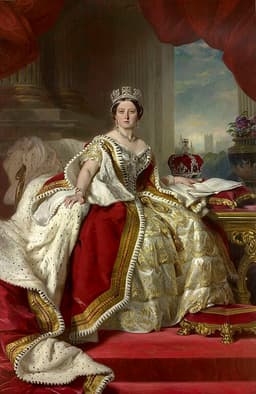
Queen Victoria
Politician · Modern
64.6Total

Vladimir Putin
Politician · Modern
66.2Total
Basic Information
Born
1819
1952
Died
1901
—
Era
Modern
Modern
Nationality
United Kingdom
Russia
Occupation
Politician
Politician
Civilization
Western
Western
Score Comparison
Military (10%)
25.9
70.0
Political (20%)
70.0
78.0
Influence (20%)
75.0
68.0
Legacy (20%)
70.0
55.0
Leadership (15%)
72.0
78.0
Strategy (15%)
45.0
50.0
TOTAL
64.6
66.2
Queen Victoria — Complete Timeline
1851 AD
Great Exhibition of 1851Cultural◆ Major
Prince Albert, Victoria's consort, organized the Great Exhibition in London's Crystal Palace. The exhibition showcased industrial and cultural achievements from around the world, symbolizing Britain's technological and imperial dominance during the Victorian Era.
ExhibitionIndustryCulture
Impact: globalconstructive
1857 AD
Indian Rebellion of 1857War
The Indian Rebellion of 1857, a major uprising against British East India Company rule, occurred during Victoria's reign. The rebellion was suppressed, leading to the dissolution of the Company and the establishment of direct British Crown rule over India in 1858.
IndiaRebellionEmpire
Impact: global
1867 AD
Reform Act 1867 PassedReform◆ Major
The Reform Act 1867, passed during Victoria's reign, expanded the franchise to include many urban working-class men in Britain. This electoral reform increased the electorate by over a million voters, reshaping British politics and the two-party system.
ReformDemocracyPolitics
Impact: nationalprogressive
British North America Act PassedPolitical Action◆ Major
The British North America Act, passed by the UK Parliament, created the Dominion of Canada as a self-governing entity within the British Empire. Victoria's approval marked the beginning of Canadian confederation and a model for future colonial autonomy.
CanadaColonialSelf-Government
Impact: regionalconstructive
1899 AD
Second Boer War BeganWar◆ Major
The Second Boer War broke out between the British Empire and the Boer republics in South Africa. The conflict, which ended in 1902, resulted in British victory and the incorporation of the Transvaal and Orange Free State into the empire, but at great cost.
WarSouth AfricaEmpire
Impact: regional
Vladimir Putin — Complete Timeline
1999 AD
Second Chechen WarWar◆ Major
Putin, as Prime Minister, launched a military campaign in Chechnya in September 1999 after apartment bombings in Russia. The war restored federal control over the region but resulted in widespread destruction and human rights abuses.
ChechnyaWar
Impact: nationaldestructive
2000 AD
First Presidency of RussiaPolitical Action◆ Major
Putin became acting President on December 31, 1999, after Boris Yeltsin's resignation, and won the March 2000 election. He consolidated power by centralizing federal authority and curbing the influence of oligarchs.
PresidencyCentralization
Impact: global
2014 AD
Annexation of CrimeaWar◆ Major
Putin ordered the annexation of Crimea from Ukraine in March 2014 following a disputed referendum. This action was condemned by the international community, leading to sanctions against Russia and a deterioration of relations with the West.
UkraineAnnexation
Impact: globaldestructive
2020 AD
Constitutional AmendmentsReform◆ Major
Putin oversaw a constitutional referendum in July 2020 that reset his presidential term limits, allowing him to run for two more terms. The amendments also strengthened presidential power and enshrined conservative social values.
ConstitutionPower Consolidation
Impact: national
2022 AD
Invasion of UkraineWar
Putin launched a full-scale invasion of Ukraine on February 24, 2022, escalating the conflict that began in 2014. The invasion resulted in massive casualties, a refugee crisis, and unprecedented Western sanctions against Russia.
UkraineWar
Impact: globaldestructive
Expert Analysis
Origins
Queen Victoria was born on May 24, 1819, at Kensington Palace, London, the only child of Prince Edward, Duke of Kent, and Princess Victoria of Saxe-Coburg-Saalfeld. Her father died when she was eight months old, and she was raised under the strict 'Kensington System' devised by her mother and Sir John Conroy, which isolated her from court. She became heir presumptive after the death of her uncle, King William IV. Her education focused on languages, history, and music, but she was largely sheltered from political affairs.
Vladimir Putin was born on October 7, 1952, in Leningrad (now Saint Petersburg), Russia, to a working-class family. His father was a factory foreman and World War II veteran, and his mother worked in a factory. Growing up in a communal apartment, Putin was a streetwise child who took up judo and Sambo. He studied law at Leningrad State University, graduating in 1975, and was recruited by the KGB, serving as a foreign intelligence officer in East Germany from 1985 to 1990. His early life instilled discipline and a pragmatic, security-oriented worldview.
Rise to Power
Victoria ascended the throne on June 20, 1837, at age 18, following the death of her uncle William IV. Her coronation took place on June 28, 1838. She relied heavily on her first Prime Minister, Lord Melbourne, who acted as a mentor. In 1840, she married her first cousin, Prince Albert of Saxe-Coburg and Gotha, who became her chief advisor and helped her navigate political crises, such as the Bedchamber Crisis of 1839 and the repeal of the Corn Laws in 1846. Her early reign was marked by a struggle for influence between Whig and Tory factions.
Putin rose to power after a career in the KGB and then as an aide to Mayor Anatoly Sobchak in Saint Petersburg. In 1996, he moved to Moscow, joining the presidential administration under Boris Yeltsin. He became director of the Federal Security Service (FSB) in 1998 and Prime Minister in August 1999. On December 31, 1999, Yeltsin resigned, making Putin acting President. He won the March 2000 election decisively. His ascent was accelerated by the Second Chechen War (1999-2000), which he launched as Prime Minister, restoring federal control over Chechnya and boosting his popularity.
Leadership & Governance
Victoria reigned as a constitutional monarch, exercising influence through advice and persuasion rather than direct rule. She worked with ten prime ministers, from Lord Melbourne to Lord Salisbury. She was particularly close to Benjamin Disraeli, who she felt understood her imperial vision, and clashed with William Gladstone, whom she found moralizing. Her support for the Reform Act 1867 and the British North America Act 1867 demonstrated her willingness to adapt to changing political realities. She was a symbol of national unity during the Victorian era, which saw industrial expansion, social reform, and imperial growth.
Putin governs as an authoritarian leader, centralizing power and suppressing opposition. He has used the security services to consolidate control, including the FSB and the military. His leadership score is 78.0, reflecting his ability to dominate Russia's political landscape. He has amended the constitution to reset term limits, potentially allowing him to remain in power until 2036. He has also cracked down on independent media, political rivals like Alexei Navalny, and civil society. His governance style is pragmatic and nationalist, emphasizing stability and Russia's great power status.
Triumph & Tragedy
Victoria's triumphs include the Great Exhibition of 1851, which showcased British industrial dominance, and the expansion of the British Empire to its territorial peak, encompassing Canada, India, Australia, and large parts of Africa. Her reign saw the passage of the Reform Act 1867, extending the franchise, and the British North America Act 1867, creating the Dominion of Canada. However, tragedies include the death of Prince Albert in 1861, which led to her prolonged withdrawal from public life, and the Second Boer War (1899-1902), which exposed the British Army's shortcomings and led to international criticism. The Indian Rebellion of 1857 resulted in brutal suppression and the end of East India Company rule.
Putin's triumphs include restoring Russian territorial integrity after the Chechen wars, annexing Crimea in 2014 (scoring a 70.0 in military), and reasserting Russian influence in Syria since 2015. He has also overseen economic growth in the 2000s, fueled by oil and gas revenues. However, his invasion of Ukraine in 2022 has been a strategic disaster, leading to massive casualties, economic sanctions, and Russia's international isolation. The war has also exposed military corruption and inefficiency. Domestically, his crackdown on dissent has stifled innovation and created a culture of fear.
Character & Destiny
Victoria was known for her strong will, emotional volatility, and deep devotion to duty. After Albert's death, she wore black for the rest of her life and avoided public ceremonies, earning the nickname 'the Widow of Windsor.' Her personality shaped her reign: she was stubborn but also capable of growth, as seen in her later embrace of imperial symbolism. Historians assess her as a symbol of an era, with a political score of 70.0, reflecting her influence within constitutional limits.
Putin is characterized by his cold, calculating pragmatism, a product of his KGB training. He is risk-tolerant, as shown by the annexation of Crimea and the invasion of Ukraine, but also cautious in domestic political maneuvering. His leadership score of 78.0 indicates his ability to maintain power, but his strategic decisions have led to catastrophic outcomes. His destiny is tied to Russia's conflict with the West; his legacy may be defined by the war in Ukraine.
Legacy
Victoria's legacy is the Victorian era, a period of British global dominance, industrial progress, and cultural influence. Her name became synonymous with the era's values: morality, family, and imperial pride. The British Empire reached its zenith during her reign, and she remains a symbol of constitutional monarchy. Her scores: Influence 75.0, Legacy 70.0.
Putin's legacy is more contested. He restored Russian pride after the chaotic 1990s but has led the country into a destructive war. His political score is 78.0, but his legacy score is only 55.0, reflecting the uncertainty of his long-term impact. He has changed Russia's trajectory toward authoritarianism and confrontation, but his ultimate legacy will depend on the war's outcome.
Conclusion
While Victoria presided over the expansion of an empire that shaped global history for centuries, Putin's impact is more immediate and destructive. Victoria's overall score is 64.6, slightly lower than Putin's 66.2, but her influence and legacy scores (75.0 and 70.0) exceed his (68.0 and 55.0). Victoria's reign saw the spread of industrial capitalism, parliamentary democracy, and the British Empire, which left a lasting imprint on law, language, and governance worldwide. Putin's rule has been marked by centralization of power, territorial aggression, and international isolation. In terms of enduring positive impact, Victoria clearly surpasses Putin, despite his higher tactical scores in military and leadership. Her era set the stage for the modern world; his may be remembered as a tragic detour.
Rankings
🥇
Vladimir PutinLeader
Mil: 70.0Pol: 78.0Inf: 68.0
66.2
🥈
Queen Victoria
Mil: 25.9Pol: 70.0Inf: 75.0
64.6
+1.6 behind
How This Comparison Works
Algorithm
Each figure is scored on 6 dimensions (0—100 scale) based on structured historical data: Military (10%), Political (20%), Influence (20%), Legacy (20%), Leadership (15%), Strategy (15%). The weighted total produces the final ranking.
Data Sources
Scores are computed from structured sub-indicators in the database. Scale factors adjust for era (Ancient ×0.85, Modern ×1.0) and civilization size (Eastern ×1.05, Other ×0.80) to account for differences in population and military scale.
Maximum 3 Figures
Comparisons are limited to 2—3 figures to ensure readability and statistical meaningfulness.
Error Margins
±5 points per dimension — Sub-scores are derived from historical records with inherent uncertainty. Two figures within 5 points on a dimension should be considered roughly equivalent in that area.
Total Score Accuracy
±3 points overall — The weighted combination of 6 dimensions produces a total score with approximately ±3 points of uncertainty. Differences of less than 3 points are not statistically significant— the figures are effectively tied.
Known Limitations
- Historical records are incomplete and uneven across civilizations
- Figures from oral-tradition societies may be underrepresented
- Occupation labels can misclassify multi-role figures
- Scores measure capability and impact, not moral character
- Quantitative scoring is a comparison tool, not absolute truth
Capability Radar
Military (10%) — Battles & Warfare
Battles
10
65
Win Rate
10
70
Expansion
70
70
Political (20%) — Governance & Reform
Reform
60
70
Diplomacy
75
80
Economy
80
65
Influence (20%) — Cultural & Global Reach
Cultural
85
55
Global
85
75
Legacy (20%) — Historical Impact
Historical
90
70
Longevity
80
60
Leadership (15%) — Power & Stability
Tenure
95
85
Stability
85
60
Strategy (15%) — Tactics & Innovation
Strategy
20
75
Tactics
10
60
Reform
30
80
Similar Comparisons
Comments & Discussion
No comments yet. Be the first to share your thoughts!